In our August 2016 podcast: The Big Four accountancy firms: Are they in fact more like the Big One? And should they be broken up? Continue reading “Our August Tax Justice Network podcast: are the big four accountancy firms really the ‘big one’?”


In our August 2016 podcast: The Big Four accountancy firms: Are they in fact more like the Big One? And should they be broken up? Continue reading “Our August Tax Justice Network podcast: are the big four accountancy firms really the ‘big one’?”

Matti Ylo?nen
This guest blog by Matti Ylönen is partly based on an academic article Cities as World Political Actors: “Tax haven free cities” initiative and the politics of public procurement.
Public procurement — the next frontier for tax justice campaigning?
The international movement for tax justice and tackling secrecy jurisdictions has come of age. Many of the demands that were deemed impossible a decade ago have reached the political mainstream, even though progress has often been painstakingly slow, sometimes hindered by loopholes that have weakened even the most progressive initiatives.
Where are the next frontiers for tax justice campaigning? It is interesting to draw a comparison with other, much older strand of campaigns on reforming the international trade rules.
For decades, these trade campaigns have progressed along two distinct paths.
Continue reading “Public procurement — the next frontier for tax justice campaigning?”

Margaret Hodge
There has been much talk in Britain of new government proposals that tax advisors giving advice on tax avoidance could face large fines of up to 100% of the tax lost if their schemes are defeated in courts. We warmly welcome the principle of the thing: these players have been getting away with impunity when they market tax-cheat schemes to multinational corporations and wealthy individuals. In the case of the so-called Luxleaks scandal, where PwC was caught out marketing an astonishing array of socially abusive tax schemes to the world’s multinationals, the only two people to face any sanction were the whistleblowers who exposed the scheme. In 2013 UK Public Accounts Committee (PAC) heard that from one Big Four accounting firm officials that their company would flog schemes even if they thought there was only a 25 percent chance of surviving a court challenge.
In the words of Margaret Hodge, the PAC’s chair:
“What really depresses me is you could contribute so much to society and the public good and you all choose to focus on working in an area which reduces the available resources for us to build schools, hospitals, infrastructure.”
Continue reading “Will the British government target tax dodging enablers at last?”
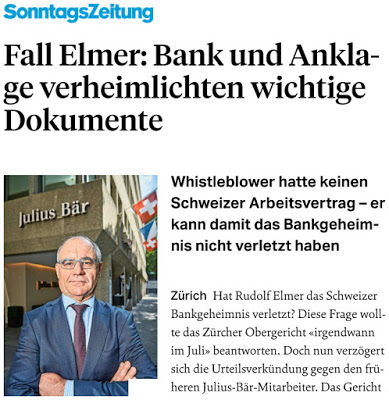 Rudolf Elmer, the Cayman-based Swiss whistleblower who went to prison after spilling secrets relating to the Swiss bank Julius Baer, has long been victimised not only by the Swiss banking establishment, and Switzerland’s courts (which as we’ve extensively documented, seem to have played fast and loose with the law in order to nail him) – but also by much if not most of the Swiss media. In Switzerland he’s been demonised as a traitor and a criminal, and jailed too.
Such is the fate of the offshore whistleblower. Continue reading “Why the Swiss case against whistleblower Elmer may hurt the bankers”
 The UK’s All Party Parliamentary Group on Tax has published a report entitled A more responsible global tax system or a ‘sticking plaster’? An examination of the OECD’s Base Erosion and Profit Shifting (BEPS) process and recommendations. They consulted us (among many others) and the result is a really strong document of tax justice, with significance for all countries, since Britain is such a central player in the global system of tax havens. The APPG’s summary, via email, says: Continue reading “New report from UK parliament: tax justice to the fore”
 We recently helped publicise a report by the UN Conference on Trade and Development (UNCTAD) in our blog entitled Some countries “lose” 2/3 of exports to misinvoicing. As a reminder, trade misinvoicing is a form of money laundering that involves deliberately misreporting (on an invoice to customs) the value of a commercial transaction, so as to shift money illictly across borders. The study seeks to get a handle on the scale of the problem by studying mismatches between export data from the exporting countries (Chile, Cote d’Ivoire, Nigeria, South Africa and Zambia, in this case), and values reported by the importing countries, including hubs such as Switzerland, the Netherlands, the United Kingdom and United States.
There’s been some pushback against the UNCTAD study since we wrote that, and there’s lots to welcome here. In particular, the South African component in the report has prompted both business interests and South Africa’s respected chief statistician, Dr Pali Lehohla, to criticise the assessment. Continue reading “Finally, trade misinvoicing gets political”
 A guest blog by Rasmus Corlin Christensen, with his kind permission, originally published @FairSkat Blog
One of the major 21st century challenges for politicians and polities at both the national, regional and international levels is the governance of ever-more global, mobile and flexible economic and financial flows. No more so than in the area of taxation, which looks likely to remain the last bastion of entrenched perceptions of national sovereignty, an undisputed cornerstone of the independent and authoritative government, the undeniable prerogative of national policy-makers in the face of growing global economic integration.
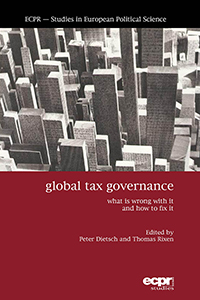
Or perhaps world leaders are slowly warming to the fact that they need international co-operation, if they want to address tax competition and the pilloried global tax system in any meaningful way? Peter Dietsch and Thomas Rixen’s recent edited volume on Global Tax Governance (sub-titled “What is wrong with it and how to fix it” – straight to the point) certainly seeks to leave you with the feeling that it is both desirable and irrefutable, “an idea whose time has come”, with reform proposals waiting for the Obamas and Merkels of this world to wake up and smell the coffee.
Global Tax Governance comprises fifteen chapters from a very strong line-up of contributors across the disciplinary divides, compiled by Dietsch and Rixen into 350-or-so pages of excellent reading. International tax competition and co-operation are not simple issues; they are multifaceted, difficult, wicked phenomena, so the diversity of inputs is both welcome and necessary. The chapter authors include economists, legal scholars, political scientists, and political philosophers. This provides a well-rounded gathering of perspectives, which covers many of the key stories of both the problems and solutions related to global tax governance. But there is no denying that this is first and foremost a political economy book – the pure economic and pure legal perspectives, for instance, are marginal. Still, for anyone looking for an intermediate dive into tax competition and the state and issues of international tax governance, this is, to my mind, the top place to start today. Continue reading “Book review: Global Tax Governance – What is wrong with it and how to fix it”
Updated with an additional story
From the New York Times:
“How can America’s leaders foster broad prosperity? For most Republicans — including Donald J. Trump — the main answer is to “cut and extract”: Cut taxes and business regulations, including pesky restrictions on the extraction of natural resources, and the economy will boom. Mr. Trump and House Speaker Paul Ryan are united by the conviction that cutting taxes — especially on corporations and the wealthy — is what drives growth.”
The NYT provides a handy graphic, using political party affiliation as a proxy for tax-and-spend policies. The red states tend to favour “cut and extract”, while the blue states tend to favour more tax and public investment.
Which states have fared better on quality of life indicators? Click on the article to see the graphic.
There’s a question of causation here (do people vote for certain parties because they’re deprived – or are they deprived because of the policies these parties enact?). But it’s still a powerful set of observations, complementing a whole lot of other research elsewhere.
Also see Ed Kleinbard’s excellent “tour de force” We are Better Than This: How Government Should Spend Our Money, about tax and spending in the U.S.
Update: There’s another new New York Times story, The Case for More Government, that’s also relevant here.
“Last month, four academics — Jeff Madrick from the Century Foundation, Jon Bakija of Williams College, Lane Kenworthy of the University of California, San Diego, and Peter Lindert of the University of California, Davis — published a manual of sorts. It is titled “How Big Should Our Government Be?” (University of California Press).
. . .
Here are some other things Europeans got from their trade-off: lower poverty rates, lower income inequality, longer life spans, lower infant mortality rates, lower teenage pregnancy rates and lower rates of preventable death. And the coolest part, according to Mr. Lindert — one of the authors of the case for big government — is that they achieved this “without any clear loss in G.D.P.”
Now read on.

Brooke Harrington
We recently hosted Brooke Harrington, an Associate Professor at the Copenhagen Business School, on our Taxcast, talking about her remarkable research on tax havens. She wrote an article in The Atlantic last October, entitled Inside the Secretive World of Tax-Avoidance Experts – which we’d urge you to read if you haven’t already – and now she’s followed it up with another equally powerful article, also in The Atlantic, entitled Why Tax Havens are Political and Economic Disasters. This article draws directly and explicitly from TJN’s work on The Finance Curse, spearheaded by TJN’s John Christensen and Nicholas Shaxson. In short, if your country is overdependent on financial services, it will suffer many of the same problems that are faced by countries overdependent on exporting minerals like oil, and for mostly similar reasons. Continue reading “Finance Curse in The Atlantic: how to mount an offshore coup”
We’re happy to share a rather brilliant explanation of corporate tax reduction erm, elimination shennanigans from the news and political satire show in Australia, The Undercurrent. In their words:
“Thousands of global companies avoid paying tax. That leaves us, taxpaying citizens, to pick up the tab. So we humbly present to you The Undercurrent Guide to Legal Tax Evasion. If you’re as pissed off as we are, you can do something about it here.” (More on their #iPhone7Boycott petition below.)
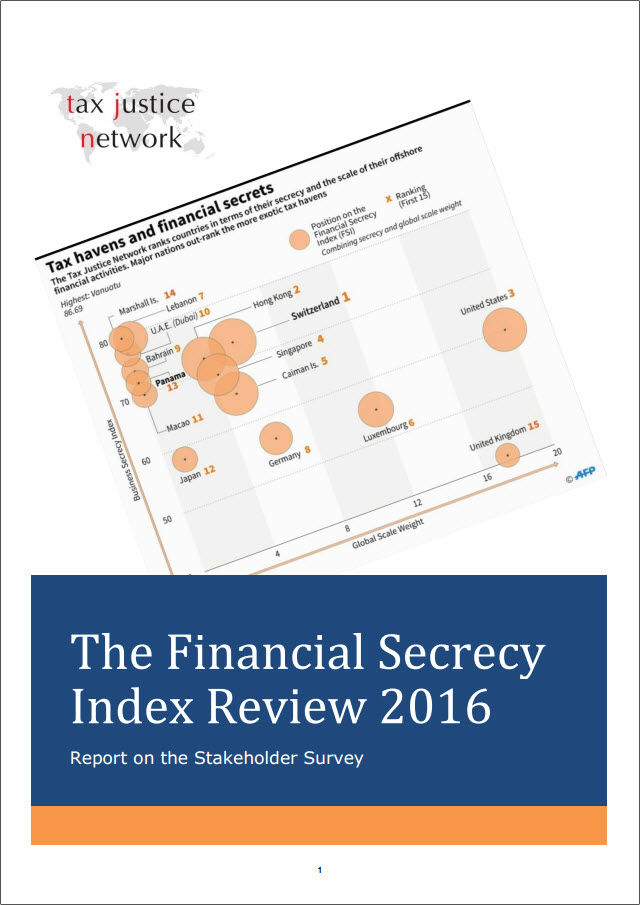
Our new FSI survey report, with many thanks to all who contributed
The implications of financial secrecy offered by tax havens have never been higher on the agenda of both national and international policymakers. The difficulty in defining tax havens and the susceptibility to political pressure on processes of drawing up lists of havens led the Tax Justice Network to create the Financial Secrecy Index (FSI). Conceived in 2007 and published on a biannual basis since 2009, the FSI ranks some major economies ahead of the ‘usual suspects’ and reveals a spectrum of secrecy rather than a binary division between ‘tax havens’ and others.
While some methodological improvements have been made since the FSI was first published, in 2016 we carried out the first full-scale review of the index in order to adapt the FSI for the decade ahead. The review process comprises two main elements: firstly, an independent statistical audit by the Joint Research Centre (JRC) of the European Commission, and secondly, a detailed and technical survey with various stakeholder groups.
Today, we publish the results of the stakeholders survey (pdf). The survey was conducted from January to March 2016, and distributed across TJN networks and to specific stakeholder groups through targeted emails. Over 200 people responded to the survey, (although 70 were screened out by an introductory question regarding knowledge of the FSI). The remaining 136 respondents come from 49 different countries, including developing countries, OECD member states and small island financial centres. Of these, 86 respondents completed the entire survey, and therefore for each question we have between 86 and a maximum of 136 responses. Continue reading “The Financial Secrecy Index Methodological Review – Results of the Stakeholder Survey”
In this month’s Spanish language podcast presented by Marcelo Justo and Marta Nunez: (abajo en castellano)
– we go to Colombia, where tax evasion isn’t a crime
– the magical realism of tax havens: how the multinational company Fresh Del Monte exports pineapple from Costa Rica from… the Cayman Islands?!
– what impact did the Panama Papers really have in Latin America? A big scandal? Or a fuss about nothing?
– we begin our story of the history of tax havens from Sir Francis Drake until today Continue reading “Our Spanish language tax justice podcast is out! ¡Salió nuestro podcast en castellano!”
 Our friends at Righting Finance have released their fourth in a series of advocacy tools on tax policy and international cooperation for human rights. The aim of these advocacy tools is to assist education and dissemination of the standards on tax policy and human rights contained in a report produced by the UN Special Rapporteur on Extreme Poverty and Human Rights in 2014.
Continue reading “Advocacy tools on tax policy and international cooperation for human rights”
Press Release: For immediate release, July 22, 2016
This weekend G20 Finance Ministers from the G20 countries will meet in China. One of the items on their agenda will be to agree the criteria for identifying non-cooperative jurisdictions with respect to tax transparency, which the OECD has been mandated to establish. The first details of the proposals have become public and our analysis gives rise to grave concerns that the criteria are, in the same way as past attempts at blacklists, weak and ineffective. The USA in particular is likely to escape blacklisting because of the peculiar nature of the criteria.
The three criteria the OECD has come up with for assessing non-cooperative jurisdictions are summarised below. Each country has to meet two of the three in order to escape blacklisting:
Continue reading “The G20 and OECD tax haven blacklist proposals risk becoming another whitewash”
In the July 2016 Taxcast:
‘Hello. This is John Doe. Interested in data? I’m happy to share.’ We talk to the two journalists who got the Panama Papers scoop, Bastian Obermayer and Frederik Obermaier who’ve written a book about their experience.
Plus: what does Brexit mean for tax justice? We discuss the F4 (unholy) alliance between Switzerland, Hong Kong, Singapore and the UK, and the accelerated corporate tax race to the bottom.
‘Unfortunately there is the world people like you and me are living in and there is a second world, a parallel world, the offshore world where people with enough money will always find possibilities to hide their money…there are people out there choosing which law they want to stick to and that is a problem for democracy.’ Frederik Obermaier
‘I am very clear about what would happen if you take away the secrecy, if you take away the anonymity. I am completely sure that the whole system would crash because why would they go to the British Virgin Islands for a company when you can see who owns it? You know, it’s not rocket science.’ Bastian Obermayer
Post-Brexit: ‘I think that Britain’s likely development strategy will be to actually deepen its tax haven role sitting offshore Europe.’ John Christensen
Featuring: The Tax Justice Network’s John Christensen, Bastian Obermayer and Frederik Obermaier of the Sudduetsche Zeitung newspaper and authors of the new book: The Panama Papers: Breaking the Story of How the Rich and Powerful Hide Their Money. Produced and presented by Naomi Fowler for the Tax Justice Network. Also available on iTunes.
Subscribe to the Taxcast either by emailing naomi [at] taxjustice.net to be added to the mailout list OR use our rss feed OR subscribe to our youtube channel Tax Justice TV.
 Finance Ministers from the G20 countries meet in China on July 23-24 – this weekend. Amid sessions that will focus heavily on Brexit-related issues, there will be an important tax component. At their previous meeting they mandated the OECD to “establish objective criteria . . . to identify non-cooperative jurisdictions with respect to tax transparency.”
A blacklist, in other words.
Continue reading “Will the OECD tax haven blacklist be another whitewash?”
 After Panama: developing countries need to be involved more closely in international co-operation on tax issues
A guest blog by Christian von Haldenwang, German Development Institute / Deutsches Institut für Entwicklungspolitik (DIE)
Bonn, July 4, 2016 – Two major mechanisms squeeze the tax base in developing and emerging countries. Rich individuals evade their tax obligations by moving money abroad and submitting false statements regarding income and assets. Large multinational companies exploit international loopholes in laws and regulations and shift profits artificially to states with particularly low rates of taxation. Continue reading “Guest blog: involve developing countries more in international tax co-operation”
From UNCTAD, the UN Conference on Trade and Development, via email:
“Some commodity dependent developing countries are losing as much as 67% of their exports worth billions of dollars to trade misinvoicing, according to a fresh study by UNCTAD, which for the first time analyses this issue for specific commodities and countries.
Trade misinvoicing is thought to be one of the largest drivers of illicit financial flows from developing countries, so that the countries lose precious foreign exchange earnings, tax, and income that might otherwise be spent on development.”
Continue reading “Some countries “lose” 2/3 of exports to misinvoicing”
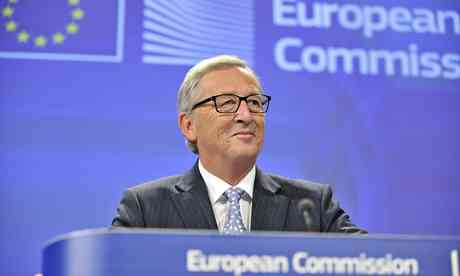 Jean-Claude, Juncker, the President of the European Commission, has long tried to distance himself from his role as one of the key architects of Luxembourg’s crime-fueled tax haven factory. An excellent new investigation by Newsweek now reminds us of his efforts to display whiter-than-white credentials:
“It’s the tax authorities that develop the specific rules that are applied,” [Juncker] said last September during a hearing of the European Parliament. “I haven’t taken a position on individual tax dossiers because that also isn’t my role. The Luxembourg tax authorities are very allergic to the idea of ministerial interference.”
Continue reading “New questions over Juncker’s role in Amazon Luxembourg affair”
From the Global Alliance for Tax Justice, on June 28:
“On June 28th , Madrid saw the presentation ceremony of the Spanish Plataforma por la Justicia Fiscal (Platform for Tax Justice),an alliance of public organizations, trade unions, social movements, NGOs and others society civil groups. The Platform considers that “the actual tax situation of the country is unacceptable because it is unfair, regressive and insufficient. The alliance organizes itself with social movements to achieve a progressive, sufficient and fair tax system”.
Read the full article in Spanish here.
? ¡Nace una Plataforma por la Justicia Fiscal en España!
? Crimen medio-ambiental relacionado con la injusticia fiscal“

Luxembourg: not so pretty under the surface
A month ago we wrote an article entitled Now Luxembourg, Switzerland are working to bolster Tax Haven USA. This concerns a global scheme to share banking information, the OECD-led Common Reporting Standard, (CRS, which starts up next year and complements separate schemes and campaigns to see public disclosure of the beneficial owners of entities and arrangements like trusts and companies.)
In a nutshell, under the CRS you are supposed to ‘look through’ certain investment entities to their beneficial owners, if that entity is not in a ‘participating jurisdiction’ – that is, participating in the CRS. The United States isn’t a participating jurisdiction: it has its own FATCA programme which is loosely and very imperfectly hooked up to the CRS: for more details see our Loophole USA blog. Continue reading “Luxembourg backing down on supporting tax haven USA”

George Rosvany won’t work as a corporate lobbyist again
In March The Economist magazine rang alarm bells (again) about a rise in concentrated market power: a problem where the biggest firms get ever bigger and more like monopolies, making it easy to extract wealth from the rest of us (as opposed to creating wealth.) This, in turn fosters steeper inequality and poverty and reduces economic growth. As they put it:
“High profits across a whole economy can be a sign of sickness. They can signal the existence of firms more adept at siphoning wealth off than creating it afresh, such as those that exploit monopolies. If companies capture more profits than they can spend, it can lead to a shortfall of demand.”
Continue reading “Top tax expert: Big 4 “accountants of fortune” must be broken up”