You will shortly be redirected to the our UN tax convention live hub.


You will shortly be redirected to the our UN tax convention live hub.
Between 3 August and 13 August, the Intergovernmental Negotiating Committee of the United Nations Framework Convention on International Tax Cooperation (UNFCITC) met in New York for the fifth session of negotiations.
The fifth session marked the half-way point of the three year negotiation term. The Intergovernmental Negotiation Committee is expected to complete its work and submit the final text of the framework convention and the two early protocols to the General Assembly of the United Nations by the end of 2027.
The fifth session also marked the first session of negotiations in which delegates discussed ‘zero-drafts’ with a full text on both the framework convention and its protocols.
At the Tax Justice Network, we follow the negotiations of this potentially world-changing treaty closely. A full extended summary by our staff of the fifth session of negotiations is available here.
After the session, interested stakeholders were invited to submit comments on the so-called ‘zero-drafts’ and the negotiations in New York. The ‘zero-draft’ for each workstream is provided below, along with links to the Tax Justice Network’s written stakeholder input on each.
Workstream 1- Framework Convention:
Workstream 2 – Protocol on Cross-Border Services:
Workstream 3 – Protocol on Dispute Prevention and Resolution:
More information on the UN tax frame convention can be found on our dedicated webpage. The webpage includes, among other things, latest news on the negotiations, a build-a-convention tracker with summaries and analysis on the various components of the convention, a country position database and technical notes on the negotiations, including notes on the recent draft services protocol and notes on the dispute protocol.
The Sixth Session of negotiations takes place in Nairobi between 30 November and 10 December 2026.
Our beneficial ownership lead and acknowledged international expert Andres Knobel has had it. As another court decision supports the ‘weaponisation of privacy’ to defeat even basic transparency, Andres argues that the lobbyists have been so successful that they have defeated the case for the longstanding quid pro quo that justifies limited liability. Is it time for the return of unlimited liability?
“Saudade não tem fim” (nostalgia has no end) could describe the feeling among transparency activists today. The momentum that started with the Panama Papers a decade ago and positioned Europe at the vanguard of beneficial ownership transparency is undoubtedly gone following the infamous European Court of Justice ruling of 2022 that invalidated public access to beneficial ownership information. But it did not end there. The weaponisation of privacy is now sweeping away transparency regulations that predate even the advent of beneficial ownership transparency. On 3 September 2026, the European Court of Justice managed to sink even lower by invalidating public access to shareholder information.
This counter-secrecy reform based on the weaponisation of privacy is not just affecting beneficial ownership data or public access to information. Since 2022, rulings by the European Court of Justice and by the European Court of Human Rights have invalidated access by tax authorities to banking information as well as to company formation data held by law firms. But let’s get back to the issue of beneficial ownership and shareholder information.
The September 2026 ruling that invalidated public access to shareholder information follows the same line of argument as the 2022 ruling that invalidated public access to beneficial ownership information: the general public does not need access to shareholder information because competent authorities and obliged entities (eg banks and lawyers) are the ones responsible for fighting money laundering and other illegal activities (para 79). For this reason, according to the Court of Justice, it should suffice for access to shareholder information to be based on demonstrating a legitimate interest, just as is now the case for access to beneficial ownership information in the EU (para 89).
The ruling’s arguments may sound sensible in theory, but they do not apply to real life. First and foremost, “legitimate interest access” does not work in practice. “Legitimate interest” may sound like a good balance between privacy and the public interest, but it is usually a way to deliberately or inadvertently restrict access. For instance, in Argentina, where shareholder information had always been publicly accessible, the Commercial Registry decided to restrict access to shareholder information based on a legitimate interest when a former vice president came under investigation for corruption. Journalists and legislators investigating the vice president were found not to have a legitimate interest and had to go to court to request access. In the EU, the 2022 Court of Justice ruling reinstated access to beneficial ownership information based on a legitimate interest (as required in 2015 by the 4th Anti-Money Laundering Directive), even though legitimate interest access had already proven not to work in the past. It was because legitimate interest was ineffective that, in 2018, the EU established public access to beneficial ownership information, until the Court invalidated it in 2022. Unfortunately, the second time’s not the charm. Transparency International reported in 2025 that legitimate interest access to beneficial ownership information was not working properly in most EU countries.
Second, it is disheartening that the Court did not consider the impact, or lack thereof, of its rulings in real life. Despite shareholder information having been publicly available online for decades in a number of countries, from Latvia and the UK to Ecuador and New Zealand, without any evidence of misuse, the Court made it clear that “it does not matter whether the information in question relating to private life is sensitive or whether the persons concerned have been inconvenienced in any way on account of that interference” (para 67). For the Court, the mere fact that the information is publicly available is bad enough.
Nor does the Court consider whether authorities have the staff and resources to implement legitimate interest access and respond to requests for access to beneficial ownership information, and now also to shareholder information. The ruling makes clear that a theoretical infringement of the right to privacy outweighs any practical difficulties faced by authorities: “although the referring court indicates that the national companies register, which is the data controller, might not be in a position to determine whether each person requesting information does in fact have a legitimate interest in accessing the personal data concerned, it should be borne in mind that any practical difficulties associated with verifying the existence of a legitimate interest are not such as to demonstrate that an interference with the fundamental rights guaranteed by the Charter is strictly necessary” (para 83).
As mentioned above, the Court’s arguments for invalidating public access to shareholder information are similar to those used to invalidate public access to beneficial ownership information. Our work on privacy washing and the weaponisation of privacy also applies here.
The first argument we could repeat is that “private family life” should stop, or at least be limited, when an individual goes outside their private family home and engages in “public” acts such as coming before a government authority to create a company that can sue other people, own assets with the protection of private property (and thus exclude others), limit the liability of its members against all of society and sometimes even get a bailout from the government. None of these corporate acts are “private” matters. Second, we could argue that information on shareholders would be unlikely to say anything about the wealth of those individuals (para 70), given that there is hardly any integration between asset ownership and corporate registries, and that ownership of an unlisted and unknown company says very little about one’s wealth.
Thirdly, we could point to one contradiction in the ruling regarding public access to information on the initial shareholders of a company – the risk of pointing this out, however, is that even more transparency could be taken away in the future. The Court does not seem to have a problem with the fact that the initial shareholders of a company who signed the incorporation documents must be named and have their information made publicly available (Art 14(a) and 4(i) of Directive 2017/1132). It is only subsequent changes that need not be made public. In other words, the Court somehow considers that the privacy of new shareholders matters, but not that of initial shareholders – even if they remain shareholders because they have not sold their shares: “while Article 14(a) of Directive 2017/1132, which is to be read in conjunction with Article 4(i) of that directive, requires disclosure of the instrument of constitution and the statutes of a public limited liability company, those documents being required to state the identity of their signatories, including, where applicable, the company’s initial shareholders, no provision of that directive expressly requires disclosure of any subsequent change in the composition of the shareholders of such a company” (para 43).
Finally, the Court claimed that “where there is a choice between several measures appropriate to meeting the legitimate objectives pursued, recourse must be had to the least onerous” (para 62). Based on the need to choose the less onerous measure when two rights are in dispute (eg privacy vs the public interest in information), the Court could have considered that countries are already implementing a “less onerous” measure that addresses the interference with privacy: corporate law allows shareholders to hold shares through other entities rather than directly in their own name. By holding shares indirectly, natural person shareholders would not be disclosing their information in public shareholder registers.
As regards the need to access shareholder information for beneficial ownership transparency, the following arguments could be proposed. First, shareholder information, including the full ownership chain of shareholders, is indispensable for verifying beneficial ownership information: if you don’t know who owns every layer of intermediate entities, you cannot confirm who the ultimate beneficial owner is.
Second, shareholder information is especially relevant when there is no public access to beneficial ownership information, as is now the case in most of the EU following the 2022 ruling. In this case, journalists, civil society organisations and even authorities (especially foreign ones) need to determine the beneficial owner on their own, starting with shareholder information. Investigators need to check which natural person shareholders directly or indirectly hold more than 25 per cent of the shares.
Third, although many beneficial ownership definitions consider anyone with more than 25 per cent of the shares to be a beneficial owner, access to shareholder information is necessary for investigations because the purpose of beneficial ownership is not just to determine who is in control of a company. As we have argued many times, a 1 per cent interest in a very profitable company may give the shareholder no control over the company, but it may be extremely relevant for tax and asset recovery purposes. That valuable shareholding without control may help determine a person’s wealth tax liability. It can also be used to determine unjustified enrichment if the shareholder cannot explain how they acquired that stake based on their low declared income, or it may help with the enforcement of debts if that minority shareholder owes money to authorities or other individuals.
Lastly, data on all shareholders (including minority ones) is particularly relevant when investigating complex ownership structures. A minority shareholder may indeed be a beneficial owner, for instance in a scenario where two majority shareholders, each with 49.5 per cent of the shares, are in dispute. In this case, the shareholder with 1 per cent would have control because their vote would enable either of the other shareholders to obtain a majority. In addition, shares can have different classes, with one type giving extraordinary or exclusive voting rights. In this case, an individual could retain control over a company despite being a minority shareholder. More importantly, information on all shareholders is needed to uncover obfuscating strategies, for instance where there are more than four shareholders so that no one passes the 25 per cent threshold to be identified as a beneficial owner. (Interestingly, the plaintiff in the lawsuit that resulted in the 2026 ruling analysed in this blog post was a company with more than 17 shareholders.) In cases with many shareholders, beneficial ownership transparency requires all direct and indirect shareholdings to be considered to determine the beneficial owner. A minority shareholder can only be confirmed not to be a beneficial owner after confirming that they do not own additional shares either directly or indirectly. Companies that claim not to have a beneficial owner (eg because no individual has more than 25 per cent of the shares) should be thoroughly investigated because they could be deliberately distributing shareholdings among so many people that no one passes the beneficial ownership threshold. Instead of rewarding them with more secrecy, these companies with many shareholders should be considered high risk, and all of their shareholders should be identified and investigated.
Yet it is unlikely that any of these arguments would suffice for a Court that has proven to uphold the weaponisation of privacy. The Court seems to have little regard for what happens in the real world, as it appears to expect that understaffed and under-resourced authorities (at best), or captured ones (at worst), will effectively fight financial crimes without the help, advocacy and demands for accountability from journalists and civil society organisations, which will no longer be able to easily access information.
So it’s time to explore other arguments.
Lack of access to shareholder information will deal a heavy blow to beneficial ownership transparency because it will make it harder to determine and verify beneficial owners and to hold authorities accountable for a lack of enforcement. However, we should also acknowledge that most beneficial ownership registries and frameworks aren’t really working effectively, even in scenarios with full transparency, such as in the UK, where free online public access to beneficial ownership data has so far resisted the weaponisation of privacy.
One ambitious solution could tackle both the weaponisation of privacy and low compliance with beneficial ownership transparency: ending corporate limited liability as we know it.
There are multiple reasons for this poor state of beneficial ownership transparency. Many of these have to do with a lack of understanding, a lack of supervision, low sanctions and no enforcement in cases of non-compliance. But from a law and economics perspective, the main reason why beneficial ownership transparency isn’t working is the lack of incentives. Beneficial ownership is a transparency measure to help tackle illicit financial flows, but it is completely unrelated to corporate law. One need not be registered as a beneficial owner in order to control a company, receive dividends or vote. All of that depends mostly on shareholdings. For this reason, companies comply with beneficial ownership transparency only if they want to, or if they are afraid of sanctions for non-compliance. If companies don’t comply with beneficial ownership requirements, they can keep operating in the economy, enjoying limited liability and all the same rights as any other “subject of law”.
Unlike beneficial ownership registries, which are now required to be strengthened and resourced to verify information (eg process discrepancy reports) and undertake many other proactive measures, commercial registries worked well even when they were passive repositories of information that accepted pretty much whatever companies declared. They worked, and continue to work, because companies have an incentive to tell the truth when it comes to declaring their directors and representatives who can represent the entity before third parties. It’s in their own interest. The same logic explains why asset registries work. People want to tell the truth to the land registry about who the legal owner of a house is, so that the registered legal owner can enjoy the protection of private property. (When legal ownership is different from beneficial ownership, the best of both worlds is achieved: enjoying the protection of private property without disclosing the real individual who owns and enjoys the property.)
But, and this is a big but, public access to shareholder information was never relevant from a corporate law perspective (and that is why neither the Financial Action Task Force nor the EU Directive on Company Law requires it as basic information that should be public). Unlike “general partnerships” (eg société en nom collectif), where all partners are fully liable and thus their identity is important to third parties, in a typical company with limited liability (eg société anonyme), the identity of the shareholders is irrelevant (that’s why it can be called an “anonymous company”). Because of limited liability, the company will only respond with its own assets (not those of the shareholders), so whether shareholders are criminals or honest people, rich or poor, makes no difference from a liability perspective.
The end of limited liability could thus be the answer to how the law could be changed so that incentives are aligned with transparency and compliance with beneficial ownership requirements. Our proposal is not just to require beneficial ownership registration as a precondition for any shareholder to vote or receive dividends, but to replace full limited liability with pro rata liability, so that shareholders and, where applicable, beneficial owners become liable for the entity’s obligations (based on the percentage of their interest). This way, the identity of shareholders would become relevant and would thus need to be publicly available.
This proposal to replace limited liability with pro rata liability may create outrage among those who think this is throwing the baby out with the bathwater. However, the resulting transparency from pro rata liability is a very good side effect, not the main reason for it. The real reason to end limited liability is justice.
The current status of limited liability is unfairly asymmetric: shareholders’ losses are capped at the amount invested in the firm, while their gains are unlimited. A revision of limited liability could propose that either losses remain fully capped (as they currently are), but gains are also capped, say at double the investment – with any gain beyond that deemed to belong to the State, similar to a windfall tax – or, more reasonably, that gains and losses are made symmetric. Currently, shareholders receive dividends on a pro rata basis. Liability should apply in the same way to shareholders, and if the shareholders are insolvent companies, then the beneficial owners would become liable.
This is what we proposed in our paper Rethinking limited liability. In fact, the current state of affairs, where incorporation equals limited liability, is not a “divine right” set in stone, but rather a concept that emerged after the “separate personality” resulting from incorporation. First, there were many cases of firms with double or triple liability, or pro rata liability. Second, limited liability was conceived as a way to promote economic growth by encouraging individuals to invest in businesses without risking losing all of their personal wealth. Instead, limited liability is now enjoyed even by multinational corporations that create special purpose vehicles simply to isolate risks within the same economic group.
While this proposal to replace limited liability with pro rata liability should be further explored to determine how it could be implemented without unwarranted consequences, it would be a positive change towards greater fairness (symmetry between rights and obligations, and between gains and losses) and transparency – the identity of shareholders and beneficial owners would become known to the public.
To sum up, the weaponisation of privacy keeps expanding and taking away even longstanding transparency measures that were available before the new transparency momentum started by the Panama Papers. This weaponisation of privacy looks set to continue apace unless new measures are tried. For this reason, we should explore more ambitious reforms, such as replacing corporate limited liability with pro rata liability. By making losses and gains fully symmetric, not only would we achieve greater fairness, but the identity of shareholders and beneficial owners would also become necessary information for third parties and would therefore need to be publicly accessible.
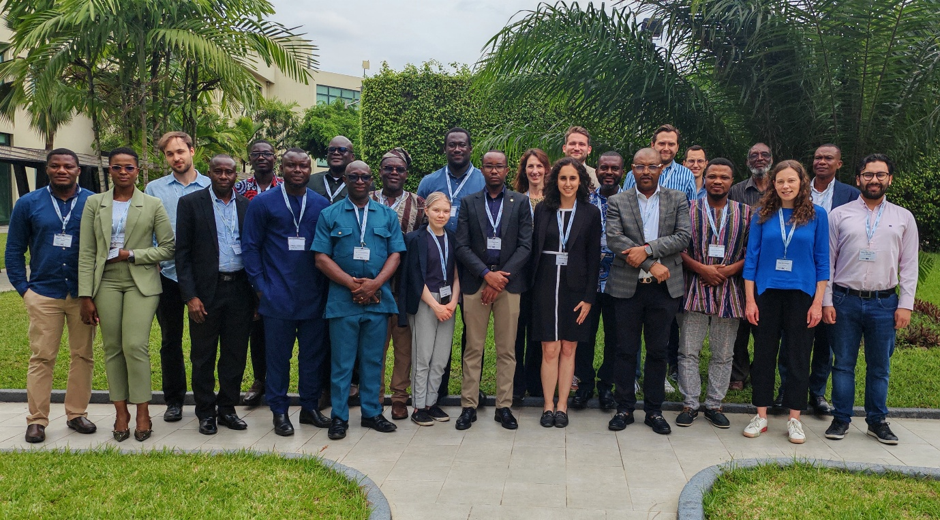
Participants at the Administrative Data and Tax Policy Analysis Workshop in Africa, Accra, Ghana (11–12 June 2026).
The global financing landscape for development is changing fast. Foreign aid is falling, debt servicing costs are rising, and demands on public finances are growing. Bilateral aid to Africa fell sharply in 2025, with the IMF estimating a decline of 26 per cent, while interest payments on sovereign debt reached 27.5 per cent of government revenue in 2024, the highest share in more than a decade (Afreximbank, 2025). As a result, developing countries, especially those in Africa, must find sustainable sources of development finance.
Against this backdrop, strengthening domestic revenue mobilisation, a country’s ability to raise money from its own tax base, matters more than ever for building fiscal resilience and financing Africa’s long term development. The international community has long recognised this, including through the Addis Ababa Action Agenda. Governments must now turn these commitments into action by broadening tax bases, improving compliance, and designing tax policies that raise revenue fairly and efficiently while supporting growth and building public trust.
Building such tax systems requires robust evidence. Decision makers need to know which reforms improve compliance, which incentives deliver value for money, where revenue leaks away, and how taxpayers respond to policy changes. This evidence matters even more now, as African countries take a bigger role in negotiations on the proposed United Nations Framework Convention on International Tax Cooperation and other reforms to the global tax system. Insights from African tax systems can help the African Group build shared priorities, back up its positions, and show the international community where existing tax rules succeed and where they fall short. Administrative tax data1 provide exactly that evidence, letting tax authorities and researchers evaluate reforms, strengthen compliance, spot revenue risks, and design policies based on how taxpayers actually behave.
But turning administrative data into evidence takes more than a single research project; it takes a strong evidence ecosystem connecting revenue authorities, researchers and policymakers. Revenue authorities provide secure, sustained access to administrative data; researchers turn that data into rigorous, policy relevant evidence; and policymakers put the findings into tax design and implementation. By building these relationships into lasting institutions, African countries can keep improving their tax systems, strengthen domestic revenue mobilisation, and bring evidence grounded in African realities to international tax negotiations.
Recognising this broader need, the Administrative Data and Tax Policy Analysis in Africa Workshop was one practical step toward building this evidence ecosystem. Held in Accra, Ghana, on 11–12 June 2026, the workshop brought together researchers, tax administrators and development partners to showcase ongoing research, strengthen collaboration, and accelerate the use of administrative data for evidence-based tax policy across the continent. The Tax Justice Network organised the workshop in partnership with the Ghana Revenue Authority, the International Growth Centre, and Skatterforsk – Norwegian Centre for Tax Research.
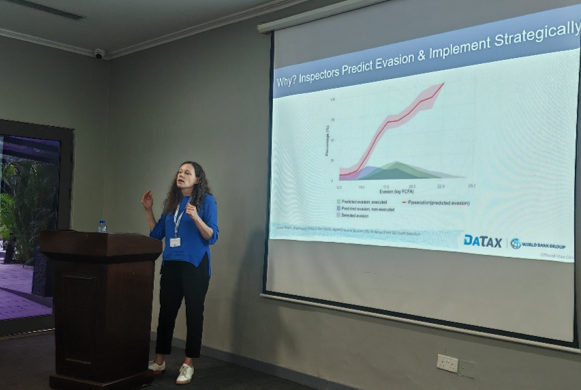
Anne Brockmeyer, Global Lead for Tax Data Analytics at the World Bank, delivering the opening keynote on the role of administrative data in evidence-based policymaking.
The opening keynote by Anne Brockmeyer carried a simple yet powerful message: administrative data are among policymakers’ most valuable assets. When collected, linked and analysed effectively, they let governments evaluate policy using evidence drawn from their own tax systems.
This message echoed throughout the workshop: administrative data are no longer just records collected for tax administration. They are strategic public assets that can improve tax policy, customs, compliance, investment policy and public finance more broadly.
Four thematic sessions showcased research from Ghana, Kenya, Nigeria, South Africa, Rwanda, Eswatini and Zambia, all tackling real policy questions with administrative data. Three themes stood out across the papers.
Taxing small firms and the informal economy: How can tax systems reach micro and small businesses without overwhelming them? Presenters examined simplified and presumptive tax regimes, the use of third-party data to improve turnover taxation, and the trade-offs these approaches create between revenue, fairness and compliance costs. Evidence on taxpayer education showed that what small businesses know about the tax system shapes how they engage with it, a reminder that compliance is built through knowledge as much as enforcement.
Confronting international profit shifting: A second cluster of papers tackled the international side of revenue loss. Drawing on corporate tax returns, audit records and customs data, researchers examined what audits reveal about profit shifting by multinational companies, how that shifting can be detected across countries, how treaty shopping and the digital economy strain existing rules, and how price-filter methods can flag suspicious import values. Together, these studies illustrate that administrative data give African revenue authorities the tools to measure and start recovering revenue lost to cross-border tax abuse.
Strengthening tax administration, compliance and enforcement: A third theme focused on the machinery of revenue collection itself: managing tax arrears, the effects of risk-based audits, compliance certification at customs, and how VAT registration thresholds are set. Papers also looked at how firms respond to shocks, including climate shocks, and what that means for the tax base’s resilience. The common thread: administrative data let revenue authorities test and refine their own tools, rather than importing solutions designed elsewhere.
Although the topics differed, the conclusion was consistent: better evidence leads to better policy.
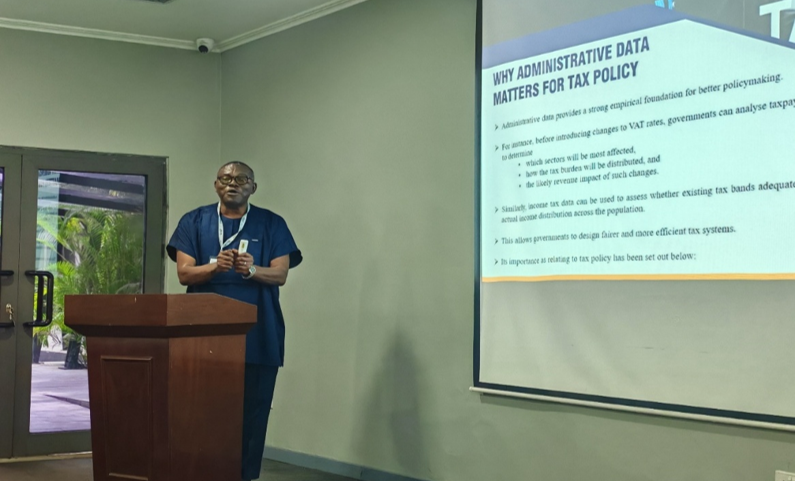
Abdallah Ali-Nakyea emphasised the legal and institutional foundations of evidence-based tax policy.
The second keynote, from Abdallah Ali-Nakyea of the University of Ghana, made a similar point: evidence alone isn’t enough unless it’s translated into sound legislation and practical reforms. That takes strong collaboration between researchers, revenue authorities and legal experts.
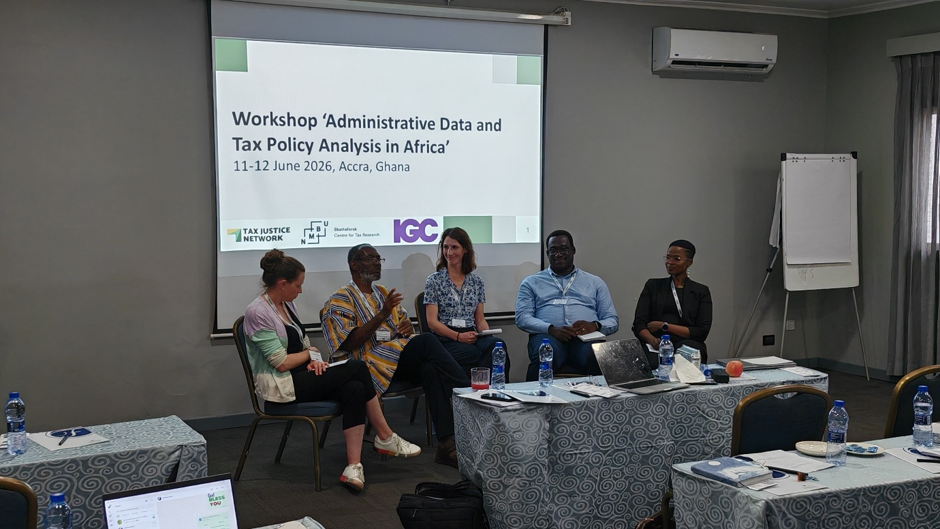
Panel discussion on strengthening collaboration between researchers, tax administrations and development partners.
Perhaps the workshop’s most important message, summed up in the closing policy panel, was this: sustainable domestic revenue mobilisation begins with building an evidence ecosystem. That ecosystem goes beyond individual research projects; it means tax administrations, universities, research institutes, policymakers and development partners working together over the long term.
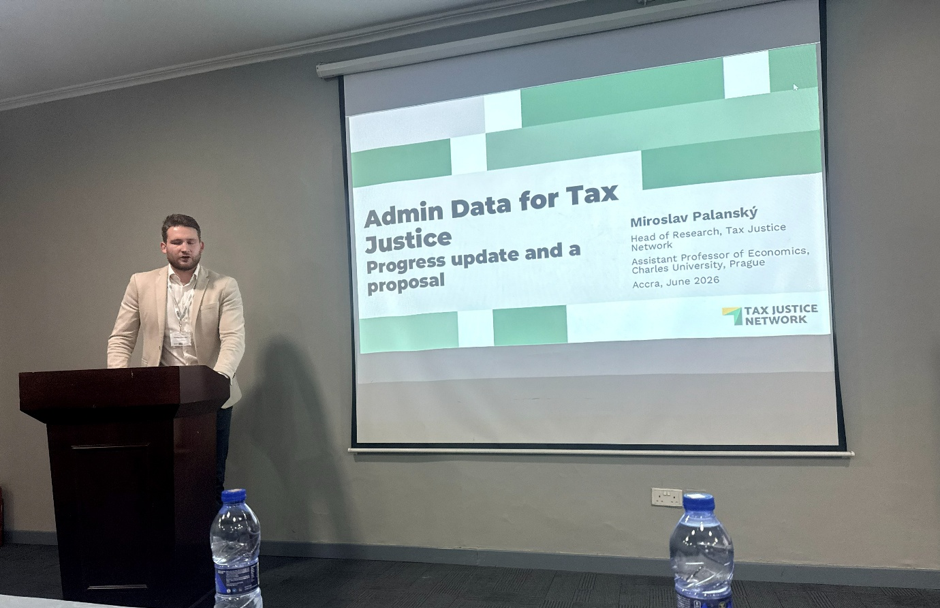
Miroslav Palansky, head of research at the Tax Justice Network, giving an update on the Admin Data for Tax Justice Initiative.
The Accra workshop forms part of a broader agenda under the Administrative Data for Tax Justice initiative, launched by the Tax Justice Network in December 2025. Through it, we are working with revenue authorities to expand secure researcher access to administrative tax data and to build a growing, publicly documented body of evidence on tax policy.
Our ambition is for this workshop to become Africa’s leading annual forum for evidence-based tax policy, bringing together researchers, revenue authorities, policymakers and development partners to strengthen the continent’s evidence ecosystem. Achieving this requires sustained partnerships, long-term investment and a shared commitment to building research capacity across the continent. We invite development partners, foundations, universities, tax administrations and individuals who share this vision to join us in supporting the 2027 edition. Whether through financial sponsorship, institutional collaboration or strategic partnerships, your support will help advance evidence-based tax policymaking and ensure that rigorous research continues to inform policies with lasting public impact.
To discuss how you or your organisation can get involved, please get in touch at [email protected].
On 25 June 2026, the IMF published its Guidance Note for Addressing Anti-Money Laundering/Combating the Financing of Terrorism Issues in Surveillance, Financial Sector Assessment Programs, and Use of Fund Resources. This Guide can help address one of the main problems of the anti-money laundering system. One of the central reasons the system fails to curb illicit financial flows is that, in addition to weak international standards, countries tend to approach anti-money laundering and transparency requirements as a check-the-box exercise. What prevails is an attitude of doing the bare minimum simply to prevent being blacklisted or poorly rated. Instead, this Guide helps show the main decision-makers in ministries of finance that anti-money laundering measures are not just a matter for the financial intelligence unit. As the Guide rightly notes, money laundering can have “macroeconomic impact” and financial crimes can “undermine financial stability, economic growth, and quality of institutions.” This should be enough to convince government economists of the need to prevent financial crime. If that is not enough, the Guide also reminds Treasuries around the world that the IMF will be watching this issue very closely.
The Guide also demonstrates the IMF’s engagement on many of the transparency policies that the Tax Justice Network holds dear.
First, the Guide makes it clear that the IMF can go beyond current international standards (e.g. those of the Financial Action Task Force (FATF)) and propose more appropriate (and ambitious) measures when needed: “where appropriate, the Fund may recommend a closer alignment of Fund member countries’ policies with best practices that go beyond the FATF standards or mutual evaluation recommendations.”
A great example of where the IMF has gone further than the FATF is in promoting public beneficial ownership transparency, one of the main policy priorities reflected in the Tax Justice Network’s Financial Secrecy Index and our Roadmap to Effective Beneficial Ownership Transparency. The Guide describes how the IMF required some countries receiving Covid-19 funding to publish information on beneficial owners: “One such measure was to ‘publish’ the names of the beneficial owners of legal entities awarded procurement contracts—a novel measure in an area that is at high risk of corruption. While not prescribed in the FATF standards, the publication of such information in member countries has contributed to enhancing transparency of public procurement, strengthening fiscal governance, and detecting fraudulent deals through increased public oversight and financial management information systems.”
Second, the Guide highlights the need to increase transparency in the real estate sector, aligning with our recent reports on Beneficial Ownership of Real Estate Around the World. The Guide notes: “given the wide range of impacts of illicit financial flows, including as a contributing factor for real estate bubbles in some countries, the Fund has promoted beneficial ownership transparency in a wide range of sectors with a focus on real estate.”
Third, the Guide recognises many of the financial crime risks present in countries with offshore centres targeting non-residents. These risks are the focus of many of the Financial Secrecy Index indicators, such as:
Fourth, consistent with the findings of the Financial Secrecy Index ranking (e.g. the top 10 countries), the Guide makes it clear that illicit financial flows are mainly enabled by major countries rather than by small secrecy jurisdictions (although they all share some responsibility): “While SDS [small developing states] with offshore characteristics facilitate only a minor share of global cross-border financial services as compared to the advanced economies with global financial centres, they face significant challenges in mitigating ML/TF risks from non-resident activity disproportionate to the size of the domestic economy and institutions.” (emphasis added).
The Guide rightly points out the spillover effects of each country’s frameworks: “Cross-border proceeds of financial crimes (or IFF) and weak AML/CFT frameworks generate cross-border spillovers”, particularly when it comes to major and small offshore centres that function as conduit or destination jurisdictions: “weak policies to address ML [money laundering] and economic crime in the transit and destination countries create arbitrage opportunities for illicit actors in search of financial institutions and company formation for misuse, as well as attractive jurisdictions in which to integrate criminal proceeds.”
In complete alignment with the Financial Secrecy Index ranking, the Guide recognises the major responsibility of advanced economies towards other countries:
“Advanced economies are also frequently destination jurisdictions for laundered funds originating in less-advanced economies, reflecting criminals’ preference for stable environments offering a wide range of financial products and services. Where such assets are not effectively detected, confiscated, and recovered, the resulting safe-haven effect can exacerbate instability in source countries by entrenching illicit economies, weakening state capacity, and undermining development—underscoring the fight against ML/TF as a global public good.”
Despite acknowledging the responsibility of major financial centres, the Guide fails to highlight the urgency of requiring advanced economies to be the first to strengthen their legal frameworks and enforcement. On the positive side, when proposing targeted policies for different types of countries, the Guide closely aligns with the Tax Justice Network’s policy recommendations for major financial centres: deepening understanding of cross-border risks and the risks associated with the misuse of legal entities and arrangements; enhancing beneficial ownership transparency across sectors, including the real estate sector; leveraging anti-money laundering measures to tackle tax crimes; and enhancing international cooperation on risk assessment and mitigation (e.g. supervision, investigation, prosecution and asset recovery).
In this context, we hope the IMF will take this Guide even further by recommending concrete policy measures in advanced economies to neutralise the cross-border spillover effects of secrecy and money laundering risks, such as:
Finally, we hope the IMF will adopt and promote the use of the Financial Secrecy Index by countries’ financial intelligence units and obliged entities to identify and address geographic risks. (For instance, the EU Anti-Money Laundering Regulation’s “high-risk factors” related to customer due diligence include many of the elements assessed by the Financial Secrecy Index, such as exchange of information, banking secrecy and beneficial ownership (Annex III, 3.f)). When assessing or assisting a country, the IMF could consider the Secrecy Score of that country’s main economic partners as a way of identifying high-risk flows. In other words, the Index could be used to identify secrecy risks among a country’s principal economic partners when assessing foreign direct investment, portfolio investment, trade or bank deposits. The Financial Secrecy Index could also be used for geographic risk assessment at the micro level, based on specific transactions processed through financial institutions, particularly in countries where the financial sector lacks robust risk models and other measures to prevent illicit financial flows.
In conclusion, just as the IMF did in relation to opaque bank ownership, this Guide continues to demonstrate leadership by calling for more ambitious reforms. It provides an important opportunity for key decision-makers in ministries of finance to take ownership of—and recognise the self-serving benefits of—transparency reforms. At a time when a UN Tax Convention is being negotiated to establish stronger international rules to combat illicit financial flows, this Guide helps advance the discussion on policies that go beyond existing international standards.
Under unitary taxation, multinational companies are treated as what they are: single businesses. Their global profits are aggregated, and the right to tax them is allocated among countries according to where the group’s economic activity takes place. Economic activity is usually measured using a formula that captures the factors contributing to multinational profits. Under a formula based on employment and sales, for instance, a country hosting 10% of a multinational’s employees and accounting for 10% of its sales would be allowed to tax 10% of the group’s global profits at its own rate. This would end profit shifting, create a level playing field between domestic and multinational companies, and allow the countries and societies on which multinational profits depend to tax a fair share of those profits. In a study published with with Public Services International, we estimate what this would be worth: between US$300bn and more than US$500bn in additional revenue worldwide, in every year we examine.
Is it really that simple? We treat multinationals as single companies, allocate taxable profits using a formula, and almost all the problems we have been trying to solve for years are gone? As we show in our study, the answer is yes and no. Yes, because that is exactly what unitary taxation can achieve. No, because we need to get a few things right for it to deliver. Two of them come down to something as mundane as measurement, and getting the measurement wrong hurts precisely those countries that stand to gain most from unitary taxation in relative terms: low- and lower-middle-income countries.
Both core ingredients of unitary taxation – aggregating profits and apportioning them with a formula – require measurement. First, which global profits do we aggregate? Second, how do we measure economic activity? As our report shows, the answer to the first is “all of them, except those arising from resource extraction”. Ours is the first study to give countries’ rights over their own natural resources priority over taxing rights before profits are apportioned. Without this step, resource-rich countries can appear to lose from a reform designed to help them. The answer to the second is “the formula is a political compromise – but sales should be measured where the customer is located”. Our study is also the first to provide unitary taxation estimates in which sales are consistently measured where customers are actually located, and a large part of what lower-income countries stand to gain depends on that single choice. This blog explains why both measurement choices matter.
Multinationals do not generate their profits in a vacuum. They use land and water, draw on forests, fisheries, minerals and energy resources, and may leave behind pollution, degraded ecosystems and climate damage. Their profits therefore rest not only on workers’ effort, machinery and customers’ payments – the economic activity usually captured by standard apportionment formulas – but also on natural wealth that belongs to the people of the countries in which it is found.
Resource-rich countries already claim part of the value generated by their natural resources. This is done most systematically in the extractive sector, where royalties and licence fees, taxes on extractive profits, production-sharing arrangements and state equity participation have evolved alongside one another over decades. For their interaction with unitary taxation, it matters how a country claims its share. Claims paid before profit is calculated – such as royalties and licence fees, which companies deduct as costs – are unaffected by how global profits are reallocated.
But most resource-rich countries also rely on claims paid out of reported profit, in particular taxes on extractive profits and returns from state participation. If extractive profits are now simply added to the global profit pool and apportioned using a formula based on assets, employees or sales, they are allocated away from the country where the resources are located and towards the places where extractive multinationals hold assets, employ people and make sales. The associated taxing rights move with them, stripping the resource-rich country of its resource rights.
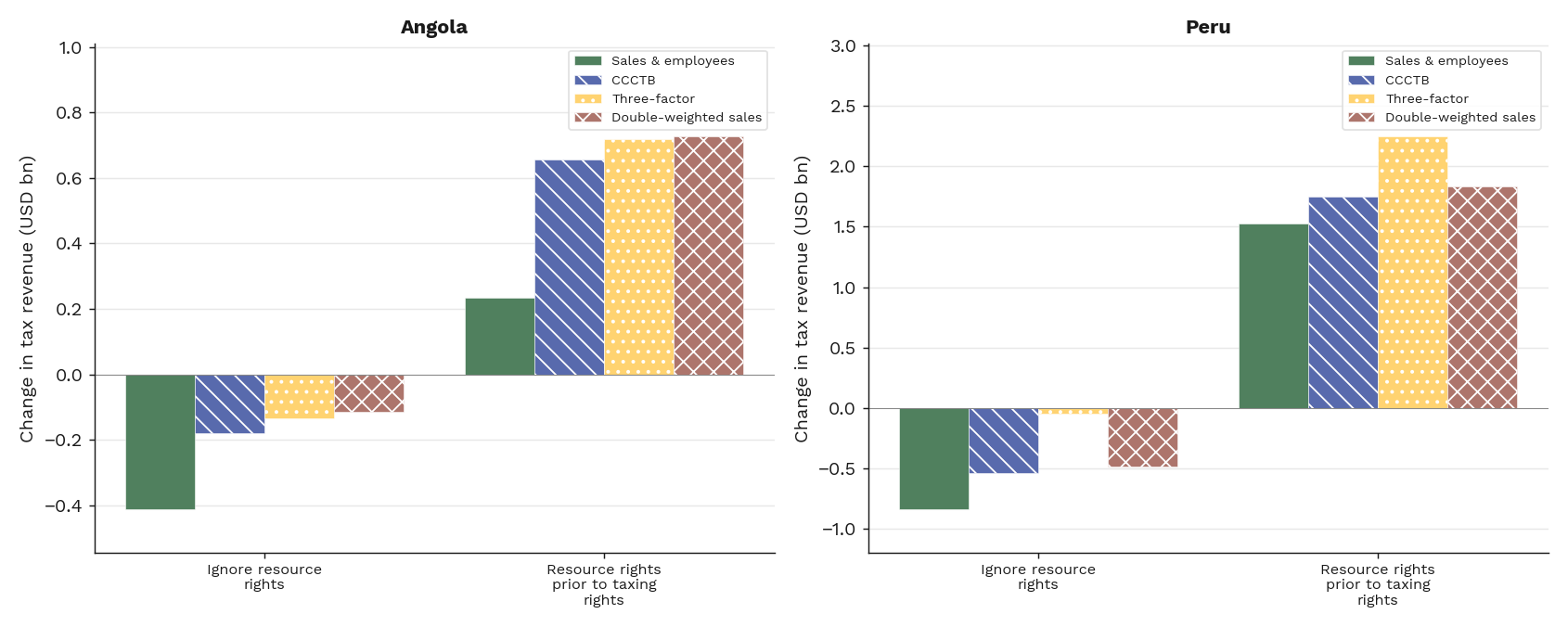
The examples of Angola and Peru show what this can mean for resource-rich countries. In Angola, oil accounts for around 95% of exports and more than 30% of GDP (Reuters, 2025; IMF, 2024, 2025a); in Peru, mining – dominated by copper and gold – accounts for more than 60% of exports and roughly one tenth of GDP (Chin et al., 2025; MINEM, 2024; IMF, 2025b). Much of the profit that multinationals report in both countries therefore stems from resource extraction. Royalties and licence fees have already been deducted before these profits are reported and remain unaffected. But the resource rent that Angola and Peru currently capture through taxes on extractive profits would be reallocated under a system of unitary taxation that ignores resource rights. As a result, both countries appear to lose: under the sales and employees formula, Angola by around US$410m a year and Peru by around US$835m (Figure 1, left-hand panels).
In principle, this problem could be addressed within the formula by adding a resource factor that allocates part of the profits to the country of extraction. But reliance on natural resources varies greatly across multinationals, making sector-specific formulas necessary. Besides increasing complexity, such formulas could invite manipulation. They would also treat countries differently depending on how they capture resource rents: countries relying mainly on royalties would already have secured their claims before profits enter the unitary pool, while countries relying more heavily on taxes on extractive profits would need the formula to restore taxing rights that had first been taken away.
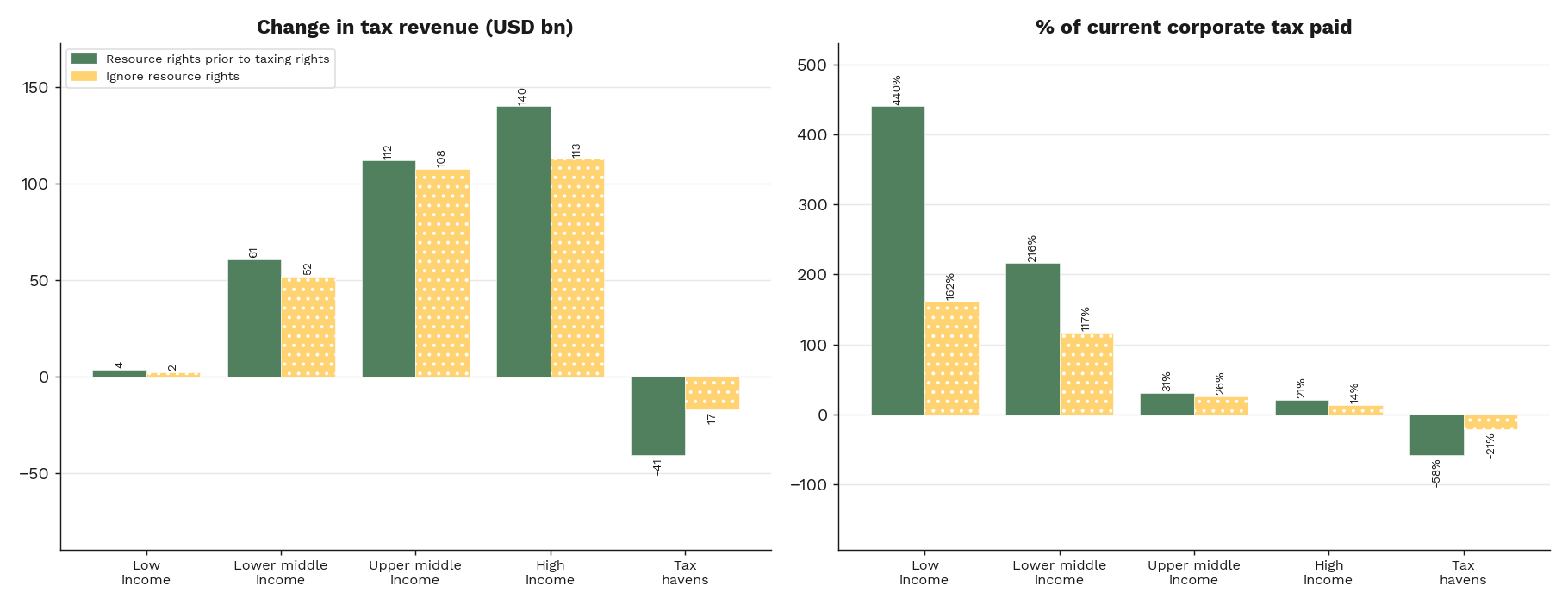
A better solution than trying to weave resource rights into unitary taxation is to treat them strictly as prior to taxing rights. This means reserving for the resource-rich country the extractive profits on which it currently levies taxes or receives returns, before the remaining profits enter the unitary pool. Only value arising directly from extraction is protected in this way; refining, processing, transport and sale remain fully within the unitary tax base. To estimate the revenue effects of unitary taxation, we apply this correction using EITI data, UNU-WIDER’s Government Revenue Dataset, Orbis and a manually compiled database of resource fiscal regimes. Once resource rights are treated in this way, resource-rich countries that would otherwise appear to lose under unitary taxation become net winners. For Angola and Peru, the results are shown in the right-hand panels of Figure 1. Angola gains about US$233m a year and Peru about US$1.5bn under the sales and employees formula, and both countries gain under every formula we model. More generally, as shown in Figure 2, ignoring resource rights reduces the gains of low-income countries by 35%, those of lower-middle-income countries by 15%, and those of high-income countries by 20%. It also understates the losses of tax havens, because profits arising from natural resources are treated as if they legitimately belonged wherever they are currently reported.
The second important measurement choice concerns the definition of “real economic activity”: which factors should enter the formula, and with what weights? There is some general guidance. A good formula should capture both the input and output sides of profit generation, work reasonably well across sectors so that no sector-specific solutions are needed, rely on factors that can be measured consistently and assigned clearly to countries, be difficult to manipulate, and avoid creating strong incentives for relocation. No formula satisfies all these criteria perfectly. But even if one did, the choice of factors and weights would remain political: each combination distributes taxing rights differently across countries, so choosing a formula also means choosing who gains more and who gains less.
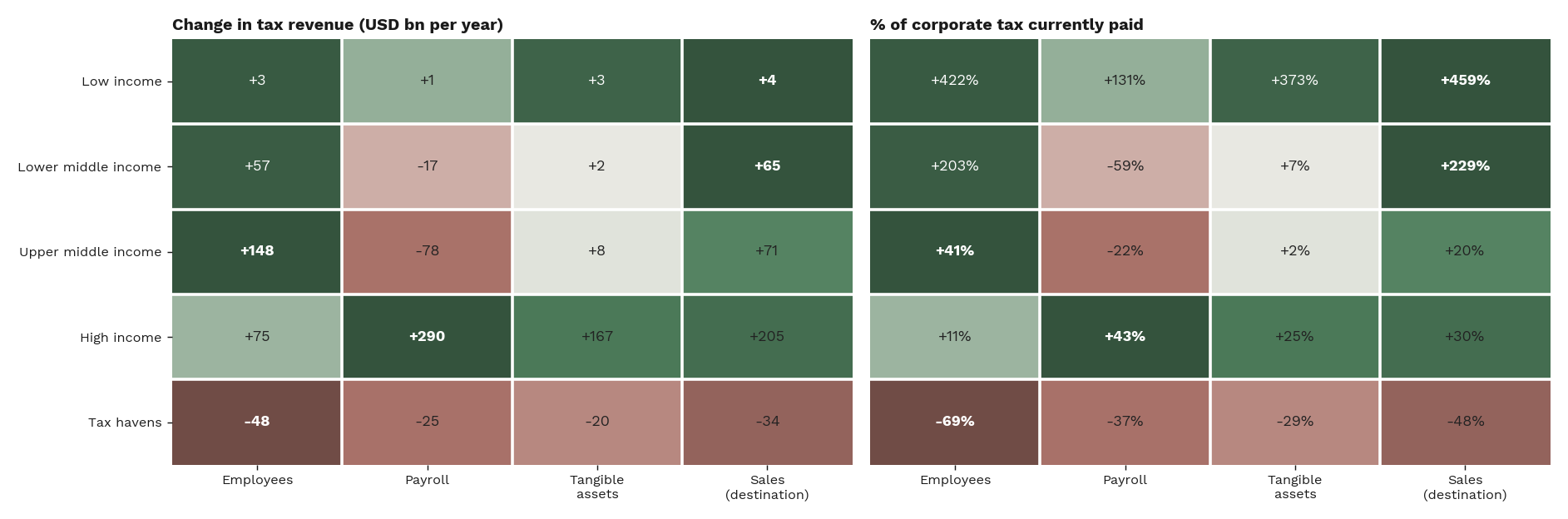
To allow for a systematic comparison of these distributional effects, Figure 3 shows how giving full weight to a single factor would change revenues.[1] Two factors benefit every income group except tax havens: sales to customers and employee headcount. Sales produces the largest relative gains for low- and lower-middle-income countries. Employee headcount shifts substantial taxing rights towards middle-income countries with large workforces, while still leaving high-income countries better off than they are today.
The other two factors – payroll and tangible assets – create clearer conflicts between income groups. Payroll delivers the largest gain of any factor to high-income countries, but lower- and upper-middle-income countries lose revenue under it, simply because the same work is paid less there. Tangible assets benefit low-income countries, whose capital stocks are large relative to the very small profits currently reported there. But assets are also the factor that is easiest to place strategically. This is visible in the figure: they shift less revenue away from tax havens than any other factor, because a country with almost no workers or customers can still hold assets. Employee headcount, by contrast, shifts more taxing rights away from tax havens than any other factor, precisely because a workforce is harder to relocate for tax reasons than a balance sheet.
Even once the formula has been agreed, its factors still have to be measured. For sales, this is where much of the outcome is decided, without anyone appearing to make a distributional decision at all. Under current rules, sales are attributed to the seller rather than the buyer: to the origin of the sale, not its destination. That is also how they appear in the country by country reporting data usually used to estimate the effects of unitary taxation, so most estimates defaults to an origin-based measure unless the sales factor is constructed separately.
What does “origin” mean in practice? Under an origin-based measure, a sale is recorded in the country where the multinational’s subsidiary that books the sale is located, even if the customer is elsewhere. A multinational may, for example, route sales through a related trading or marketing subsidiary in another country. That subsidiary books the sale, while the country where the customer is located may record little or none of it. The gap is widest in digital business models. A cloud, software or platform company can serve customers in dozens of countries through only a handful of contracting subsidiaries. Its revenue is then recorded in those few countries, while the countries where its customers are located may show no sales at all.
Origin-based measurement therefore fails on three counts. First, it reintroduces precisely the arrangements that unitary taxation is meant to eliminate: multinationals no longer shift profits directly, but they can still shift the factor determining where those profits are taxed. Second, it systematically allocates less profit to lower-income countries, since selling into a market often leaves no trace in the seller’s own accounts there. Third, it defeats the purpose of including sales in the first place. If the factor is meant to capture the consumption side of profit generation, measuring it where the seller sits simply measures production a second time.
Instead, sales must be measured where the customer is located. Unfortunately, this information is not available from existing country by country reporting data, because multinationals are not currently required to report it. To estimate it, we draw on two sources. First, we use the local sales of multinationals across all sectors from the OECD’s Analytical AMNE database, which captures what is sold to customers through a local presence (OECD, 2020). But this misses everything that reaches a market without such a presence. We therefore add a second component: each country’s imports of digitally deliverable services from the OECD-WTO Balanced Trade in Services database, counting only the share that multinationals are likely to supply (Amaro and Picciotto, 2026). This matters because a growing share of what multinationals sell into a market – cloud services, software, licensing, professional and information services – reaches customers without a local affiliate at all. Estimating destination sales from local presence alone therefore smuggles a physical-presence assumption into the numbers and understates precisely those markets that are served remotely.
Figure 4 shows how much this matters. Under the sales and employees formula, moving from origin to destination raises the annual revenue gains of low-income countries by more than 40%, and those of lower-middle-income countries by 120% – from about US$28bn to about US$61bn a year, or from roughly doubling to more than tripling what they currently collect from multinationals. Upper-middle-income countries gain 48% more and high-income countries 12% more. The difference comes entirely out of tax havens, whose losses are 34% larger under a destination-based measure. Figure 4 also shows that imposing a physical-presence nexus requirement on destination-based sales shifts taxing rights back towards high-income countries and tax havens, reducing lower-middle-income countries’ gains from about US$61bn to US$54bn while increasing those of high-income countries from US$140bn to US$154bn. In an economy where multinationals reach customers through platforms, distributors and regional sales hubs, such a requirement has been overtaken by digitalisation.
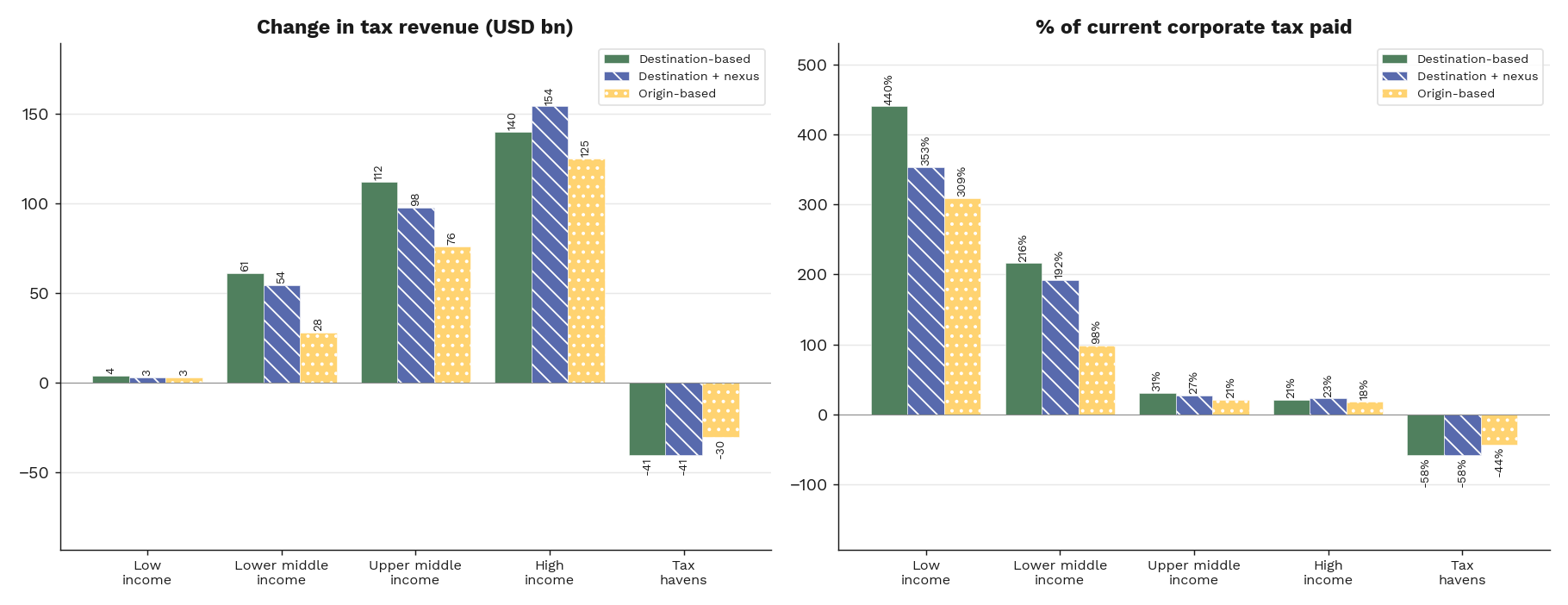
Our measure of destination-based sales relies on imperfect proxies. It misses advertising-funded digital services, which generate no recorded imports in the users’ country, as well as goods sold directly to consumers from abroad through e-commerce. These are limits of the available statistics, not of unitary taxation itself. In practice, the system should not have to rely on proxies. It requires accurate data on where multinationals’ customers are located and how much revenue they generate there. Multinationals should therefore be required to report their revenues by customer location in their public country by country reports.[2]
Neither of these two questions looks political. Whether resource profits enter the unitary pool before or after apportionment sounds like a technical question of scope; whether sales are recorded where the seller or the customer is located sounds like a data problem. But getting the first wrong makes resource-rich countries appear to lose from a reform designed to grant them their fair share and reduces the gains of low-income countries by 35%. Getting the second wrong deprives lower-middle-income countries of more than half of what they stand to gain. In both cases, the losses fall on the countries with the largest relative gains at stake and the least capacity to challenge decisions buried in a technical annex. These questions therefore belong in the negotiations themselves, as does a commitment to global public country by country reporting that includes sales by customer location.
[1] We do not mean to suggest that single-factor formulas should be used. We present the effects of each factor separately only to allow for a systematic comparison of their distributional impacts.
[2] Most country by country reports are currently filed confidentially with tax authorities and are not publicly available. Public disclosure is necessary both to hold multinationals accountable for their current tax practices and to enable public scrutiny of profit allocation under unitary taxation.
Amaro, F. and Picciotto, S. (2026). Options for a Protocol on Services under the UN Framework. Working Paper. G-24. https://g24.org/wp-content/uploads/2026/04/Options-for-a-Protocol-on-Services-under-the-UNFCITC-1.pdf
Chin, M., Di Gregorio, E. and Torres, J. L. (2025). Revamping Fiscal Decentralization to Secure Peru’s Position as a Leading Critical Mineral Exporter. IMF Selected Issues Papers. International Monetary Fund. https://www.imf.org/en/publications/selected-issues-papers/issues/2025/06/16/revamping-fiscal-decentralization-to-secure-perus-position-as-a-leading-critical-mineral-567764
International Monetary Fund (2024). Angola: 2024 First Post-Financing Assessment — Press Release and Staff Report. Country Report 2024/224. https://www.imf.org/en/publications/cr/issues/2024/07/15/angola-2024-first-post-financing-assessment-press-release-and-staff-report-551882
International Monetary Fund (2025a). IMF Executive Board Concludes 2024 Article IV Consultation with Angola. Press Release No. 2025/41. https://www.imf.org/en/news/articles/2025/02/24/pr-2541-angola-imf-executive-board-concludes-2024-article-iv-consultation
International Monetary Fund (2025b). Peru: Selected Issues. IMF Country Report 2025/126. https://www.imf.org/en/publications/cr/issues/2025/06/10/peru-selected-issues-567577
MINEM (2024). 69.5% de las exportaciones del país son generadas por el Sector Energía y Minas. Nota de prensa. https://www.gob.pe/institucion/minem/noticias/910356-minem-69-5-de-las-exportaciones-del-pais-son-generadas-por-el-sector-energia-y-minas
OECD (2020). Tax Challenges Arising from the Digitalisation of the Economy — Economic Impact Assessment. Paris: OECD/G20 Inclusive Framework on BEPS, OECD Publishing. https://www.oecd.org/content/dam/oecd/en/publications/reports/2020/10/tax-challenges-arising-from-digitalisation-economic-impact-assessment_814ce768/0e3cc2d4-en.pdf
Reuters (2025). What Are the Debt Challenges Facing Angola? Mirici, D. and Gomes, M., 15 May 2025. https://www.reuters.com/world/africa/angolas-debt-economic-challenges-2025-05-15
With disbelief I heard some days ago of the passing of Óscar Ugarteche, one of the Tax Justice Network’s long time senior advisers. This mournful news left me dismayed. The loss of an inspiring person always brings sadness even to those of us who were not fortunate enough to meet him in person. At the same time, this news made me want to pay tribute to the greatness of his persona.
Characterised by his vast knowledge and capacity to communicate complex sets of problems in an easily digestible way, Óscar was considered a prominent intellectual of his time whose acute perspective on the global economy was constantly on request. The Tax Justice Network was among the many institutions that always appreciated to have his point of view on current affairs.
Óscar worked in an array of topics related to the tax justice movement and beyond, including the interventionist role of international financial institutions, climate change and energy transition, the pandemic, the commercial conflict between the giants USA and China, the economic consequences of the wars in Ukraine and Iran, and the articulation of fiscal policies for the public interest among Latin American countries. This latter stimulating interest, present in the broad spectrum of his curiosity since his youth, led him to co-found in 2000 the Latin American and Caribbean Network for Economic, Social, and Climate Justice (LATINDADD, by its acronym in Spanish).
One of his recurrent resolutions was to champion for the redesign of the international financial architecture. His critical analysis of existing institutions like the International Monetary Fund drove him to question whether the rules of the international financial system benefit the global economy, or rather those who drafted them. Bottom line, a new international order with less conditionality and fairer outcomes for developing countries is what a healthy economy should aim for.
Marcelo Justo, host of the Tax Justice Network’s Spanish podcast Justicia Impositiva shared some of his most rewarding experiences working with Óscar for some of the episodes:
“Over the past six years, the dear Óscar became a constant touchstone for our program. The encyclopedic knowledge he commanded always offered a perspective distinct from dominant media narratives, with his beloved Latin America at the heart of his vision. Oscar combined this knowledge with a gift for teaching and a relentless pursuit of the specific data, detail, or angle that allowed for a different way of viewing the issues of our time.”
We invite you to listen to the episodes in which we had his incisive intervention in the following link. These are the most recent ones but there are more where he’s featured over the years.
Outside the field of economics, Óscar was also a role model in the defence of long-neglected rights of the LGTB+ community. As a gay man, he decided to stand up for his rights in times where the status quo was dominated by entrenched conservatism in Peru. But unity is strength, and the reason why in the early 80’s he decided to co-found the Lima Homosexual Movement (MHOL, by its Spanish acronym).
This bold first step meant hope for those who were not ready to fight head-on against the prejudices that were deeply embedded in the mindset of the times. Many joined the movement since, and some other movements were also created in this pursuit of recognition for equality among people. Some sort of awareness was triggered, and tolerance began to gain ground little by little.
Óscar eventually moved to Mexico, where he met the man who would later become his husband, Fidel Aroche. They married in 2010 under marital legislation in Mexico, which allows same-sex marriage. Then they tried to register their wedding in Peru, which still doesn’t. As the Peruvian register office rejected this request, Óscar initiated a legal battle alleging a violation of the principle and right to equality and non-discrimination. After an exhausting process that ended up in the Constitutional Court, the justices decided not to rule on the merits of the case and the case was lost due to shameful legalistic quibbles. A battle was lost. But the fire that burnt in our hearts demanding recognition remains relentless.
What we learnt from Óscar Ugarteche is that unfairness is out there ready to be confronted. Sometimes it affects others more, sometimes it touches you more personally. But in any case, the opportunity to change reality is within our reach when we start movements, form alliances, think together and work for the common good. Challenges will be tough and changes will sometimes be slow. However, it is worth the effort to rise to the occasion when one believes that a fairer world is still possible.
This is a lesson that will always stay with us, dear Óscar.
Image credit: © CDI LUM, DESCO Collection
Reflections from the UN Women Expert Group Meeting for the Seventy-First Session of the Commission on the Status of Women (CSW71)
For much of the past decade, the dominant approach to advancing gender equality has been framed around integrating women more fully into existing economic institutions. We have asked how more women can participate in labour markets, access finance, shape climate policy, occupy positions of leadership and benefit from economic growth. Those questions remain essential. But they have often left comparatively little space to ask how those institutions themselves distribute resources, allocate risk and shape the boundaries of political possibility.
Conversations about financing have followed a remarkably similar logic. They have largely begun with questions of scarcity. Where will governments find additional resources? How can countries mobilise more revenue? How do we close the financing gap? Important though they are, they also risk obscuring a more fundamental question: why do governments continue losing so much of the revenue they already generate?
In both cases, we begin by asking how to work within existing constraints rather than asking how those constraints came to exist. A feminist political economy perspective starts elsewhere. Rather than treating economic institutions and fiscal constraints as immutable, it asks how they are produced, whose interests they serve, who benefits from preserving them, and how these structural barriers can be transformed.
These reflections were prompted by participating in the recent UN Women Expert Group Meeting convened to inform the Secretary-General’s report for the Seventy-First Session of the Commission on the Status of Women and the broader global debates on what should succeed the 2030 Agenda. Over three days, researchers, policymakers, feminist advocates, civil society leaders and representatives of international organisations grappled with what the Sustainable Development Goals (SDGs) had achieved, where they had fallen short and what the next development agenda would need to confront. While much of the discussion centred on implementation, financing and accountability, it increasingly became clear that the frontlines of gender justice lie as much in political economy as in gender policy itself.
The SDGs emerged at a particular moment in history. There was cautious optimism that stronger multilateralism, expanding development finance and growing recognition of women’s rights could gradually translate global commitments into meaningful change.
A decade later, that landscape looks markedly different.
Many of the political and economic conditions that sustained progress on gender justice over the past decade are beginning to unravel. Governments are expected to finance climate adaptation, strengthen public services, invest in care systems and deliver just transitions while confronting rising debt burdens, tightening fiscal space and an international economic architecture that continues to permit wealth and corporate profits to escape taxation. The wider political landscape has shifted just as profoundly. The promise of an increasingly cooperative multilateral order is beginning to fray. International institutions are no longer simply arenas for cooperation; they have become sites of growing geopolitical contestation, where competing visions of development, sovereignty and global governance increasingly shape what is possible. At the same time, civic space continues to narrow as anti-rights movements become increasingly coordinated, better resourced and more transnational, intensifying backlash against gender justice.
The challenge, then, is not one of ideas. It is no longer about finding the next policy innovation or institutional blueprint. It is about creating the political and economic conditions that allow decades of accumulated knowledge to be translated into practice.
If one lesson became clear over the course of the meeting, it is that public finance can no longer be treated as a peripheral concern within feminist politics. It has become one of its central terrains. For many years, tax occupied a surprisingly marginal place within feminist organising. There were understandable reasons for this. Tax systems appeared highly technical, dominated by legal language, accounting rules and international negotiations that felt far removed from everyday struggles over violence, care, labour or reproductive rights. That distinction is becoming increasingly difficult to sustain. Every issue feminist movements care about ultimately depends on public finance. Care systems require budgets. Healthcare requires budgets. Education requires budgets. Climate adaptation requires budgets. Freedom from violence requires budgets. Gender-responsive social protection requires budgets. Without public resources, even the strongest commitments risk remaining aspirations rather than realities.
Countries currently lose an estimated US$492 billion every year to global tax abuse. More fundamentally, governments have far greater untapped revenue potential. Research by the Tax Justice Network finds that governments could raise up to US$2.6 trillion annually by introducing a modest tax of between 1.7 and 3.5 percent on the wealthiest 0.5 percent of households and by recovering corporate taxes lost when multinational corporations shift profits to tax havens. The United Nations estimates that achieving gender equality by 2030 requires an additional US$360 billion each year. The financing gap is substantial, but it is dwarfed by the public revenue that could be mobilised through fairer and more effective taxation. These figures challenge the idea that today’s financing gaps are inevitable. Rather, they are the product of political choices—embedded in tax rules, international agreements and the governance of cross-border wealth—and political choices can be renegotiated. The central challenge, then, is not simply mobilising additional resources, but confronting the economic rules that systematically place so much existing wealth beyond the effective reach of taxation.
At its core, taxation is about the distribution of power as much as the distribution of revenue. A feminist approach to taxation therefore asks not only how much revenue governments raise, but who pays, who benefits and who bears the costs when governments cannot finance public goods. It therefore requires tax systems that are both progressive and gender responsive: systems that ensure those with the greatest ability to pay contribute their fair share while recognising how tax policy affects women and men differently. That means paying attention not only to tax rates, but to the design of the tax system itself: what is taxed, what is exempt, whether income from wealth is treated more favourably than income from work, and whose economic activity is made visible to the tax system in the first place. In many countries, returns to accumulated wealth continue to receive more favourable tax treatment than wages and salaries, while multinational corporations can still shift profits across borders with relative ease. When wealth and multinational corporations remain undertaxed, governments are frequently left borrowing more, cutting public spending or relying more heavily on regressive consumption taxes. Women often pay for those choices twice: first through tax systems that place proportionately greater burdens on lower-income households, and again when fiscal retrenchment shifts the costs of social reproduction onto unpaid care work. Fiscal policy therefore structures gender inequality long before governments decide how public money is spent.
Taxation occupies a distinctive place within struggles for gender justice because it is one of the few financing instruments that can provide public revenue at the scale, predictability and permanence required to sustain transformative public investment. Unlike debt, it does not defer today’s costs to future generations. Unlike aid, it is not contingent on external priorities, shifting geopolitical interests or donor cycles. And unlike private finance, it is democratically accountable to the societies from which it is raised. At its best, taxation can finance care systems, public services and social protection while also functioning as a reparative instrument capable of addressing historical and colonial injustices.
Yet realising that potential depends on how the international economy is organised.
Governments are repeatedly encouraged to mobilise domestic resources while the international tax system continues to create incentives for harmful tax competition that erode those very resources. Preferential corporate tax regimes and generous tax incentives encourage countries to compete for investment by narrowing their own tax bases, weakening the fiscal capacity they are simultaneously expected to strengthen. What is often presented as a technical debate about competitiveness, investment incentives or business-friendly tax policy is, in reality, a political question about whose interests the international tax architecture serves—and who bears the costs when public revenues prove inadequate. Those costs are not distributed evenly. They are shifted onto women through both paid and unpaid labour, allowing economic systems under increasing strain to sustain themselves without confronting the structural inequalities on which they depend.
Once public finance is understood as a central site of political struggle, the geography of feminist organising also begins to shift. The frontlines of gender justice are no longer found only in ministries responsible for women’s affairs. They are equally found in ministries of finance, tax administrations, budget processes, debt negotiations, climate finance discussions and international tax negotiations, including ongoing negotiations towards a United Nations Framework Convention on International Tax Cooperation. It is precisely these institutions that determine how wealth is accumulated, public resources are governed and gendered inequalities are reproduced. Yet public finance has yet to assume the central place within feminist strategy that its significance demands, leaving the feminist project too often responding to the consequences of—and adapting to—economic systems that were never designed to value women’s lives, labour or wellbeing.
That, in turn, brings us back to the question that ran through the meeting: what exactly are we mainstreaming gender into? If our economies continue to concentrate wealth, externalise care and reward extraction over redistribution, then inclusion risks becoming an endpoint rather than the beginning of reimagining—and ultimately transforming—the economic rules that organise our societies.
The post-2030 agenda will not be judged only by the ambitions it sets, but by whether it reckons with the political economy that determines whether those ambitions can ever be realised. Perhaps that is the defining question the next development agenda must answer.
Today the Tax Justice Network published two reports on real estate transparency. The first one, “Beneficial ownership of real estate around the world” summarises the findings of the Financial Secrecy Index on real estate transparency. It also it updates the report “Beneficial ownership registration around the world 2022” by assessing the state of play of beneficial ownership registration as of 2026, and checks which beneficial ownership laws trigger registration based on holding or acquiring real estate. The report identifies the frameworks and countries with the best real estate infrastructure (e.g. central, online real estate registries) and transparency (e.g. online, free and public access to information on real estate ownership). It also compares the results based on geographical region and membership to the OECD to explore the reasons that may explain why some countries are at the vanguard of real estate transparency, while others are lagging behind.
The second report “Integrating the Collection, Use and Exchange of Real Estate Ownership Information” explains the importance of beneficial ownership of real estate to tackle illicit financial flows. The report also explores all the potential sources of real estate information, considering the advantages and disadvantages of each one (e.g. the real estate registry, the tax administration, the financial intelligence unit, as well as banks, insurance companies, real estate brokers and public notaries subject to anti-money laundering requirements). On exchange of information, the report discusses the different frameworks for international exchanges (e.g. mutual legal assistance, sharing of financial intelligence and exchanges for tax purposes), illustrating how all new frameworks for automatic exchange of information (e.g. exchanges of information on immovable property, digital platforms, financial accounts and crypto-assets) could complement each other to offer information on foreign real estate held by nationals of each country. Finally, the report proposes how to integrate all this information into one platform to allow authorities as well as other stakeholders (e.g. investigative journalists, civil society organisations) to access and use this information to tackle financial crimes.
A brief summarising both reports is available here.
The tax justice movement awaits the publication of the first full draft of the UN Framework Convention on International Tax Cooperation (UNFCITC). It is expected within the coming days.
For those not intimately following the UN intergovernmental negotiations over the last two years, the Report of the High Level Panel on Illicit Financial Flows from Africa strikes at the core of why the status quo in international tax cooperation needs to change:
“The radical reduction of illicit capital outflows from [Africa], short of ending them, is precisely the outcome [Africa] and the rest of the world must achieve to produce this strategically critical new balance…
“As a Panel we are convinced that the goals of ending poverty in the world, reducing inequality within and among nations, and giving practical effect to the fundamental objective of the right of all to development remain vital pillars in the historic process to build a humane, peaceful and prosperous universal human society.”
(Chairperson Thabo Mbeki, p4 of the report)
Ahead of the fifth session of the intergovernmental negotiations to be held in New York, 3-13 August 2026, the draft text will be published in full. Many of the contentious issues are already clear from the previous sessions.
Some of the concepts under discussion are not yet clearly defined, and remain abstract yet are foundational for the successful implementation and operationalisation of the Convention’s principles and commitments. To help shed some light, in advance of the opportunity to comment upon and influence full draft text for the Convention and the two early Protocols, we wanted to support a nuanced understanding and discussion of these concepts. In a series of four webinars we brought together researchers, governmental negotiators and advocates to unpick some of the complexity and the implications.
To agree a common understanding of such issues opens up the space to create a high reaching and legitimate UN tax convention. This is surely what we need to change our world and to flourish!
You can find recordings of the first four webinars below. We plan to delve into to other topics later in the year.
Harmful Tax Practices – defining potentially unacceptable State behaviours.
Foreseeable Relevance – as a limiting criterion for the exchange of information between states.
Value Creation – as a potentially problematic basis for determining the location of companies’ real activity.
Illicit Financial Flows – an agreed component of the negotiations, with a formal UN statistical definition and potentially wide implications.
Background resources can be found here on our dedicated UN tax convention page
Debates about taxation are often shaped less by evidence than by politically convenient narratives. Across many countries, claims that taxes are the primary cause of low wages, weak growth or economic stagnation frequently gain traction despite limited empirical support. For those concerned with tax justice, the issue is not whether taxes should ever be criticised, but whether public debate is grounded in evidence rather than assumptions.
Spain offers a useful example. Arguments that employer social contributions are the main cause of stagnant wages have become increasingly prominent in political debate. Yet the available evidence suggests a more complex picture, raising broader questions about how tax policy is discussed and whether tax cuts are being presented as solutions to problems they may not actually address.
The only thing more disappointing than Spanish wages is the political debate surrounding them. According to the OECD, Spain’s real wages have grown just 5% since 1995, one of the lowest rates in the developed world. That figure deserves a serious diagnosis. Instead, like in many political arenas, opposition parties and outlets offer a comfortable narrative, statistically questionable and with solutions that would resolve nothing except the political problem of having to talk about the real economy.
The Spanish debate illustrates how discussions about taxation can become detached from the available evidence. Rather than focusing on the structural causes of wage stagnation, it increasingly seeks to blame unsatisfactory salaries on the burdens corporations must pay to fund increasingly skimpy welfare states. At least in Spain’s case, however, the data does not support that narrative, and there is little reason to believe that lower payroll taxes would deliver the wage growth their advocates promise.
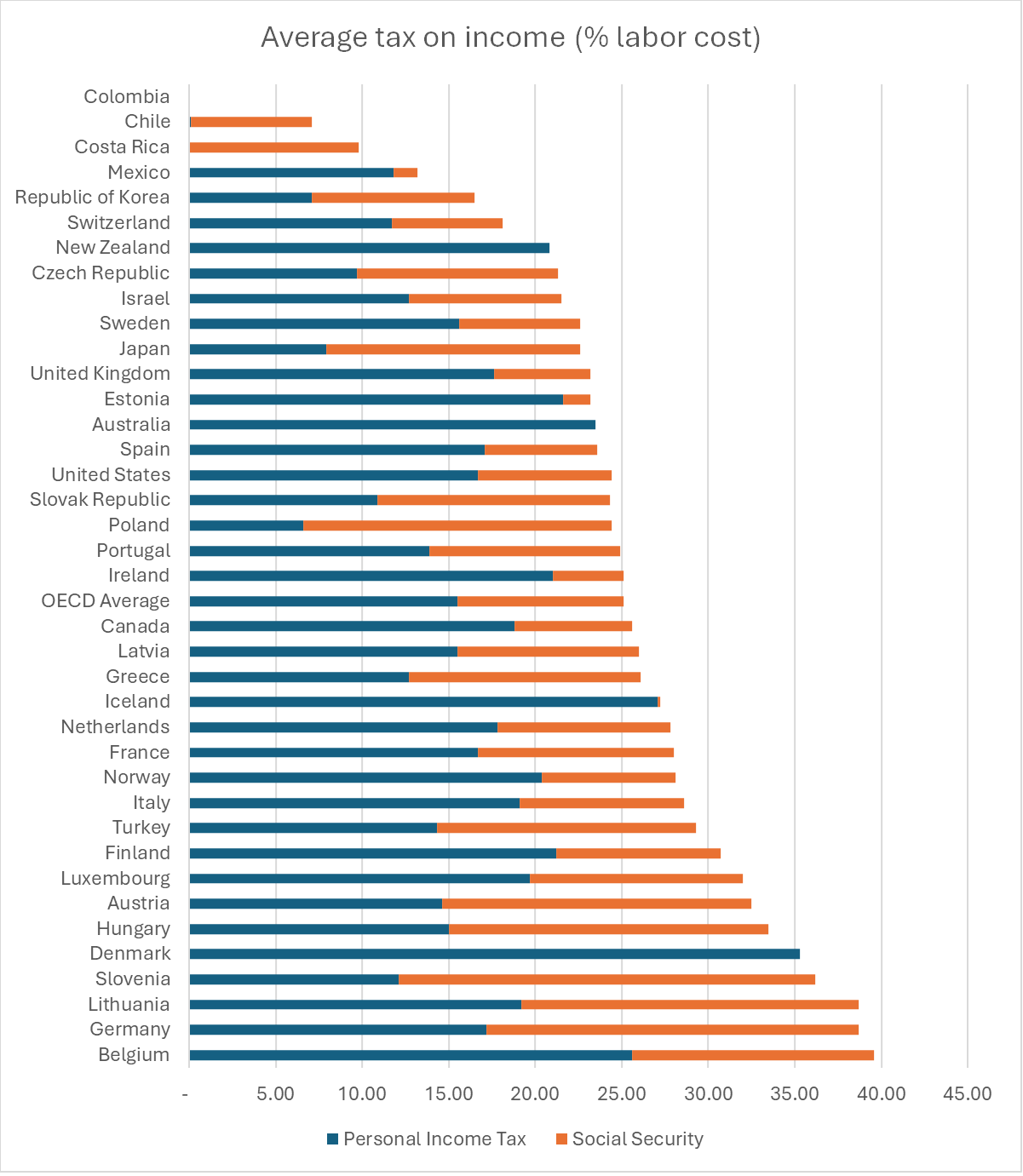
Source: Own elaboration based on OECD data
In Spain, the “tax hell” discourse isn’t new, but it’s taken on a fresh form. Faced with the evidence that Spain’s personal income tax isn’t particularly high compared to its peers, its proponents have shifted the argument toward employer social contributions, in the form of payroll taxes.
They state that a Spanish employer pays approximately 30% on top of gross wages in Social Security contributions; once you add what the worker pays, you arrive at a total burden that supposedly turns Spain into a disguised tax hell. The following chart has been circulating for months, republished by outlets and commentators of a libertarian and conservative bent.
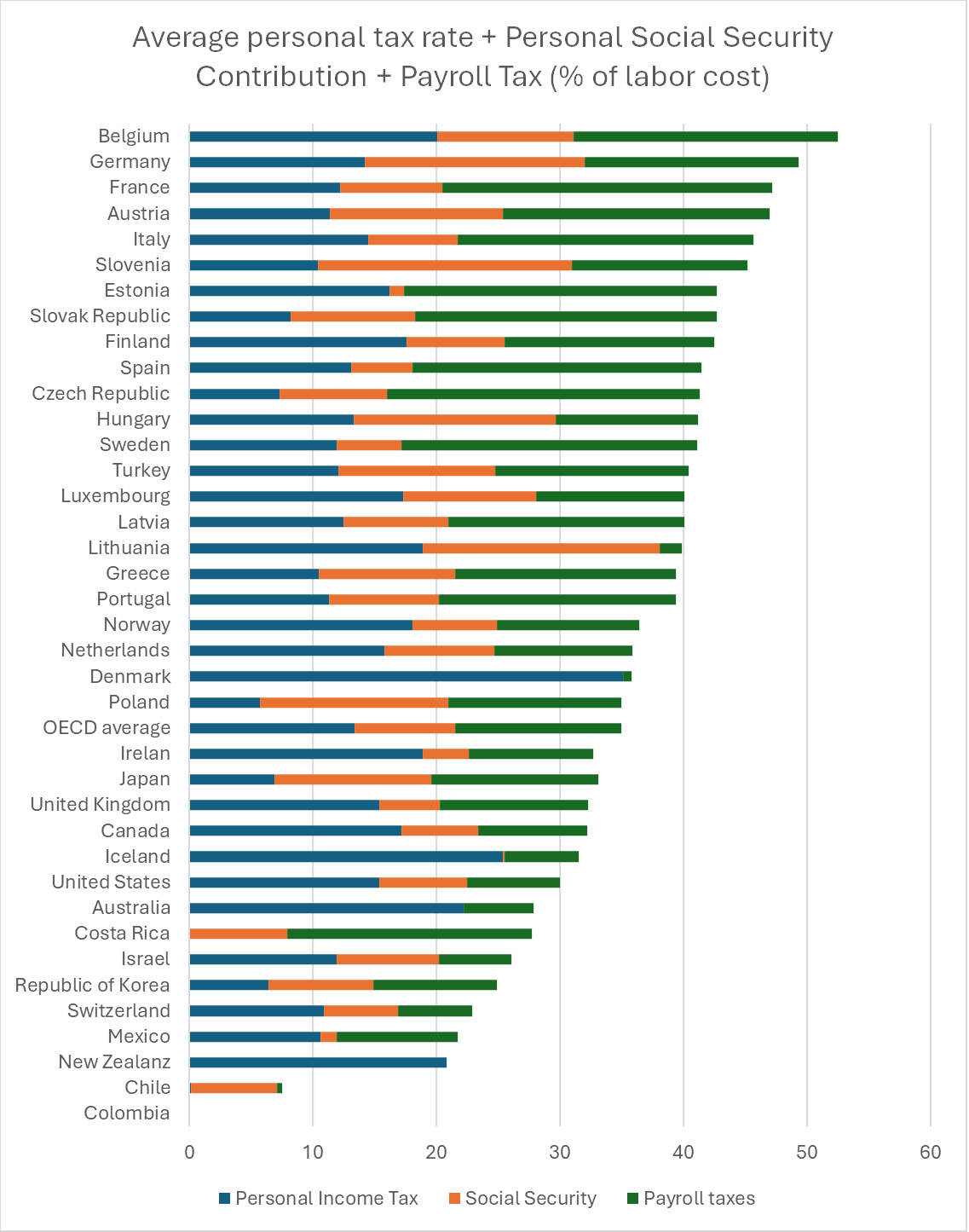
Source: Own elaboration based on OECD data
In the table, you can indeed observe that Spain has above-average payroll tax contributions on behalf of employers, which contribute to pensions and unemployment benefits and are known in Spain as social security contributions. Those parties and outlets who wish to lessen Spain’s already below-average tax-to-GDP ratio have seized on this data point.
Leader of the center-right opposition People’s Party (PP), Alberto Núñez Feijóo, summarised the argument recently: “Spain collects like a Nordic country but can’t have services like a third-world country.” Far-right Vox’s MP José María Figaredo went further, claiming that “the average worker has the state take roughly 50% of their work every year”, a figure constructed by counting employer contributions as wages stolen from the worker. Vox’s parliamentary spokesperson at the time, Iván Espinosa de los Monteros, drew a similar conclusion: the way to “raise wages” isn’t to increase the minimum wage, but to cut contributions and taxes. The cause behind low wages is supposedly well-known and easy to cure. But both the diagnosis and the cure might be mistaken.
According to Eurostat, Spain’s total tax take, taxes and contributions combined, represented 37.3% of GDP in 2023, below the EU average of 40.4%. France sits at 46.1%, Belgium at 44.8%, Austria at 43.1%, Italy at 42.4%. If Spain is a tax hell, most of Western Europe has been burning at a much higher temperature for decades.
Admittedly, social contributions represent 34.1% of Spain’s total revenue, against an OECD average of 24.8%. But Spanish companies offset that higher contribution burden with a corporate tax whose effective average rate, after deductions, depreciation, and special regimes, sits among the lowest in Western Europe. Social contributions aren’t an additional tax on businesses; they’re compensating for a corporate income tax whose effective rate, at 15.4% in 2023, sits well below the OECD average of 20.2%. Changing the label doesn’t change the bill.
You could argue that even if contributions function as an alternative business tax, cutting them would still create room to raise net wages. This trickle-down argument has permeated public discussions for decades. In Spain, that simple logic only holds up until you look at what actually happened.
In 1997, under José María Aznar’s PP government, the labour reform cut employer contributions by between 40% and 90% for permanent contracts targeting workers under 30 and over 45. Columbia University economist Ferrán Elías analysed the real effect using Social Security administrative data on more than one million workers. His conclusion was that the reduction generated a modest employment effect among workers under 30, a 2.42% increase in hirings, but wages didn’t move. For workers over 45, not even that. The tax cut translated into a transfer to companies, funded by taxpayers.
The academic research group Equalitas, studying the same reform, found that the slight wage improvement observed in that period came from the simultaneous reduction in dismissal costs, not the contribution cut. Their phrasing is direct: “with a weak link between contributions and benefits, payroll taxes are not fully passed on to employees, and employment falls.”
Additionally, the most exhaustive review of the literature for Spain, by Ángel Melguizo in Hacienda Pública Española, reaches the same wall: “results are not robust, ranging from full pass-through to zero pass-through.” The outcome depends on collective bargaining structure. In Spain, sectoral agreements set wage floors for the vast majority of private sector workers regardless of what a company contributes. Hence, the tax saving simply doesn’t reach the worker’s pocket.
Spain’s economy is overly concentrated in tourism, hospitality, and construction, sectors of low productivity and modest pay, with chronically insufficient investment in R&D and a dual labour market that weakens workers’ bargaining power. According to BBVA Research, the gap between productivity and wages, not fiscal pressure, is the central explanation for Spain’s wage stagnation. Cutting contributions doesn’t build a manufacturing industry, generate patents, or improve vocational training. It’s like trying to modernise the country by changing the ministry’s logo.
Furthermore, anti-fiscal rhetoric against left-of-centre administrations cools fast upon reaching office. In Italy, with a fiscal burden of 42.4% of GDP, Giorgia Meloni arrived promising a tax revolution. The headline achievement of her 2026 budget was an income tax cut that returned €408 per year to executives, €123 to office workers, and €23 to manual workers. Less a revolution, more finding a twenty-euro note in an old coat pocket.
The Spanish precedent is more direct. Few prime ministers have captured the gap between rhetoric and reality with such inadvertent honesty as former Spanish Prime Minister Mariano Rajoy, “I said I was going to cut taxes and I am raising them.” His government raised standard VAT from 18% to 21%, the reduced rate from 8% to 10%, and income tax rates by up to seven points, the largest tax increase in Spanish democracy according to the Ministry of Finance itself. Unfortunately, this was part of an austerity drive more concerned with maintaining the creditworthiness of Spanish bonds than with redistributing and reinvesting Spanish wealth.
Undoubtedly, the Spanish tax system is improvable, and Spanish net wages are poor relative to European neighbors. The failure to deflate income tax brackets has had a real negative effect on middle and lower earners, and there are VAT categories worth revising. There’s a serious fiscal conversation to be had. But that’s not what’s currently on air.
If PP or Vox reached government and cut employer contributions, the evidence gives no reason to expect higher wages. The most likely result is a larger public deficit and better margins for Ibex companies that just closed their best year since 1993, up 49% and at historic highs, without any of that pulling wages up with them. Low wages are the product of an economy that hasn’t modernised its productive structure in decades. That’s the debate Spaniards deserve to have.
Editor’s note: Public debates about taxation are often shaped as much by political narratives as by evidence. In this guest article, Nicolas Brennan Hernandez, an economist specialising in international trade and political economy, examines the current debate on wages and taxation in Spain, arguing that tax policy discussions should be grounded in empirical evidence rather than misleading rhetoric. The views expressed are those of the author.
Donate to Tax Justice Network
We rely on donations from people like you who value our research and campaigning to keep our work going. Help us do more work like the work above with a donation.
Since 2009, the Tax Justice Network has published the Financial Secrecy Index. This is a ranking of jurisdictions around the world, based on a thorough assessment of financial transparency and relevant areas of international cooperation. By combining the overall secrecy score with a global scale weight, the ranking reflects the share of global financial secrecy risk that each jurisdiction poses.
The Financial Secrecy Index is now widely used and trusted by organisations across the world, for research, policy analysis, criminal investigations and to carry out geographic risk assessment for anti-money laundering purposes. Those who use, cite and/or recommend the index include multiple UN bodies, the International Monetary Fund, World Bank, OECD, the European Commission, the FBI and the broader ‘Five Eyes’ intelligence alliance, along with a growing number of financial institutions.
A key insight of the Financial Secrecy Index is that the analysis is not binary. It is unhelpful to try to identify a set of jurisdictions that are bad (to be labelled ‘tax havens’, perhaps, or ‘non-cooperative jurisdictions’), while all others are by default deemed to be good. Instead, according to the Tax Justice Network, there is a spectrum of financial secrecy, by which all jurisdictions have a secrecy score substantially higher than zero (which would indicate perfect transparency and cooperation). All jurisdictions can make progress, and reduce the damage they cause worldwide. But some have greater responsibility than others.
The second insight is that the main global threats are not the small islands fringed with palm trees that remain a media trope for thinking about tax havens. When jurisdictions are assessed objectively on the basis of robust, verifiable criteria, it turns out that the greatest global risks by far are attributable to some of the major financial centres.
The United States has ranked first and worst since 2022. In the latest update to the Financial Secrecy Index, that position is only confirmed. With the Trump administration having pushed back against key areas of progress initiated under its predecessor, the US continues to pose the greatest threat to the rest of the world by facilitating crossborder tax abuse and the laundering of the proceeds of corruption and other crime.
Rather than update every component of the Financial Secrecy Index in a single revision every two years, we have recently adopted rolling updates. This allows us to keep the Index relatively fresh, while focusing each update on particular variables. The 2026 update addresses the indicators of so-called ‘golden visas’, by which jurisdictions sell citizenship and/or residency programs with no requirement for a minimum physical presence in the country and exacerbate risks of financial crime; and the transparency of real estate ownership.
The ease with which high-value property can be acquired and transferred makes real estate a prime asset for those seeking to park illicit gains. As such, effective transparency of the beneficial owners is a critical measure to protect the jurisdiction where the property is located, whose markets can become heavily distorted as they are also increasingly home to corrupt funds. This transparency is also important to protect those jurisdictions from which the dirty money funding the acquisition flows.
The real estate ownership transparency assessment in the Financial Secrecy Index is constructed to reflect the general availability of ownership data for immoveable property in each jurisdiction, as well as the ability of foreign companies and other legal vehicles such as trusts to hold local property while keeping the ultimate beneficial owners anonymous. The resulting score ranges from 0 to 100.
Jurisdictions scoring zero, for perfect transparency in this area include Denmark, Slovenia and Luxembourg. The latter might seem surprising, given Luxembourg’s longstanding role in financial secrecy provision more broadly. However, the jurisdiction has shown a greater willingness to address transparency concerns when they affect its own scant area than when they arise in its wider offshore financial sector, which continues to facilitate anonymous ownership of financial assets and income streams.
Most jurisdictions have intermediate scores – from Spain (25), China (40) and Norway (45) at the lower end, to Germany (55), Qatar (70) and the UK (both 80).
The perfect failure, a score of one hundred, is obtained by a small but significant group of countries – significant because they include some of the biggest real estate markets in the world like Canada, Australia, and Mexico.
Alongside the 2026 update of the Financial Secrecy Index, we have constructed a separate Real Estate Secrecy Index, which follows the methodology of the overall Financial Secrecy Index. This combines the secrecy score with a measure of global scale, in a cubic/cubed root formula to balance the components. Here we use the specific secrecy score of the real estate ownership indicator, and combine it with a measure of the market size for commercial real estate in each jurisdiction.
| Country | Commercial real estate market, $bn | Real estate secrecy score (SI06) | RESI value | RESI rank |
| United States | 12440.77 | 100 | 678,425 | 1 |
| Canada | 985.4 | 100 | 291,356 | 2 |
| Australia | 788.2 | 100 | 270,457 | 3 |
| India | 687.75 | 100 | 258,442 | 4 |
| Mexico | 558.86 | 100 | 241,168 | 5 |
| Indonesia | 312.98 | 100 | 198,789 | 6 |
| United Arab Emirates | 235.01 | 100 | 180,682 | 7 |
| United Kingdom | 1533.91 | 80 | 172,884 | 8 |
| Italy | 1025.83 | 80 | 151,187 | 9 |
| Malaysia | 128.86 | 100 | 147,885 | 10 |
| Switzerland | 400.9 | 80 | 110,535 | 11 |
| Saudi Arabia | 536.73 | 70 | 81,614 | 12 |
| Sri Lanka | 19.57 | 100 | 78,901 | 13 |
| Turkiye | 394.72 | 70 | 73,668 | 14 |
| Chile | 112.01 | 80 | 72,262 | 15 |
As the table of the top 15 jurisdictions shows, the worst actor in terms of the global risks posed through real estate secrecy is the same as for overall financial secrecy: the United States.
The other worst-ranked jurisdictions include some with large markets but somewhat better transparency (eg the UK and Italy), and a number with much smaller markets but perfect failure scores for secrecy, such as the United Arab Emirates (UAE). Not shown are the many jurisdictions with much larger markets than the UAE, but much stronger transparency that rank far down the index, including China, France, Germany, Japan and South Korea.
The UK has rescheduled its Illicit Financial Flows summit for December 2026. One component of the summit is intended to address the transparency of real estate ownership, and it is understood that discussions continue with invited jurisdictions. Meanwhile the UK government’s Anti-Corruption Champion (and long-time opponent of financial secrecy), Baroness Margaret Hodge, is working on a broad analysis of ownership transparency that is expected to make key recommendations in the coming months.
The opportunity is clear, to set a new standard and lead a global shift away from secrecy in some of the world’s largest real estate markets. With political commitment, the UK can advance into its summit with policies in place to reach the gold standard of transparency, and credibly encourage a range of participants to do likewise.
Many countries in the global South outperform major OECD countries. The OECD’s 2025 standard on exchange of immoveable property information will commence its first exchange in 2029 but so far has fewer than 30 members. With no loss of time, an obvious alternative would be to support a globally inclusive instrument to be developed as part of the ongoing negotiations on the UN Framework Convention on International Tax Cooperation.
Donate to Tax Justice Network
We rely on donations from people like you who value our research and campaigning to keep our work going. Help us do more work like the work above with a donation.
In a world where we push people crossing seas in small boats back into dangerous open water and build ever higher walls to keep out people who seek a better life, the commodification of citizenship and residency and the selling of golden visas to the richest raises serious moral concerns. The Golden Visas indicator of the Financial Secrecy Index shows that the practice of investment immigration also raises serious financial secrecy concerns.
The ‘Golden Visas’ indicator assesses the financial secrecy risk posed by investment immigration by scoring countries on two separate components: how strict or lax their rules on citizenship and residency are (based on whether they offer golden visa programmes), and the comprehensiveness of their personal income tax regime. Given that the interaction of the two components can trigger additional secrecy risks, countries are also scored on the combination of scores they get on the two components.
So, if a country scores badly on the first component and badly on the second component, it gets additionally penalised in its total score for the indicator. That’s because the risk of an individual pretending to be resident in another country just to underpay personal income tax someplace increases if said country has both weak citizenship and residency rules and weak personal income tax rules.
Golden visa programmes can create significant financial secrecy risks by providing opportunities for money laundering, tax evasion and the circumvention of transparency measures.
Below, we provide more details on the indicator’s components and on the results of our most recent assessment of the 141 jurisdictions covered by the Financial Secrecy Index.
Strict or lax citizenship/residence rules
One of the aspects assessed under the Golden Visas indicator is whether countries have strict or lax citizenship or residency rules based on any available citizenship by investment (CBI) or residency by investment (RBI) programmes. These programmes grant citizenship or residency if the applicant makes a passive investment in the country (eg in purchasing local real estate, shares in local companies, or bank deposits or donations). We consider these rules to be lax and pose risks if they do not require sufficient physical presence.
Citizenship or residence by investment programmes without the requirement of sufficient physical presence are known to provide a range of opportunities to hide assets, mask suspicious high-value transactions or enable the movement of significant sums of illicit funds across the borders. These risks are well documented, including by the OECD and the FATF in their recent publication on ‘Misuse of Citizenship and Residency by Investment’.
Our findings show that the number of jurisdictions assessed as having lax citizenship or residency rules increased from 73 out of 141 jurisdictions in 2021 to 81 jurisdictions in 2026.
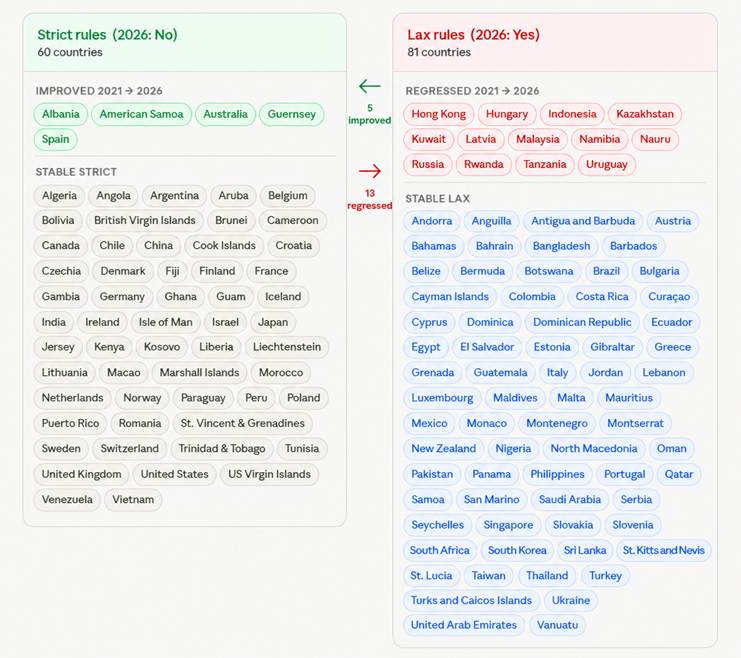
Worryingly, among those countries having regressed into the adoption of lax citizenship/residency rules are a significant number of Global South countries. Countries like Namibia, Nauru and Rwanda have historically stayed clear of polices that score negatively on the Financial Secrecy Index, consistently landing them in the bottom half of the index’s ranking. The regression on citizenship/residency rules is out of character for the countries financial secrecy risk profiles.
Countries often adopted lax citizenship/residency rules under the impression that doing so has the potential to boost domestic resource mobilization through investment migration. It is not disputed that there is money to be made by countries in the sale of golden visas. Citizenship by investment passport sales in Dominica, for example, are reported to have accounted for up to one third of the country’s gross domestic product in recent years. However, as noted by the IMF in a recent study, countries should be wary about expecting similar revenue windfalls based on anecdotal evidence. The authors conclude that for most countries, the likely effects of golden visa programmes may not be beneficial and might be outright harmful. A recent study by the United Nations details how criminal groups in Southeast Asia are increasingly targeting citizenship by investment schemes in the region to circumvent law enforcement.
Comprehensive personal income tax (and the lack thereof)
For a personal income tax to be comprehensive in its scope, it needs to apply the same tax base rules – a rate above zero per cent – equally to all natural persons considered tax residents, including all income from any sources across the world. Any opt-out from the general tax regime in a certain jurisdiction (eg lump sum taxation, tax exemption on foreign-sourced income, territorial tax base or taxes on a remittance basis) results in the jurisdiction being considered by the indicator to not have a comprehensive personal income tax. It can also be the case that the country does not even levy a personal income tax.
The number of jurisdictions without a personal income tax is 17, 15 of which offer golden visa programmes. This combination of components presents a significant problem to automatic exchange of information, as will be explained below.
Avoiding the Common Reporting Standard (CRS) and Crypto Asset Reporting Standard (CARF)
Since the inception of the Common Reporting Standard (CRS) in 2014, the Tax Justice Network has consistently warned that the combination of citizenship and residency by investment regimes and low or no personal income tax in a country creates a specific risk for abusive behaviour, namely Common Reporting Standard avoidance. With the Crypto Asset Reporting Standard (CARF) coming into for this year, this risk of avoidance now also extends to the new standard.
Avoidance of reporting under either standard can take place if the owner of a financial account or crypto wallet in Country A obtains a golden visa in Country B and uses their new passport to record Country B as their country of residence for reporting purposes under the standards. Country B will receive the automatically exchanged information on taxable income and assets. If Country B does not levy income tax on the offshore income and assets, the information is exchanged but not used. At the same time, Country A, the genuine residence country, will be left in the dark regarding its resident’s foreign finances.
The OECD, aware of the abovementioned risk, keeps as of 2018 an updated list with jurisdictions that operated citizenship and residence by investment schemes that can potentially be abused for to avoid reporting under the Common Reporting Standard. Jurisdictions are listed if they give a taxpayer access to a low personal income tax rate of less than 10% on offshore financial assets and do not require significant physical presence of at least 90 days in the jurisdiction offering the citizenship and residence by investment scheme (see OECD FAQ). Based on this methodology, 13 jurisdictions are currently listed.
The Golden Visa indicator casts a different and wider approach to identify jurisdictions that pose a high-risk of Common Reporting Standard avoidance. Under the indicator, high-risk jurisdictions are those that have a citizenship and residence by investment scheme that does not require 183-day physical presence, and have either a complete absence of personal income tax or active choose ‘voluntary secrecy’ under the Common Reporting Standard. As explained in detail in the indicator on automatic exchange of information, voluntary secrecy jurisdictions participate in the Common Reporting Standard but have actively opted out of receiving information from other jurisdictions on their residents’ offshore accounts.
As a result, the indicator identifies a larger and different group of jurisdictions that potentially pose a high risk to the integrity of the Common Reporting Standard than the group of jurisdictions listed by the OECD. This larger group of high-risk jurisdictions consists of the jurisdictions that score a maximum secrecy score on the indicator.
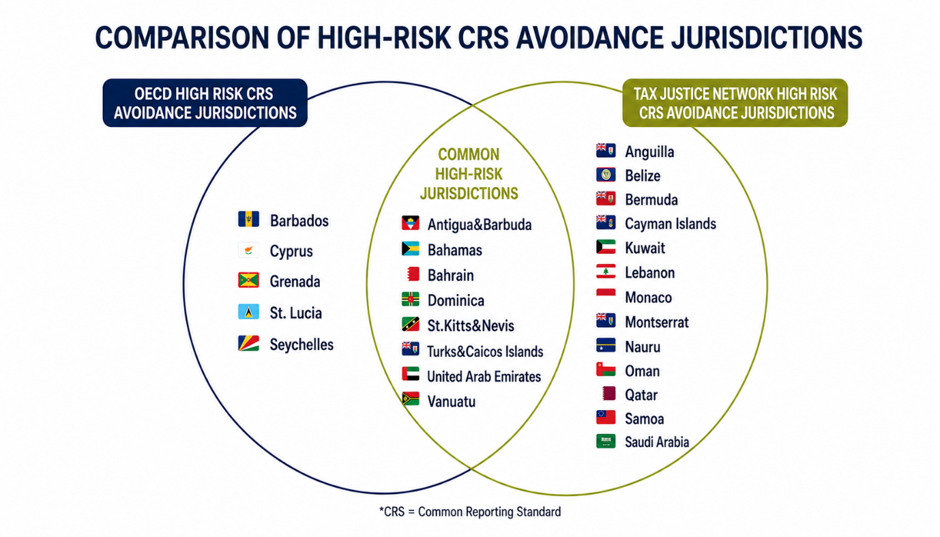
It also means that certain jurisdictions listed by the OECD as high-risk are not considered to be high-risk (or highest-risk) by the Financial Secrecy Index and vice versa. Monaco, for example, is considered a high-risk jurisdiction under our indicator because it has no personal income tax and a golden visa regime that requires only 90 days of presence. These 90 days are sufficient for the OECD to consider Monaco non-risky. The opposite is true for Cyprus. Cyprus has a problematic golden visa regime earning it a high-risk grading by the OECD, but because it has a personal income tax (albeit with important exemptions), the indicator qualifies it as less risky.
In total, we have identified 21 jurisdictions that pose a high-risk for avoiding the Common Reporting Standard. New additions on the list of high-risk citizenship and residence by investment regimes are Kuwait and Nauru. Both countries are exercising voluntary secrecy under the Common Reporting Standard, and have recently jumped on the citizenship by investment (Nauru) and residency by investment (Kuwait) bandwagons.
Conclusion
Investment migration and especially the role played therein by golden visas is a controversial topic, as their issuance does not equate physical relocation of individuals. It usually means applicants obtain a secondary place of residency or citizenship, with the associated risk that the golden visa will be abused for nefarious purposes, like money laundering and tax evasion.
The new data under the indicator reveals two things. First, the number of jurisdictions with ‘lax’ citizenship/residency rules remains high. A number of countries have abolished their questionable citizenship and residence by investment regimes, whereas a slightly bigger number have introduced new ones. Another worrying trend is that these newcomers include Global South countries not generally known to be financial secrecy hotspots. Domestic resource mobilization through citizenship and residence by investment is not a good idea, however.
Meanwhile, countries have also not been addressed gaps in their personal income tax systems over the past five years. There is no significant change in the number of countries whose personal income tax systems are not comprehensive or who do no tax income altogether.
Second, the total of countries with lax citizenship/residency rules combined with the absence of personal income tax or the choice for voluntary secrecy under the Common Reporting Standard also remains high at 21 jurisdictions. The indicator shows that the financial secrecy risk caused by citizenship and residence by investment is of a wider scale than that estimated by the OECD and remains as problematic as ever. For money launderers and tax evaders, the buying of a golden visa remains one of the main ways to obtain financial secrecy.
We therefore advise: visa-selling countries beware (and reconsider)!
Donate to Tax Justice Network
We rely on donations from people like you who value our research and campaigning to keep our work going. Help us do more work like the work above with a donation.
There is weaponisation of privacy, and then there are cases that take it a step further. One thing is to close “public” access to information, as the infamous ruling of the European Court of Justice did to beneficial ownership information in 2022. But restricting routine access to information by tax authorities is another matter entirely. The European Court of Justice also did this in 2024, when it prevented Luxembourg tax authorities from accessing information held by a law firm to respond to a request from Spain. In that case at least, legal professional privilege (a sharp double-edged sword against privacy) was also at play. Now, the European Court of Human Rights (ECHR) has taken a similar approach. In the ruling Ferrieri and Bonassisa v. Italy of May 2026, it prevented Italian tax authorities from accessing local banking data on Italian taxpayers because it breached the right to privacy.
Again, the tax authority didn’t want to access medical records, WhatsApp messages or personal photos. Italian tax authorities only sought information from banks including bank account details, transaction histories, and details of other financial operations.
Importantly, the ECHR ruling also notes that, based on domestic regulations, these access powers are not a blank check, but based on objective criteria, mainly upon any indication of tax evasion or high-risk transactions:
“the Tax Authority established criteria for selecting taxpayers and investigation methods in relation to checks on income tax and value-added tax. In respect of the criteria for carrying out tax audits of banking data, the relevant part of the circular read as follows:
‘Tax audits of banking data will, in particular, be carried out in respect of
- total or near-total tax evaders;
- persons with no accounting records or with accounting records that are obviously unreliable;
- persons carrying out import-export transactions;
- persons who have issued and/or used invoices for non-existent transactions; [and]
- persons whose financial capacity is clearly in stark contrast to the[ir] declared income.”
The ruling also described that Italian regulations require requests to be substantiated before tax directors can authorise them, and that these directors must check that those conditions are met:
“Circular no. 131/1994 further stated that tax offices asking for authorisation to carry out tax audits of banking data “[had to] sufficiently substantiate requests for authorisation to the regional directorates, in order to provide them with useful elements of evaluation”. In particular, a request had to indicate the following elements:
“- the data aimed at identifying the taxpayer;
- the reasons for undertaking the inquiry;
- the elements aimed at assessing the fiscal situation of the taxpayer;
- the reasons for considering that a tax audit of banking data would be useful in respect of the tax inquiry;
- the time period in respect of which the tax audit of banking data should be carried out;
- the banks … to which the request should be submitted …;”
Circular no. 131/1994 clarified that, on the basis of that information, the regional directorates had to check the formal and substantial legality (controllo sia di legittimità che di merito) of the request before issuing the requested authorisation.
The ruling’s description of Italian circulars also suggests that Italian tax authorities do not seem too eager to access banking data, because doing so involves more time and resources to finish the audit. For that reason, directors should only authorise such requests where the likely benefits justify the costs:
As regards a decision to carry out a tax audit of banking data, the circular further stated that the domestic authorities had to undertake a cost‑benefit analysis:
“It must be stressed that tax audits of banking data should be initiated in cases [where] the fruitfulness of the tax audit [in question] has been assessed. So, on the basis of common experience, the ‘costs’ of the tax audit (represented by the inevitable extension of the inquiry in terms of time and the complexity of the analysis of the accounts) must be weighed against the relative ‘benefits’ of an evidential nature, relating to the presumed size of the recoverable taxable amounts. The principle of economy of action (in terms of cost-benefit) must, moreover, strongly guide all the tax audit activity of the offices.”
And again:
“With specific regard to … financial investigations, it is reiterated that [they] must be used only after carefully assessing the risk of significant discrepancies in [a] tax declaration (significative anomalie dichiarative), and ideally only when the tax office has already instituted a tax inquiry.”
Taken together, these provisions suggest that Italian tax authorities are not particularly inclined to obtain banking information unless it offers substantive benefits compared to the costs involved.
However, the ruling focused on another issue. The ECHR ruling cited an Italian court decision suggesting that the final authorisation (likely from a director of a tax office) to request information from a bank did not need to be reasoned. In the court’s view, this gave the authorities unfettered discretion and made the measure incompatible with the right to privacy:
27. In judgment no. 8849 of 30 April 2015, the Court of Cassation observed that authorisation did not have to contain reasons, as no such requirement had been imposed under the applicable domestic provisions. The court held that such authorisation was merely an internal administrative act which could not be challenged by the bank that had been asked to provide the information, and the taxpayer concerned did not have to be notified of it. Since the authorisation could not be challenged, in the Court of Cassation’s view, it did not need to include any kind of reasoning.
…
81. The Court is prepared to accept that the clear and detailed criteria laid down in the circulars adopted and published by the Tax Authority [mentioned in the quotes above] might be sufficient to complement the applicable domestic provisions and delimit the scope of discretion conferred on the domestic authorities, provided that they are binding on the authorities.
However, this does not appear to be the case. In particular, the Court cannot but note that in the light of the Court of Cassation’s case‑law, authorisation does not have to contain reasoning (see paragraph 27 above). It follows that the authorities are not required to justify the exercise of their powers by giving reasons for their decisions and thereby showing that they are following the criteria laid down in the relevant domestic provisions, including the administrative circulars, resulting in them exercising unfettered discretion (see Bernh Larsen Holding AS and Others, cited above, § 130).
82. In the light of the above, the Court considers that the legal basis for the contested measures was incapable of sufficiently delimiting the scope of discretion conferred on the domestic authorities, and accordingly did not meet the “quality-of-law” requirement under Article 8 of the Convention.” (emphasis added).
Let’s recap. Tax authorities in all cases struggle to detect tax evasion. Tax evasion is not a binary issue. It’s not like mining for gold and you either find something yellow and shiny or you don’t. Tax evasion is determined after looking at what the taxpayer declared, the risk of transactions, and many other factors. Even then, it can only be confirmed after getting access to additional documentation (e.g. banking data) to verify the taxpayer’s declarations.
Even then, Italian tax authorities do not seem too eager about banking data. In addition to taxpayer rights’ concerns, Italian tax authorities’ circulars suggest that accessing banking information is mostly discouraged in the tax administrations’ own interest. It should not be done on a routine basis but only after a cost-benefit analysis because of the extra resources and time it will demand. For this reason, the tax auditor should provide reasons why access to banking data is necessary before the tax office director will authorise it. Once the director authorises it, however, the authorisation does not add to or explain the reasoning behind the request when asking the bank to provide the information (luckily, as the bank then tells its clients, as in this ruling). So, because this final authorisation does not require reasoning or justification, the ECHR found it to be discretionary and thus lacking a sufficient legal basis to justify interference with the right to privacy enshrined in Article 8 of the Convention for the Protection of Human Rights and Fundamental Freedoms.
We could be more sympathetic to the case if the tax authorities seemed to be exceeding their need for data, or going after political opponents or vulnerable populations. However, based on the limited information available in this case (the ruling also anonymises the full names of the taxpayers), it appears that they are ordinary taxpayers and that the tax authority only sought routine banking information.
While Italian law could perhaps be drafted more effectively, supranational courts need to understand the crippling effect of their rulings, especially at a time when inequality is soaring, tax authorities are being diminished (including in Italy), and tax transparency is being challenged on privacy, data protection and taxpayers’ rights grounds. After the European Court of Justice ruling of 2022, many European countries closed their beneficial ownership registries, including secrecy jurisdictions where the ruling was not even binding. The weaponisation of privacy, whether through court rulings or concerns about the EU’s General Data Protection Regulation (GDPR), can also result in self-censorship. A report by Transparency International described the challenges of investigating grand corruption when it comes to privacy:
“Privacy concerns compound the problem. Across EU member states, enforcement authorities have pointed to data protection rules, particularly the General Data Protection Regulation, as a major obstacle. Unclear or overly strict interpretations have fostered a climate of caution among data providers, who fear heavy fines for non-compliance. This has created a legal paradox: investigators need access to ownership and financial data to substantiate suspicion but cannot access that data until suspicion already exists.” (emphasis added)
In other words, this ruling is a new bump in the road in the fight against tax evasion and illicit financial flows, especially considering that the road is already in poor shape. Although this case dealt with access to information for domestic tax purposes, there have also been lawsuits seeking to stop the exchange of information for tax purposes.
If this weaponisation of privacy or abuse of taxpayers’ rights continues, it may not be long before new lawsuits or rulings begin requiring suspicion of tax evasion or the existence of a tax audit in order to narrow the scope of automatic exchange of information. Currently, automatic exchanges such as the OECD’s Common Reporting Standard and the Crypto-Asset Reporting Framework are useful precisely because they apply to all taxpayers. One could also imagine attempts to narrow access by tax authorities to domestic data based on conditions that apply to exchange of information on request, such as the “foreseeable relevance” requirement.
To address these secrecy risks, a UN Tax Convention may help strengthen tax transparency, particularly on access to and exchange of information, and counter the weaponisation of privacy. Countries in the Global South may also offer useful alternatives to current European approaches to privacy, data protection and tax transparency. For instance, in Argentina the tax authority routinely has access to bank account and credit card information on taxpayers above a relatively low threshold. Better examples need to be identified to counter the weaponisation of privacy in Europe.
Donate to Tax Justice Network
We rely on donations from people like you who value our research and campaigning to keep our work going. Help us do more work like the work above with a donation.
We’re pleased to share this blog from the Tax Justice Network chair Lyla Latif (Pan-African lawyer, academic, and policy strategist) on how domestic work platforms are replicating colonial labour exclusions in digital form. As Lyla writes: “This is not simply an administrative inefficiency. It is a form of structural injustice with fiscal mechanisms.” You can read the original blog here in The Elephant which provides African analysis, opinion and investigation. The image is Lucy Nyangasi, domestic worker, Kenya by Solidarity Center, licensed under CC BY 2.0.
There is a woman who crosses Johannesburg before dawn. She takes two taxis, changes in Bree Street, and arrives at a house in Sandton by seven. She will spend eight hours cleaning floors, scrubbing bathrooms, washing laundry, and caring for children who are not her own. She booked this job through an app on her phone, a platform that promises convenience to homeowners and flexibility to workers. By six that evening, she will be on her way home, exhausted, with R250 deposited into her bank account and nothing else to show for her labour. No Unemployment Insurance Fund contribution. No Compensation for Occupational Injuries and Diseases coverage. No formal tax record that would make her visible to the state as a worker deserving of protection. She is economically active, socially essential, and fiscally invisible.
This is the situation of hundreds of thousands of women working through domestic service platforms across Africa. SweepSouth, the largest such platform in South Africa, has over 1.2 million domestic cleaners registered on its app. The company’s own annual reports document that 92 per cent of these workers are women, the vast majority are Black, and 83 per cent are the sole financial providers for their families, and they are supporting an average of four dependents each. They are, in the language of economics, essential workers. In the language of the fiscal system, they do not exist.
To understand why this matters, one must go further back than the app, further back even than the post-apartheid constitutional settlement. The exclusion of domestic workers from labour and fiscal protection in South Africa was never accidental, it was a design feature of a colonial labour economy that needed Black women’s reproductive and care labour to be cheap, abundant, and invisible. The Natives (Urban Areas) Act of 1923, the Women’s Enfranchisement Act of 1930, and successive pass laws constructed a legal architecture in which Black women moved through cities as necessary to service white domestic life but were denied the civic status that would have made that service legally cognizable as work. They could not vote. They could not own urban property. They were excluded from the Unemployment Insurance Act of 1946 and from the Workmen’s Compensation Act of the same year on precisely the grounds that domestic service was not “real” employment within the meaning of those statutes. These were not neutral administrative decisions. They were the fiscal expression of a racial political economy that required the extraction of labour without the obligations of reciprocity.
The post-apartheid settlement has progressively extended formal protections to domestic workers through the Basic Conditions of Employment Act in 1997, the extension of Unemployment Insurance Fund coverage in 2002, the landmark Constitutional Court ruling in Mahlangu v Minister of Labour in 2021, which finally extended Compensation for Occupational Injuries and Diseases Act coverage to the domestic sector after a decades-long legal battle. Each of these victories was hard won and significant. Yet each has also been partial, operating at the margins of a fiscal and labour architecture that was built around the formal male waged worker as its normative subject. The platform model did not create this problem. It inherited it, systematized it, and gave it a new interface.
The promise of platform work was supposed to be different. The app would bring work to your fingertips. No more walking from house to house looking for “piece jobs”. No more uncertainty about whether you would earn anything today. The algorithm would match you with clients, the platform would handle payment, and everything would be documented, transparent, modern. Yet what has actually happened is something more troubling: the formalization of informality, the digitization of invisibility. The problem is not that these women are unregistered with the tax authority. Many of them are. The problem is that the entire fiscal architecture of the South African state was built around a model of the formal employee, someone who has an employer who deducts taxes at source, contributes to the Unemployment Insurance Fund, registers the worker with the Compensation Fund, and generates the documentary record of economic participation that makes a person legible to state institutions. The platform model deliberately avoids triggering any of these obligations by classifying workers as “independent contractors” rather than employees.
This classification is a legal fiction that merits examination under any honest application of the common law tests of employment. SweepSouth sets the prices. SweepSouth allocates the bookings. SweepSouth rates the workers and removes those whose ratings fall below the threshold. The platform controls every meaningful dimension of the working relationship, that is, the terms on which labour is offered, the discipline mechanism by which workers are sanctioned, the data through which their performance is assessed. But by calling these workers contractors, the company transforms what would be employer obligations into worker burdens. The woman cleaning the house in Sandton is now responsible for registering herself as a provisional taxpayer, filing biannual returns, and navigating a system designed for accountants and professionals. The results are predictable in that, according to SweepSouth’s own data, 77 per cent of domestic workers surveyed are not registered for Unemployment Insurance Fund. Only 12 per cent fully understand their rights under the Compensation for Occupational Injuries and Diseases Act. When a platform worker is injured cleaning a client’s home, she falls through a gap in the law: she is not an employee of the homeowner, and the platform denies that she is its employee either. The 2021 Mahlangu ruling, which extended the Compensation for Occupational Injuries and Diseases Act coverage to domestic workers, has not reached her.
The discipline of fiscal sociology, which traces the relationship between taxation, state formation, and social legitimacy, has long argued that a tax system encodes the political priorities of the state that designs it. Rudolf Goldscheid, writing in 1917, described the state budget as “the skeleton of the state stripped of all misleading ideologies”. More recently, scholars working in the tradition of feminist political economy, such as Kathleen Lahey and Miranda Stewart, have documented how tax systems systematically undervalue care work and reproduce gender hierarchies through apparently neutral rules. The South African fiscal system is an example of this dynamic in unusually sharp relief: a state that formally committed itself to gender equality and substantive transformation through its constitution continues to operate a tax and social insurance architecture that cannot see the economic contribution of the majority of women who work within its borders, precisely because those women do not work in the forms the system was built to recognize. Platform companies have understood this architecture better than the legislators who are supposed to regulate them, and they have designed their business models accordingly.
What makes this particularly urgent is that the model is replicating across the continent. Kenya has Lynk which operates with the same basic architecture of contractor classification and algorithmic management in the domestic and skilled trades sectors. Nigeria has Eden Life. Egypt has FilKhedma. Each of these platforms interacts with national fiscal systems that were not designed to see informal workers in the first place. These are systems inherited from or shaped by colonial administrations that likewise excluded domestic and care workers from formal fiscal recognition. The colonial and apartheid-era exclusions were constructed through explicit statutory text. The platform-era exclusions are constructed through contractual design and data architecture. The technical form has changed. The structural outcome has not. In each case, the state loses the fiscal data it would need to extend social protection, the worker loses the social protection to which she would otherwise be entitled, and the platform company captures the economic value of the labour without assuming the legal responsibilities of the employer.
The European Union has recognized this structural problem and moved to address it. The EU Platform Work Directive, which came into force in October 2024, establishes a rebuttable presumption of employment for platform workers across member states. This means that platforms like SweepSouth, were they operating in Europe, would be required to demonstrate that their workers are genuinely self-employed rather than placing the burden on exhausted, low-income women to prove that they have employment relationships they often do not fully understand. The Directive is imperfect; it took years of lobbying by platform companies to weaken its enforcement mechanisms, and transposition into member states’ national law will be contested. But it represents a legislative acknowledgement that the contractor classification model is a legal fiction incompatible with social protection obligations, and it places the burden of proof where the informational and legal power actually lies, that is, with the company. African states have no equivalent protection, and it is not sufficient to argue that African economies are “different” or that informality is somehow culturally embedded. Informality in Africa is structurally produced – by colonial labour law, by structural adjustment programmes that dismantled social protection systems in the 1980s and 1990s, and now by platform architectures that exploit the regulatory gaps those earlier transformations created.
Why does this matter beyond the individual hardship it produces? Because taxation is not merely about revenue collection. It is about the social contract between state and citizen, the mechanism through which economic contribution is recognized and social protection is earned. When a woman works for years through a platform, paying for transport, wearing out her body cleaning other people’s homes, and generating nothing that the fiscal state can see, something has fractured in the relationship between economic contribution and social protection. She is sustaining households. She is enabling the productivity of formal-sector workers who would otherwise have to provide their own childcare and domestic labour. She is performing work that the society she lives in cannot function without, and the systems that are supposed to recognize and reward economic contribution have no category for her existence. This is not simply an administrative inefficiency. It is a form of structural injustice with fiscal mechanisms.
The solution is not to extend the reach of existing systems without reconsidering their design premises. Fiscal systems built around the formal male waged worker cannot be made to see care work by simply adding a new registration category. They need to be redesigned on the premise that care work is economically valuable, that informal economic activity is legitimate economic activity, and that fiscal citizenship should not depend on participation in formal employment structures that were never designed to include the majority of those who work. This requires statutory reform in at least three directions: first, a rebuttable presumption of employment for platform workers that mirrors the EU approach but is adapted to African institutional contexts; second, care-adjusted social insurance contribution frameworks that account for the interrupted, part-time, and multi-employer nature of domestic and platform work; and third, algorithmic impact assessments for fiscal and labour systems, so that states can identify and remedy the discriminatory outcomes that digital management systems produce without anyone having consciously intended them. None of this is technically complicated. It is politically contested, because it would require platforms to assume costs they have successfully externalized onto workers and the public purse, and because it would require states to acknowledge that their fiscal architectures have reproduced, in digital form, the exclusions they formally committed themselves to dismantle.
This research forms part of Project TERRA (Technology, Equality, Regulatory Risk Assessment), a programme investigating how algorithmic systems interact with fiscal architectures to produce exclusion across Africa. The project is supported by Luminate and has enabled sustained research into the mechanisms through which digital transformation is reshaping how gender bias and fiscal policy interact across Africa. The woman crossing Johannesburg before dawn is not a marginal case. She represents the majority of those who labour in African economies, and her fiscal invisibility is not an oversight but an outcome, produced by specific legal choices that specific states have made or failed to make. The app did not create her invisibility. But it has perfected it, and the tax system is being asked to see her in a language it was never designed to speak.
Donate to Tax Justice Network
We rely on donations from people like you who value our research and campaigning to keep our work going. Help us do more work like the work above with a donation.
I was often told that ending poverty required economic growth.
Grow the economy. Create more wealth. Raise incomes. And poverty will eventually disappear.
Yet after decades of growth-centred policymaking, poverty remains widespread, inequality continues to rise, and governments around the world struggle to fund the public services people depend on.
What if poverty is not just the result of economies growing too slowly? What if it is also shaped by political choices about who benefits from economic activity, who accumulates wealth, and who is expected to pay for the systems that keep societies functioning?
These are some of the questions explored in the Roadmap for Eradicating Poverty Beyond Growth, launched in April following a three-year collaborative process led by Olivier De Schutter’s team and involving hundreds of participants from civil society organisations, trade unions, research institutions, UN agencies and governments around the world.
The roadmap challenges the idea that economic growth alone can deliver social progress. Instead, it asks what would be needed to build economies centred on human wellbeing, social justice and ecological sustainability.
For the Tax Justice Network, the launch of the roadmap marks the culmination of a process we have been part of since 2024.
Our involvement began when the UN Special Rapporteur on Extreme Poverty and Human Rights launched a call for inputs on eradicating poverty in a post-growth context.
In our 2024 submission, we argued that discussions about poverty cannot be separated from questions of tax abuse, wealth concentration and governments’ ability to raise revenue.
In 2025, we contributed again through a second call for inputs. This time, we focused on what tax justice looks like in a post-growth economy, including the role of corporate taxation and the unequal distribution of taxing rights between countries. We joined hundreds of organisations, researchers and advocates in contributing to the roadmap’s development from different areas of work and expertise.
Over the following year, the roadmap evolved through consultations, exchanges and discussions involving organisations working across a wide range of issues, from labour rights and social protection to climate justice and human rights.
In April, many of those contributors gathered in Geneva for the roadmap’s launch conference to reflect on the process and discuss the next steps.
One thing that stood out throughout the consultation process was how often discussions about poverty led to questions about public revenue.
Participants approached the conversation from very different perspectives – social protection, labour rights, public services, care work, climate action and human rights. Yet many of these discussions returned to a common challenge: how can governments reduce poverty and inequality if they lack the resources needed to invest in people?
For the Tax Justice Network, that question inevitably leads to tax.
Every year, governments lose an estimated US$492 billion to tax abuse by multinational corporations and wealthy individuals. These are resources that could otherwise be invested in healthcare, education, social protection and other measures aimed at reducing poverty and inequality.
Governments are currently negotiating a UN Framework Convention on International Tax Cooperation (UFCITC), which could reshape the global rules that determine where profits are taxed and who gets to tax them.
While the roadmap focuses on poverty eradication and the convention focuses on international tax cooperation, both processes raise related questions about economic governance, inequality and governments’ capacity to act. How can countries secure the revenues needed to fund public services? How can they curb cross-border tax abuse? And how can international rules better reflect the needs and priorities of all countries, particularly those that have historically had less influence over global tax rule-making?
The roadmap will be presented to the Human Rights Council on June 25, 2026. In addition, a series of policy briefs will now explore different aspects of the roadmap in greater depth. One of these, written by the Tax Justice Network and due to be published later this month, focuses on corporate taxation and the role it can play in supporting poverty reduction and more equitable economies.
Together, these briefs will deepen the evidence base underpinning the roadmap by exploring how different policy domains can contribute to a post-growth transition. By linking broad principles with concrete policy measures, they aim to support informed debate and help identify pathways towards more equitable and sustainable economies.
As this work move forward, we also welcome the appointment of Ms Elena Carolina Díaz Galán, as the new Special Rapporteur on Extreme Poverty and Human Rights. We look forward to continuing to support this agenda and helping hold governments and institutions accountable for the delivering the commitments needed to tackle poverty and inequality.
Donate to Tax Justice Network
We rely on donations from people like you who value our research and campaigning to keep our work going. Help us do more work like the work above with a donation.
Picture the scene. It’s August in New York and international negotiators are meeting to continue moves to ensure that multinational companies are finally required to pay taxes according to where their real economic activity takes place.
Only one country is missing from around the table – the United States. Despite physically hosting the discussion, the Trump administration refuses to participate in the talks that will define the UN Framework Convention on International Tax Cooperation.
This is part of a pattern. After coming to power in 2025, the administration upended everything that had been negotiated at the OECD since 2019. First they vetoed ‘pillar one’ of the agreement, and then they demanded an exemption from most of ‘pillar two’ – which was largely designed by the US to begin with. Now the negotiations have moved to the UN, and the US is being left behind.
When combined with the deeply damaging Tax Cuts and Jobs Act passed by the first Trump administration, the result is that US multinationals are now shifting twice as much profit out of the countries where they do business.
But don’t imagine that the US is benefiting. On the contrary, those multinationals are paying even less tax to the US than they did before. Don’t think that foreign multinationals are lining up to pay tax either – when in Rome, after all. Nor has the US gained any jobs from giving away the farm – so pretty much everyone is a loser.
That includes US states, who typically base their state-level corporate income tax on whatever the US administration accepts at federal level, adjusted for the state’s share of the multinational’s real (US) economic activity. So as the second Trump administration again lets multinationals, US and foreign, walk all over their tax obligations, that laxness deprives the states of revenue too.
And this is where California is stepping up.
The US states, just like the provinces of Canada and the cantons of Switzerland, among others, use a taxing method known as formulary apportionment to determine their corporate taxes. A multinational’s total profits are added together and then distributed to states according to the share of its economic activity taking place there. Each state is then allowed to tax the share of profits that fits its share of the multinational’s employees, assets, or sales. For instance, if half of the employees and half of the sales are happening in California, California would be allowed to tax half of the profits.
The key point is to make sure that companies pay where they play – rather than making their profits in one place, but declaring them somewhere else for tax purposes.
The reason to rely on this formulary apportionment method is that the basis of international corporate tax rules – the arm’s length principle – is unfit for purpose. This approach allows multinational groups to set ‘transfer prices’ for the exchange of goods and services between sister companies, as if they were operating independently (at arm’s length from one another). Inevitably, multinationals succumb to the temptation to manipulate these transfer prices in order to shift the group’s profit into entities in other jurisdictions where they will pay little or no tax. This allows companies to pay where they say the profits are, instead of where they actually arise.
The growing importance of intangible assets such as corporate brands and intellectual property, and the more recent phenomenon of digitalisation, has made it increasingly difficult for tax authorities to challenge abusive transfer prices. The result is that the scale of profit ‘misalignment’ – the share of multinationals’ profits that are declared where they say, instead of where they play – has rocketed. Back in the early 1990s, around only 5% of the global profits of US multinationals were misaligned in this way. That doubled within the decade and continued to rise ever since, reaching 20% by the 2010s and an average of 24% for 2016-2021 – supercharged by the Tax Cuts and (No) Jobs Act.
The current Trump administration’s recent changes, and undermining of even the limited OECD reforms, have further exacerbated the problem. Major US tech companies now pay tax at effective rates that are barely into double digits. Pharma companies and others channel vast profits through Switzerland, Ireland, Puerto Rico and Singapore.
That’s why the countries of the world, with the exception of the refusenik Trump administration, are now negotiating on a UN tax convention that would commit to allow all states to exert taxing rights over economic activity in their jurisdiction. This lays the base for the subsequent Conferences of the Parties to agree a formulary apportionment approach – an approach that may already be embedded in the protocol for taxing crossborder services which is being negotiated alongside the convention.
The state of California is now pioneering the approach in the US. At present, and like a number of US states, California offers companies an election: for the apportionment of tax base that underpins their state tax liability, they can either be assessed on their declared US profit, or they can elect to be assessed on the appropriate share of their global profit. To the extent that the US share of profits has historically been less than its share of economic activity, it has almost always been cheaper for multinationals to pay state tax on the basis of their US profits – and so they elect for ‘water’s edge’ option, where the assessment stops at the US border.
California’s proposed legislation, AB 1790, would end this election and require companies to be assessed on the unitary basis – according, that is, to the global profits of the whole group, rather than the claimed US profits only. This would mandate ‘Worldwide Combined Reporting’ (WWCR). That is, companies would have to report the global activity and profits of their group.
If the legislation passes, California will cut through the abuses of the arm’s length principle and simply tax multinationals according to California’s fair share of each group’s global economic activity. This will not only point the way for other US states to follow, but also aligns with the direction of travel for negotiators at the UN: away from the obsolete arm’s length principle, and towards a system of taxing rights based on the location of real economic activity.
As this new future of corporate taxation comes ever more closely into view, California’s policymakers are weighing up their opportunity to end the loophole of the water’s edge election and mount a powerful defence of their tax base.
Thinking of the questions that policymakers might have, we’ve put together a Q&A based on close engagement with expert allies. The full text is below, or you can download a pdf.
Q1. How do multinational companies use profit shifting to avoid US state taxes?
In US states, a corporation’s income tax base essentially begins with its federal tax base. That means that the offshore profit shifting that drains the federal tax base drains the state tax base as well. Profit shifting schemes take different forms, many incredibly complex and intentionally opaque. Often, they are engineered by creating paper transactions among artificially manipulated legal entities, typically in the types of jurisdictions that top our Corporate Tax Haven Index – while the real economic activity that produced those profits never moves at all.
Q2. Do traditional anti-abuse rules eliminate state tax avoidance?
No. Traditional anti-abuse rules still rest on the legal fiction that the prices for internal transactions in a multinational group, including of subsidiaries transacting with their controlling parent, can be set as if they were independent equals operating at ‘arm’s length’ from each other in a free market. This absurdity allows multinationals great leeway in practice to manipulate these transfer prices in order to make sure the profit from economic activity in one place, is declared in a much lower-tax jurisdiction elsewhere.
Q3. How does WWCR end multinational state tax avoidance?
Worldwide Combined Reporting (WWCR) ends multinationals’ state tax avoidance by taxing them based on economic reality instead of on embarrassing fictions. When a commonly controlled group of affiliates are functionally integrated and mutually interdependent, as virtually all multinationals are, then WWCR treats them all as a single taxpayer. It requires complete reporting of the entire group’s profits, everywhere. Then, to determine what portion of those profits the state may fairly tax, it uses a standard “apportionment formula” (for example, the group’s in-state share of its worldwide sales and employment).
Under WWCR, the entire group’s worldwide profits are in the tax base, so shifting profits around the group achieves nothing. And corporate state-tax avoidance disappears.
Q4. Does WWCR have any impact on corporate location decisions?
Under WWCR, corporate relocation threats are hollow. The cost and disruption of relocating significant operations out of state can be enormous. Such decisions are based not on marginal increases in tax costs but on access to infrastructure, resources, trained workers, and customers. And, in the majority of states that apportion taxable profits by sales alone, relocation would not avoid a single dollar of tax.
Furthermore, no executive could credibly justify, to shareholders, the decision to abandon a profitable market over the end of an unfair tax advantage. If anything, WWCR improves the business climate: it levels the playing field for local small and medium-sized businesses that do not have shell companies in offshore tax havens. And this is crucial: by ending the unfair tax advantage that multinationals have over the smaller, local businesses that typically provide the bulk of employment and economic dynamism, WWCR is a fundamentally pro-business measure.
Q5. Why will corporate owners, not customers, be impacted by WWCR?
WWCR’s economic incidence falls on those who actually pocket the profits — shareholders and senior executives — not consumers. The multinationals that will pay more under WWCR are not businesses competing on thin margins; they are the giants whose profits flow from market dominance, valuable intangibles, pricing power… and tax avoidance. Economic research consistently finds that this windfall — what economists call “supernormal profits” or “excess rents” — accrues to corporate owners, not customers. In fact, some research shows that where multinationals have engineered lower effective tax rates, even shareholders do not gain – they appear to receive no higher return, but they do end up taking on greater risk because the shares of aggressive tax-avoiders become more volatile. Customers never share the upside when these corporations book outsized profits. They will not bear the downside when WWCR captures part of those profits as state tax.
Q6. What ensures that WWCR taxes only those profits attributable to each state?
Two long-established principles ensure that each state taxes only its fair share. The “unitary business principle” treats an integrated and interdependent multinational corporate group as the single enterprise that it is in the eyes of management and financial regulators. “Formulary apportionment” then calculates the state’s fair share by an objective formula — for example, its share of the group’s worldwide sales, employment, etc. Picture the group’s worldwide profits as a pie: if 2 per cent of the group’s worldwide sales are to in-state customers, and 2 per cent of the group’s employees work there, the state’s slice is 2 per cent of the pie. That slice reflects in-state economic activity, not foreign profits. There is no double taxation.
The US Supreme Court has confirmed that WWCR, operating this way, does not tax “extraterritorial values.” And that makes sense, because if every state and every country took this same approach, the tax base would be precisely defined and apportioned among the different jurisdictions. No profits would be taxed in two different places; and no profits would be left entirely untaxed.
Q7. Is the legality of WWCR firmly settled?
Yes — and twice over. The US Supreme Court has upheld WWCR in Container Corp. v. Franchise Tax Board (1983), as applied to a US-based multinational, and again a decade later in Barclays Bank PLC v. Franchise Tax Board (1994), as applied to foreign-parent multinationals. Both decisions rest on principles of state taxing power and federalism that have remained stable across changes in the Court’s composition.
Q8. Is WWCR consistent with current global aims to stop tax avoidance?
Fully consistent. Article 5 of the draft United Nations Framework Convention on International Tax Cooperation being negotiated today shares the goals of WWCR, indicating that each countries’ taxing rights should be tied to the economic activity that they host. Also, for more than a decade, foreign governments have worked with the OECD on the Base Erosion and Profit Shifting (BEPS) initiative and its successor framework, Pillar One and Pillar Two. Both efforts expressly recognize the serious harm aggressive corporate profit shifting causes to public revenues worldwide.
The multilateral convention to implement Pillar One has been vetoed for now by the Trump administration, but the US was a party to the agreement and the process by which Pillar One developed the technical basis to apply unitary taxation for the first time within OECD rules. Pillar Two was intended to apply a minimum rate of tax on the profits of multinationals, in whichever country they were declared. The Trump administration has also undermined this by insisting on exemptions from key elements for US multinationals – freeing them of any constraint on profit shifting. Nonetheless, the expressed intentions to ensure multinationals pay fair tax rates, and are taxed in the places where they carry out their economic activities, are well established. No foreign government can credibly retaliate against a US state for adopting a policy aligned with the international consensus that government itself helped build.
Q9. Do powerful global corporations have the resources to comply with WWCR?
Yes — abundantly. Under the WWCR Model Statute, only corporate groups with $1 billion or more in annual revenues are required to use WWCR. These huge multinational corporations already maintain comprehensive worldwide financial data for consolidated reporting under securities laws, federal corporate minimum-tax obligations, and a growing set of international transparency standards. They already devote enormous resources to designing the complex schemes by which they shift profits in the first place; the additional work to comply with WWCR is modest by comparison.
Q10. Will revenue department enforcement of WWCR ultimately be easier?
Yes — after a reasonable start-up period. WWCR replaces the never-ending chase to identify and untangle complex profit shifting schemes with a combined report and an objective apportionment formula. There is one corporate group, one set of worldwide books, and no transfer-pricing dispute to relitigate year after year. State revenue departments can build the necessary expertise within a normal lead-in period — typically a year — by training auditors, hiring international-tax specialists, and updating systems. The expertise is widespread: Alaska has mandated WWCR for oil-and-gas corporations for decades, and a number of other states already audit elective WWCR filings with success.
Q11. How is WWCR’s modern revival grounded in history?
Solidly. By the early 1980s, twelve US states had adopted mandatory WWCR and successfully defended it in the US Supreme Court. This closed the profit shifting loophole for large multinational tax avoiders, who reacted by pressuring the UK’s Thatcher administration to press the Reagan administration to demand that the states retreat. WWCR was abandoned not because it failed, but because Washington forced the states’ hand.
No such pressure campaign could work today, when the problem of profit shifting by aggressive global corporations is widely understood and condemned – including by the UK public. States revisiting WWCR are returning to a tested, court-affirmed framework on far stronger ground than four decades ago.
Q12. Why is California the heart of WWCR’s revival?
California is the birthplace of Worldwide Combined Reporting. The unitary business principle on which WWCR rests was forged largely in the state’s tax cases before the US Supreme Court. In the early 1980s, California became the first state to mandate WWCR. Four decades later, in 2026, the state again leads: a bill based on the widely respected WWCR Model Statute passed favourably out of the Assembly Revenue and Taxation Committee — the first WWCR bill to clear any California legislative committee in more than 40 years, and a development closely watched in other state capitols. With the global momentum to ensure taxing countries’ rights are aligned with their share of multinationals’ economic activity, California is set to lead nationally on an issue where the US administration has simply vacated its role.
Donate to Tax Justice Network
We rely on donations from people like you who value our research and campaigning to keep our work going. Help us do more work like the work above with a donation.
The Tax Justice Network has banged the drum about the threats posed by trusts for decades. On 21 May 2026, the European Court of Justice has finally joined us. They have published rulings that directly relate to trusts regarding two major risks: secrecy and asset protection. As we set out below, these represent a significant step against the widespread abuse of trusts, and we urge authorities across the European Union to take action now.
In the first case, the European Court of Justice simply confirmed that access to information on a trust’s beneficial owners based on a ‘legitimate interest’ is good enough. This is by no means radical, and it does not “undo” the disaster of the infamous European Court of Justice ruling of 2022 which invalidated public access to beneficial ownership information by upholding the weaponisation of privacy. Since then, many more EU countries have closed their public registries and others (e.g. British secrecy jurisdictions) have abolished plans to go in that direction.
Recognising access to trusts’ beneficial owners based on a legitimate interest was already contemplated in the EU anti-money laundering directive of 2018 (known as AMLD 5). It was then developed further under EU AML Package of 2024. The unfortunate European Court of Justice ruling of 2022 also admitted this access to beneficial owners of legal persons based on having a legitimate interest. In 2026, the European Court of Justice simply confirms that it also applies to trusts. As reported by the press release:
“laying down public access to beneficial ownership information, provided there is a legitimate interest, is compatible with the rights guaranteed in Articles 7 and 8 of the Charter of Fundamental Rights of the European Union. According to the Court, by that legislation, the EU legislature is pursuing a legitimate and important objective, namely, the prevention of money laundering and terrorist financing through increased transparency, in accordance with the principle of proportionality.”
What is much more relevant, however, is the blow to trusts for asset protection and sanction circumvention. These cases referred to sanctioned individuals trying to escape sanctions by putting assets into discretionary trusts and being removed as protectors or beneficiaries.
The Tax Justice Network has been warning of the risks of asset protection through the “ownerless limbo” created by trusts, whereby settlors and beneficiaries claim not to own or control the assets, but are still able to enjoy them and regain access to them, when the “coast is clear” from tax authorities, sanctions or creditors.
Now, the European Court of Justice agrees with us with some remarkable understanding of how flexible and sneaky trusts can be. As described by the European Court of Justice press release:
This means that assets can be regarded as belonging to or being under the control of the settlor or the beneficiary of a trust, where those persons have power to use, benefit from or dispose of those resources or to have influence over them and over the decisions made by the trustee in relation to them…
In that regard, indications that assets belong to or are controlled by the beneficiary or the settlor may be inferred from factual circumstances3 or from the presence of needlessly complex legal structures.4
3 The relevant factual circumstances concern the relationships between the beneficiary or settlor and the other persons involved in the trust, and the allocation of the economic resources in the trust to activities intended primarily, even if indirectly, for the beneficiary or the settlor.
4 Such indications include the fact that the beneficiary or settlor holds a majority of the capital of or voting rights in the trustee; the fact that certain entities are set up or change their identity shortly before sanctions come into force; and the relationships between the director of the companies subject to freezing measures and the beneficiary or settlor.
The European Court of Justice ruling quotes remarks from the Italian court (that referred the case to the European Court of Justice) which offers even juicier understanding of the shenanigans created by trusts.
First, if a person really wanted to completely transfer an asset, they would donate it to someone else. If instead they put it into a trust, then they want to keep some control over it. This is especially true, even if the trustee is fully independent (aka not the settlor or its spouse or brother), as the trustee would have the settlor’s interests in mind:
“This contribution [to a trust] would not have the effect of definitively severing the link of ‘ownership’ between the assets contributed to the trust and the settlor, who would objectively be able to exercise substantial influence over them. Such influence would stem from the possibility of recovering formal ownership of those assets in the event of early termination of the trust or refusal by the beneficiaries to accept the transfer of those assets, as well as from the fact that, by establishing the trust and entrusting its management and control to persons in whom the settlor has confidence and whom the settlor has chosen, the settlor would be able to guide in advance its use and final destination…
take into account the relationship between the settlor, on the one hand, and the other persons involved in the trust, such as the trustee or the protector, on the other hand, and determine, in particular, whether the settlor has appointed, in the role of trustee or protector, persons of trust, linked by professional or personal ties to the settlor, who are likely to follow the instructions or suggestions of the settlor regarding the administration of the trust and its assets.”
Second, the Italian court proposes the same rule that we proposed back in 2017. Whenever taxes, unpaid debts or sanctions are concerned, assets put in a trust should be considered belonging to the settlor (because they are otherwise in an ownerless limbo), until they are effectively distributed to third-party beneficiaries:
“a trust, at least until the assets contributed to it are definitively allocated to third parties, would constitute an easily usable mechanism for circumventing the measures for freezing funds and economic resources provided for by Union law”
Third, because trusts are usually not registered, let alone published, trust documents can be amended or backdated, so it makes little sense to give too much value to the current text of a trust deed. More importantly, this same flexibility can be abused to undermine the law:
“in determining whether the settlor “controls” the assets contributed to the trust, it would be irrelevant that, under the trust deed, during the period of validity of the trust, for ordinary or extraordinary reasons, the persons responsible for administering the trust, in particular the trustee or the protector, may change, since the persons who may eventually be called upon to replace them will act under the rules established by the settlor in the trust deed…
This dissociation, as well as other characteristics of the trust, namely the private nature of this mechanism, the ease and flexibility of its creation and modification, which can lead to the opacity and structural complexity of such a mechanism, allows its use not only for legitimate purposes, but also to conceal the link that the settlor maintains with the funds and economic resources contributed to the trust…
Indeed, since the trust deed and its amendments are not subject to the obligation of publicity, identifying the true nature of the legal relationship covered by this mechanism on the basis of this deed can prove difficult, since the versions in force of this deed and its amendments may not be made available and are, in any case, liable to be modified.”
Fourth, courts and authorities should look beyond the nominee or trustee appearing as the registered owner, but instead check who is really in control:
“the notion of ‘ownership’ must be interpreted as covering not only situations in which such power over the funds and economic resources concerned can be legally attested, but also situations in which a person or entity actually possesses this power, despite the fact that, legally, the holder of said power is another person or entity.”
Fifth, just as courts in India considered the circumstances of using trusts and secrecy jurisdictions like the Cayman Islands, courts should always consider the governing law of the trust, in this case of Bermuda:
“the trust at issue in the main proceedings is constituted and governed by the law of Bermuda… take into account the prerogatives conferred by that law on the settlor, such as the power to revoke all or part of the trust, the power to give binding instructions to the trustee concerning the purchase, holding, sale or other commercial or investment transactions relating to trust property, or concerning any investment or reinvestment of such property, as well as for the purposes of exercising any power or right arising from such property, the ability to appoint, add, remove or replace any trustee or protector of the trust, the ability to add, remove or exclude a beneficiary or a class of beneficiaries, and the ability to decide to be a joint beneficiary of the trust.
These prerogatives could indicate that the settlor has influence over the funds and economic resources contributed to the trust or over the choices made by the trustee with regard to these funds and economic resources, whether these prerogatives are explicitly provided for or not in the trust deed or its amendments.”
In conclusion, the European Court of Justice is finally agreeing with what we have been saying for years. Rather than just being “private family matters”, trusts can have a crucial role and be abused to engage in money laundering, sanction circumvention and many other illicit financial flows. While trust transparency is still limited to those with a ‘legitimate interest’, at least the flexibility, ownerless limbo and asset protection features of trusts are at last being challenged to ensure that individuals cannot simply escape the law by hiding and confusing their control over assets through the use of trusts.
We welcome the European Court of Justice rulings, and urge tax authorities and law enforcement to ensure this approach is now rapidly turned into practical action to combat the many abuses.
Donate to Tax Justice Network
We rely on donations from people like you who value our research and campaigning to keep our work going. Help us do more work like the work above with a donation.
From July 2027, obliged entities will be required to take financial secrecy risks into account in geographic risk assessments under the European Union’s anti-money laundering rules. This marks a significant development: a long-standing insight that secrecy is not incidental but central to economic crime is finally being translated into regulatory practice. The way risk is defined shapes where scrutiny is directed, which financial flows are prioritised, and ultimately whether illicit activity is detected or missed.
The data reflects this clearly. Jurisdictions with higher levels of financial secrecy consistently present greater opportunities for illicit financial flows to be concealed, particularly where large transaction volumes intersect with weak transparency requirements.
For years, the role of financial secrecy has been widely acknowledged but unevenly addressed. It has appeared across guidance and research, yet rarely as a structured and measurable component of risk assessment. By requiring institutions to account for it explicitly, the EU’s new framework begins to close that gap and to align regulatory expectations more closely with how illicit financial flows actually operate.
At its core, financial secrecy is embedded in legal and regulatory systems that determine whether financial activity can be traced, scrutinised or concealed. Weak beneficial ownership transparency, barriers to information exchange, and gaps in oversight do not simply increase risk at the margins; they shape the environments in which illicit financial activity becomes possible.
Where financial secrecy persists, it enables tax abuse, corruption and the concealment of wealth at the expense of public revenues and accountability.
Anti-money laundering frameworks have long relied on country classifications to organise and prioritise risk, most notably through “high-risk” and “low-risk” lists and politically shaped ‘blacklists’. The term “blacklist” itself reflects a problematic and racialised framing, which sits uncomfortably with its disproportionate application to countries in the Global South. These approaches have provided a degree of operational clarity, but they have also tended to compress complex realities into rigid categories. In practice, this has meant that risk is often treated as a binary condition — something a jurisdiction either is or is not — rather than something that varies in degree and is shaped by underlying legal and institutional features.
The effect is not only simplification, but distortion. When risk is reduced to categories, it becomes easier to overlook how similar conditions can produce similar vulnerabilities across very different jurisdictions. It also allows some risks to remain under-scrutinised, particularly where they sit outside established classifications. In practice, this has contributed to systems that generate large volumes of low-value alerts while missing higher-risk activity, with false positive rates in some cases exceeding 90 per cent.
Recent analytical work and financial flow data raise serious concerns about the continued reliance on blacklisting as a core tool in anti-money laundering frameworks. Evidence shows that suspicious (unexplained) financial flows to and from major international financial centres — often not included on official high-risk lists — have grown significantly, while there is no evidence that flows to blacklisted jurisdictions have.
This suggests that blacklists can be not only ineffective but actively misleading, directing attention away from where risks are most concentrated. In practice, this creates a false sense of security and reinforces biases that disproportionately target smaller or lower-income jurisdictions, while overlooking systemic risks embedded in major economies.
This pattern reflects a broader structural issue: when risk identification is shaped by political processes rather than empirical evidence, enforcement efforts risk focusing on visibility rather than materiality. As a result, compliance systems may expend significant resources on jurisdictions with limited relevance to global illicit financial flows, while under-scrutinising the financial centres through which the largest volumes of potentially illicit capital move. This not only reduces effectiveness, but also risks discriminating against groups of citizens and entire countries. The racist origin of the term ‘blacklist’ makes it an unfortunately fitting label for a practice that is itself frequently discriminatory.
The introduction of financial secrecy as a geographic risk factor reflects a shift towards assessing the underlying drivers of risk, rather than relying on broad country labels. It directs attention towards the specific conditions that enable opacity, opening space for more granular and proportionate assessments that allow institutions to distinguish more clearly between different levels of exposure and risk.
This development builds on a body of work that has long argued for understanding financial secrecy as something that can be measured rather than assumed. Since its first publication in 2009, the Financial Secrecy Index has evaluated 141 jurisdictions using 20 indicators covering asset and ownership registration, legal entity transparency, tax and regulatory integrity, and international cooperation. Each jurisdiction is assigned a secrecy score on a scale from 0 to 100, allowing risk to be assessed in degrees rather than categories.
By incorporating measurable, data-driven secrecy indicators into risk assessment, institutions are better able to distinguish between environments where financial activity can be scrutinised and those where it can more easily be concealed. The result is not only more accurate detection, but more effective use of compliance resources, including by reducing unnecessary alerts and focusing attention on higher-risk activity.
However, understanding where risk is highest also depends on scale.
A consistent finding across multiple data sources is that illicit financial flows and money laundering risks are highly concentrated within the global financial system. Major financial centres and advanced economies host the bulk of financial activity, and therefore also represent the primary nodes through which illicit funds are processed.
This concentration underscores a critical point for risk assessment: evaluating risk requires not only qualitative judgments about regulatory frameworks, but also quantitative analysis of where financial flows — and therefore exposure — are greatest.
Approaches that rely primarily on qualitative, rules-based assessments without integrating scale and volume risk overlook systemic vulnerabilities. In a context where a small number of jurisdictions account for a disproportionate share of global financial activity, treating all countries as equivalent units of analysis is neither efficient nor effective.
A more accurate approach requires combining legal and institutional assessments with data on financial flows, investment stocks, and market size to ensure that risk prioritisation reflects real-world exposure.
Systematically integrating quantitative dimensions into AML risk frameworks, rather than operating with discretionary risk parameters, would help shift the focus towards the ‘big nodes’ of the global financial system — where both legitimate and illicit financial activity is most concentrated. At the micro-level, large transactions should attract a relatively higher level of scrutiny than smaller ones.
The formal recognition of financial secrecy as a core risk factor represents clear progress. It reflects a growing alignment between research, policy and regulatory practice, and it signals that more nuanced approaches to risk are both possible and necessary.
These approaches are already embedded in established frameworks. Financial secrecy indicators form a core component of the Basel AML Index and are recommended by international law enforcement initiatives, including the FBI and the Five Eyes intelligence alliance, when assessing corruption risk.
At the same time, it exposes a deeper question about consistency and responsibility.
The responsibility to act on financial secrecy now sits squarely with obliged entities. Institutions are expected to integrate new data, adapt their systems, and demonstrate that their risk assessments are both effective and defensible, with increasing emphasis on transparency, documentation and board-level accountability.
This approach is now entering a phase of formalisation. The EU Anti-Money Laundering Authority is expected to issue detailed guidance on risk factors by July 2026, following a public consultation process that will shape how financial secrecy is incorporated going forward.
At the same time, the environments that give rise to financial secrecy are created and sustained through deliberate public policy choices. Decisions about transparency, enforcement, and international cooperation are made by governments, shaping where and how financial secrecy persists.
Crucially, in many cases, the jurisdictions most deeply embedded in global financial secrecy are also those with the greatest influence over how risk is defined and applied.
Recognising financial secrecy as a risk factor therefore cannot stop at the level of private sector compliance. It also requires holding public policy frameworks to the same standard, rather than limiting responsibility to the institutions managing the risks.
If financial secrecy is to be treated as a core component of risk assessment, the same logic must be extended more widely. This means examining how domestic legal and regulatory frameworks contribute to secrecy, identifying where gaps persist, and addressing those conditions directly. It also requires a more consistent approach to how risk is understood across jurisdictions, acknowledging that existing classifications have often reflected political considerations as much as objective criteria.
A shift towards more granular, evidence-based approaches offers an opportunity to build a more accurate picture of how financial secrecy contributes to global risk. Realising that potential will depend on how broadly and consistently this approach is carried through.
The EU’s new rules demonstrate that financial secrecy can no longer be treated as a peripheral concern within anti-money laundering frameworks. They show that progress is possible when regulatory systems begin to reflect the realities of how financial flows operate.
As these expectations begin to be put into practice, financial secrecy will increasingly shape how institutions understand and prioritise risk. The question is no longer whether it should be incorporated, but how quickly and effectively it can be integrated into existing frameworks in a way that is both workable in practice and capable of withstanding supervisory scrutiny.
The next step is to ensure that this progress does not stop at the level of compliance.
Applying the same standard across public policy frameworks would move the conversation from managing the effects of financial secrecy to addressing its causes. That is where the full potential of this shift lies, and where its impact will ultimately be determined.
More detail on using financial secrecy data in anti-money laundering frameworks, including the regulatory context and available datasets, is available on our dedicated microsite.
Donate to Tax Justice Network
We rely on donations from people like you who value our research and campaigning to keep our work going. Help us do more work like the work above with a donation.
This blog is a summary of the Tax Justice Network’s most recent stakeholder submissions regarding the ongoing negotiations of the United Nations Framework Convention on International Tax Cooperation.
After four sessions of (sometimes heated) warm-up, the negotiations of the Convention are now entering into ‘crunch time’. Over the summer and in anticipation of the Fifth Session of negotiations in August, all three workstreams are expected to deliver new draft text of parts of the Convention and its early protocols.
For Workstream 1, the new text is expected to be a reworked version of the formulation of the Framework Convention’s ‘commitments’ based on the discussions in the Fourth Sessions and the subsequent inputs received.
For Workstream 2 and 3, the expected text will be the first tangible output of the two ‘simultaneously negotiated protocols’ of the Convention.
Below, we summarise the main elements of our recent stakeholder inputs.
More information and background on the Convention can be found at our UN Tax Convention Hub.
Based on the latest Workstream 1 Draft and the subsequent discussions during the Fourth Session, we have raised the following points in our stakeholder submission.
Generally speaking, we believe that the commitments should combine ambition, flexibility and cooperation with respect for sovereignty. Commitments should set the direction of travel for future work under the Convention while leaving technical detail to protocols and other conference of parties (COP) decisions.
Regarding the formulation of the individual commitments, we note the following:
Our full submission on Workstream 1 can be accessed here.
Based on the latest Workstream 2 Concept Note and the subsequent discussions during the Fourth Session, we have raised the following points in our stakeholder submission:
Our full submission on Workstream 2 can be accessed here.
Based on the latest Workstream 3 Concept Note and the subsequent discussions during the Fourth Session, we have raised the following points in our stakeholder submission:
Our full submission on Workstream 3 can be accessed here.
Tax is never neutral. It tells us whose wellbeing is protected and whose dignity is treated as negotiable. Around 500 million women and girls worldwide lack the facilities needed to manage menstruation safely. In too many countries, the products required to bridge that gap are still treated as taxable commodities, folding gender inequality into the architecture of public finance.
Ethiopia’s decision to charge a 15 percent value-added tax (VAT) on menstrual products, a flat levy paid by rich and poor alike and layered on top of import duties, shows exactly where women’s health sits in the hierarchy of fiscal priorities.
VAT is the country’s workhorse tax, collected from households regardless of income. When a system relies this heavily on regressive consumption taxes, those with the least end up paying the most, proportionally, because lower-income households must spend a larger share of what they earn simply to get by. Taxing menstrual products compounds that imbalance.
In reality, the revenue raised from menstrual products is a rounding error. Ethiopia loses far more to practices by corporations and wealthy elites that quietly drain public coffers. Illicit financial flows alone swallow an estimated 10 to 30 percent of government revenue each year. Multinational profit shifting, where companies report profits outside Ethiopia instead of where real economic activity occurs, costs the country more than US$1.1 billion annually.
The contrast matters. Capital faces no such restraint. Investors who expand production can secure full income tax relief and customs duty exemptions. Many sectors enjoy years-long tax holidays, with exporters granted even more. When the state wants to make something affordable for powerful actors, it knows exactly how to do it.
What is spared at the top is recovered in the price of everyday goods. When menstrual products are priced out of reach, only a minority of women and girls can afford to use them consistently. Others are pushed toward rags, newspapers, or ash-filled cloths out of necessity, putting their health in jeopardy.
This is the price of political convenience: instead of confronting systems that drain billions, the burden is passed onto women and girls.
Period poverty is widespread. In Ethiopia, particularly in rural areas, menstruation remains a barrier to school attendance. UNESCO estimates that one in ten girls in sub-Saharan Africa misses school during her period. Over time, losing days of learning each month compounds, narrowing girls’ educational and economic futures.
This is not simply a health or education issue. More broadly, the taxation of menstrual products reveals how social reproduction is treated in Ethiopia. The labour of caring for children, preparing food, supporting elders and sustaining households is essential, yet it is widely assumed to be women’s responsibility alone. This invisible work underpins the entire economy, but it remains largely absent from national economic planning.
Tax policy makes that invisibility concrete. The state under-taxes capital while taxing the goods women need to manage both their households and their own bodies. In periods of conflict, displacement, inflation and rising debt obligations, women are expected to stretch their labour even further, absorbing economic shocks without protection or compensation. When menstrual health is taxed, it reinforces a fiscal logic that treats women’s unpaid labour as an inexhaustible resource, available to subsidise public shortfalls.
Ethiopia already makes clear decisions about which goods are too essential to tax. In July 2025, the Addis Ababa Revenue Bureau removed value-added tax on unprocessed vegetables such as onions and potatoes to ease household food bills during a period of high inflation. Officials framed the move as necessary relief for consumers facing rising prices.
Yet menstrual products, which are just as essential, remain fully taxed.
This reflects a wider pattern. Ethiopia relies heavily on value-added tax, a consumption tax paid at the point of purchase, to fund its budget. In 2023–24, VAT collections exceeded 200 billion birr, making it the single largest source of tax revenue. Taxes on income, which rise with earnings, raised roughly half that amount. When a tax system depends more on what people buy than on what they earn, households with the least income end up paying a larger share of their resources in tax, simply because they have little room to save. That dependence is reinforced by generous tax incentives and preferential treatment for large firms, including multinationals, which drain revenue at the top and leave consumption taxes to do the fiscal heavy lifting.
A standard defence of VAT systems holds that exemptions create complexity, and that a uniform rate is more efficient, with revenues later redistributed to offset harm. In theory, that argument rests on the existence of effective public transfer schemes. In practice, no such mechanism exists in Ethiopia to guarantee that women and girls who cannot afford sanitary products will be compensated. Designing and targeting a separate cash transfer programme would be more administratively complex than simply removing VAT at the source.
Even if those practical hurdles were resolved, the case would remain unconvincing. The revenue gained from taxing menstrual products cannot justify the cost imposed on dignity, health and participation. In this case, the efficiency argument collapses under the weight of its own assumptions.
Removing tax from menstrual products would simply extend a principle Ethiopia already applies: when a good is essential to daily life and taxing it harms those with the least, the tax can be lifted. Ethiopia already adjusts its tax system when it recognises that a product matters for public wellbeing. What is missing is the political decision to treat menstrual health in the same way.
Kenya took a groundbreaking step in 2004, becoming the first country in the world to remove VAT on menstrual products. Since 2017, it has also provided free pads to girls in public schools through a national programme. Rwanda followed in 2019, removing VAT on sanitary pads and supporting local production to improve affordability and access. That same year, South Africa eliminated VAT on menstrual products.
Ethiopia, which often presents itself as a regional leader, is falling behind. It has every opportunity to change course, and the delay has become a form of structural violence, reproduced each month by a tax system that treats women’s needs as expendable.
The debate is not about affordability. Ethiopia loses far more through tax incentives, exemptions and profit shifting than it ever gains from taxing menstrual products. The real question is why a product so fundamental to dignity and health was treated as taxable in the first place. That question exposes a cruel irony: the very bleeding that makes human life possible is treated as fair ground for financing the state.
Abolishing the period tax will not fix everything, but it would mark a necessary departure from a fiscal system that treats women’s biological necessity as a legitimate source of revenue.
Tax policy is a mirror. What does Ethiopia want to see reflected back?
Donate to Tax Justice Network
We rely on donations from people like you who value our research and campaigning to keep our work going. Help us do more work like the work above with a donation.
My mother was the first woman in my family to go to university.
She worked. A lot.
She raised her children alone. She cleaned, cooked and cared. She endured long commutes, low wages and systems that never quite worked in her favour.
I grew up in Brazil, where this was common. In most families around me, it was mothers, grandmothers and aunts who held everything together.
Now, working with colleagues from other parts of the world, I hear stories that sound so similar they feel like déjà vu. Different accents. Different policy settings. Different continents. The same pattern. Women step in where systems fall short. Women compensate for what states fail to provide.
This week, as we mark International Women’s Day, gather at the Commission on the Status of Women, reflect on the follow-up to the Beijing Declaration and Platform for Action and the Bogotá Declaration, I keep thinking about those women.
Because when we talk about women’s rights, we are talking about them. And when we talk about tax justice, we are talking about changing the conditions that shape their and our entire lives.
What Brazil’s tax system means for women
Through the shadow report to the Committee on the Elimination of Discrimination against Women in 2024, in collaboration with Inesc, Latindadd and RJFALC, we examined how Brazil’s tax and fiscal policies affect women’s rights.
Brazil has one of the most regressive tax systems in the world. It relies heavily on indirect taxes, which take a larger share of income from people who earn the least. The households most affected are often headed by women, especially Black women.
These reductions were framed as necessary adjustments, as if they were neutral or unavoidable. But budgets are never neutral. They reflect what a government chooses to prioritise and what it is willing to reduce. While social spending was constrained, tax incentives and exemptions that benefited higher-income groups remained largely intact.
These budget decisions shape whether social support is accessible, whether systems respond and whether women are left to manage alone. For women in lower-income households, the consequences are immediate.
Brazil is not an isolated case
In 2025, we expanded this strand of research in Bled dry, in collaboration with AIDC and CESR. This time we analysed social impacts of tax abuse, illicit financial flows and debt across African countries. The pattern felt painfully familiar. Different histories and institutions, but the same underlying model of revenue loss, debt pressure and weakened public systems.
In parts of Africa, one in five infants miss out on basic vaccines. By adolescence, millions of girls are already out of school. The majority of working women are concentrated in informal employment.
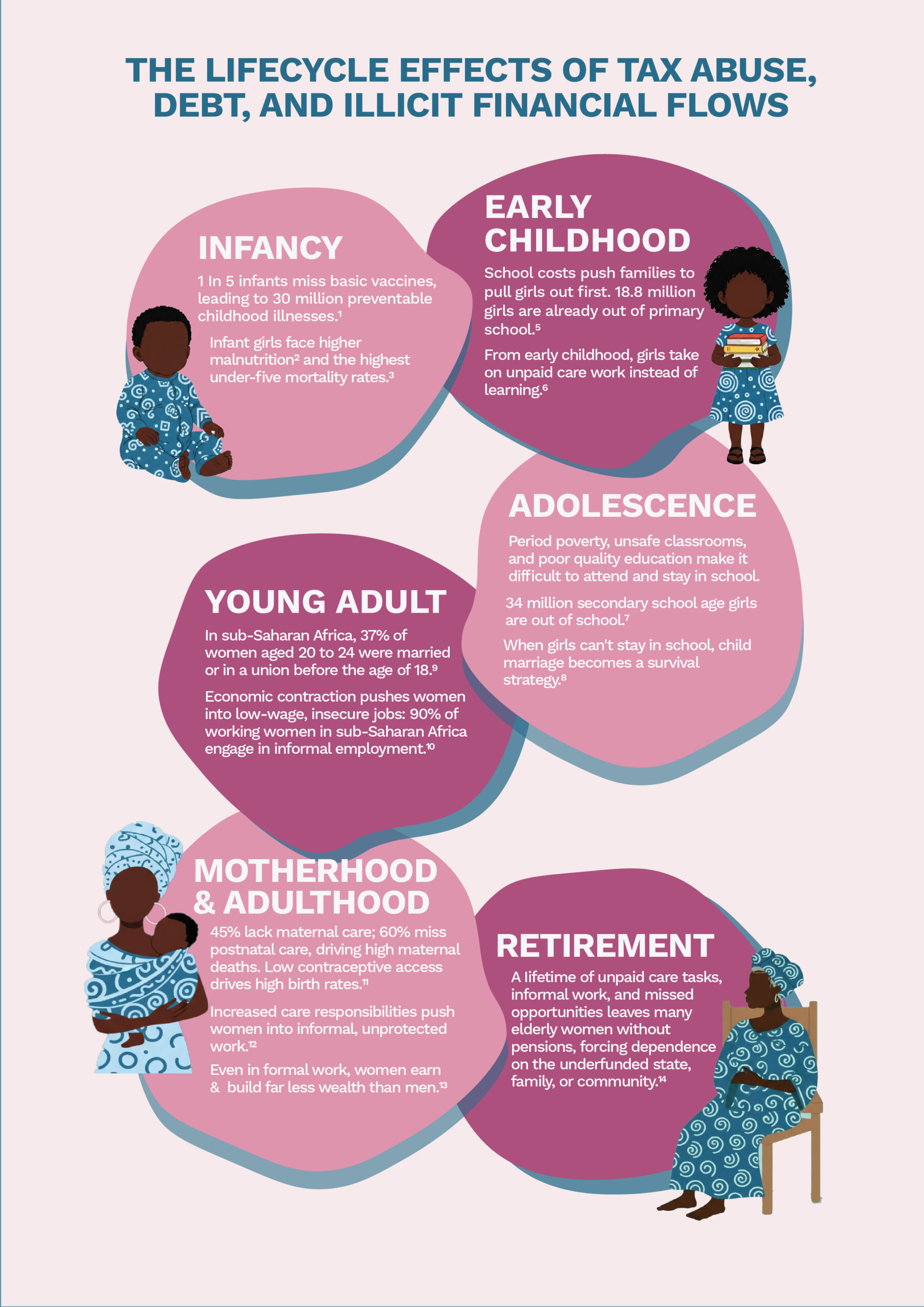
Different countries. Same logic.
Revenue is lost to tax abuse. Debt pressures intensify. Public services weaken. Women absorb the impact across generations.
Why we are mobilising through the Global Days of Action campaign
The global gender gap is projected to take more than a century to close at the current pace. That is far too long to ask women to keep compensating for broken systems. This is why we are part of the Global Days of Action on Tax Justice for Women’s Rights.
This year’s theme, “Tax Justice for the Human Right to Care”, speaks directly to realities many of us recognise. Care is not a private burden to be managed inside families. It is a public responsibility.
Care requires investment. Investment requires revenue. Revenue requires fair taxation.
As the Commission on the Status of Women convenes and we reflect on the Beijing Declaration and Platform for Action, governments are also negotiating the future of international taxation through the UN framework convention on international tax cooperation. Decisions are being made about transparency, taxing rights and whether multinational corporations and the wealthiest individuals will finally pay their fair share. For the first time, these negotiations are unfolding in a space that aspires to broader global legitimacy and inclusivity, with countries from the Global South participating on more equal footing in shaping international tax rules.
Those decisions will shape whether women continue to carry systemic failures or whether states build strong public care systems that redistribute responsibility instead of concentrating it at home.
International Women’s Day is often framed as a celebration. For us, it is also about accountability.
Thirty years after Beijing, we cannot speak about gender equality without speaking about how governments raise and spend money. We cannot talk about empowerment while allowing tax abuse to continue. We cannot demand care without funding it. As negotiations toward the UN tax convention continue this year, this is a once in a generation chance to reshape global tax rules so they support the commitments made to women’s rights decades ago. Tax justice will not solve everything. But without it, gender equality remains underfunded and fragile.
So this week, as movements mobilise, we are clear about what this work means.
It means making taxes work for women.
In Brazil.
Across Africa.
Everywhere.
Donate to Tax Justice Network
We rely on donations from people like you who value our research and campaigning to keep our work going. Help us do more work like the work above with a donation.
This guest blog was written by Nicolás Brennan Hernández, an economist specialising in international trade and political economy. The views expressed are those of the author.
Malta is one of a number of European Union member states that actively undermine their neighbours through the provision of financial secrecy and opportunities for corporate tax abuse. As our Corporate Tax Haven Index shows, Malta has ensured that its headline corporate tax rate of 35% translates for multinationals into an effective tax rate of just 5%. We are pleased to share the following analysis of Malta’s corrupting approach and the challenges it now faces.
This archipelago of 500,000 people, scattered across 316 square kilometres of Mediterranean limestone, hosts €479.7 billion in foreign investment, equivalent to more than 20 times its yearly GDP. Perched in the centre of the Mediterranean, Malta has served as a waystation since Phoenician merchants first recognised its strategic value. It continues this role, only now serving as a convenient stopover for corporate profits fleeing European tax collectors and illicit capital evading oversight.
In a world where the European Union is searching in every nook and cranny for the funds to pay for rearmament, an ageing population, the energy transition, and to compensate those affected by American tariffs and Chinese exports, the matter of taxation and where funds go to avoid it is as important as ever. Jurisdictions that allow corporations to evade taxes are generally frowned upon, but some attract more criticism than others.
As an Irishman abroad in the EU with a passion for policy debates, I have grown accustomed to apologizing for Ireland’s liberal approach to corporate taxation. It is an approach designed to attract hundreds of billions of capital flows, but that isn’t always reflected in average wages. Its Gross National Income (GNI), which looks solely at the income generated on the island, is almost half of its nominal GDP. Yet Ireland attracts disproportionate criticism. Walk down Grand Canal Dock and you’ll find genuine European headquarters. Luxembourg and the Netherlands have proven equally adept at carving profitable niches in the race toward rock-bottom rates. There is, however, a jurisdiction that makes all three look restrained: the Republic of Malta. The country makes Ireland’s GDP iffy statistics look like shoplifting compared to the Louvre robbery.
The numbers are an affront to credulity. Though Malta accounts for 0.1% of EU-27 GDP and population, and is the smallest member state on both counts, its inward FDI stock reached €479.7 billion in December 2024. For context, Spain, with 100 times Malta’s population and nearly 70 times its GDP, hosts €917 billion, less than double Malta’s haul. Against a GDP of roughly €20 billion, that €479.7 billion yields a ratio exceeding 2,300%, compared to the EU average of 48.5%.
Walk through Valletta’s ancient streets, and you won’t find the gleaming towers or bustling headquarters this half-trillion might suggest. This is because the companies exist solely on paper, channeling revenues and assets from other jurisdictions through Special Purpose Entities (SPEs). 98.2% of Malta’s inward FDI and 99.4% of outward flows derive from financial and insurance activities. Even the European Central Bank itself states bluntly that special purpose entities, the companies established on paper in Maltese soil, “dominate external accounts” with “very limited impact on real economic activity.”
At first glance, Malta’s tax regime appears, if anything, burdensome. The nominal corporate tax rate sits at 35%, exceeding Spain (25%), Italy (24%), and dwarfing Ireland’s 12.5%. Yet this façade conceals the mechanism that matters: Malta’s tax refund system for non-residents. While Maltese-owned companies face the 35% rate, those with non-domiciled shareholders pay just 5%, the EU’s lowest effective rate, and less than half of Ireland’s demonised 12.5% rate.
The policy is simple. Companies remit 35% to Maltese authorities, and shareholders then receive tax credits equal to the corporate tax paid. For non-residents, Malta permits refunds of 86% of corporate tax remitted. What began as 35% drops to 5%, and occasionally to zero, for royalties and capital gains. Easy money. Aside from hotels, pharmaceutical companies, and gaming offices, however, the multinational headquarters taking advantage of the regime are nowhere to be seen. Why?
Well, Maltese law doesn’t require physical presence. Under 2019 regulations, companies need only maintain a registered office, hold one annual board meeting on Maltese soil, and retain local records. Directors need not be residents. Staff need not be nationals. Office space can be shared among dozens of entities. The bar for “adequate” presence is nearly subterranean.
Surely someone must supervise the €30 billion that enters and leaves annually? Yes: the firms’ own representatives, of course. In practice, this means the same individual servicing a dozen letterbox companies from a shared Valletta office bears personal responsibility for detecting suspicious patterns in billion-euro flows passing through structures that exist primarily to obscure ownership. The Financial Intelligence Analysis Unit (FIAU) supervises from a distance; day-to-day monitoring rests with professionals whose business model depends on not asking inconvenient questions. For those who missed the 2008 financial crisis or found its lessons on self-regulation insufficiently clear, Malta offers a refresher course. The lack of oversight, alongside a significant online gambling sector, has led the island to develop a reputation for money laundering and “tax optimisation.”
These schemes did not pass unnoticed, however. The consequences arrived in June 2021, when the Financial Action Task Force (FATF) greylisted Malta for strategic deficiencies in combating money laundering and terrorist financing. FATF’s 2019 evaluation found chronic enforcement failures, including that money laundering investigations weren’t priorities, teams lacked resources, and authorities couldn’t investigate financial crimes involving corruption.
The permissiveness surrounding money laundering and corruption would reach a boiling point in 2017. Investigative journalist Daphne Caruana Galizia, whose Panama Papers reporting exposed the “intimacy between big business and politics,” was assassinated by car bomb in October of that year. An official government inquiry concluded the state bore responsibility for creating an “atmosphere of impunity.” The greylisting was a belated acknowledgement that Malta had become a jurisdiction where financial crime flourished under official protection.
The delisting twelve months later proved nearly as controversial. In 2022, FATF declared that Malta had “strengthened its [Anti-Money Laundering] regime,” but some civil society groups were convinced that the progress was meant to assuage FATF’s concerns rather than solve internal deficiencies. Money laundering charges plummeted from 57 in 2021 to 16 in 2023, a decline critics viewed as evidence that reforms “targeted smaller players” while structural issues persisted. More troubling, Maltese courts began overturning FIAU penalties as “unconstitutional,” invalidating hundreds of thousands of euros in fines that had helped convince FATF to delist Malta.
Malta’s National Risk Assessment, published in December 2023 by the very body tasked with improving the country’s reputation, painted a damning picture: only 5% of lawyers and 1% of tax advisors submitted suspicious transaction reports. Advisors handling cross-border planning operated without licensing or fitness checks, and their effectiveness was rated “LOW.” Clearly, while legislation was put in place to improve Malta’s reputation and return capital flows, enforcement remains weak. In spite of it, or perhaps because of it, Malta’s FDI was reaching new heights by 2024.
Malta’s less than thorough approach to financial monitoring was highlighted in its response to EU sanctions following Russia’s invasion of Ukraine. Across Europe, enforcement produced substantial results: Italy seized €143 million, France impounded vessels worth hundreds of millions, and Spain froze assets exceeding €10 billion. In contrast, Malta only identified €150,000 in sanctioned assets, less than the price of a studio apartment. This comes from a jurisdiction that cultivated Russian elites as clients, selling, as recently as 2024, passports to Russian oligarchs with direct involvement in the war in Ukraine, until the EU struck down the law. When a country hosts €479.7 billion in FDI stock, the claim it harbours virtually no sanctioned Russian wealth is highly suspicious. Either Malta’s enforcement proved especially incompetent, or it declined to look where uncomfortable discoveries might lurk.
Defenders might argue Russian capital simply wasn’t a significant share. I would love to verify the claim, but Malta, conveniently perhaps, stands alone among EU-27 members in refusing to report the geographic origin and destination of FDI flows and stocks to Eurostat. While every other jurisdiction publishes detailed breakdowns, Malta’s submissions contain only aggregate totals. This opacity is not oversight but deliberate policy. The ECB notes diplomatically that Malta’s special purpose entities “dominate external accounts,” yet ultimate beneficial owners remain shrouded. Jurisdictions declining to disclose capital sources typically have compelling reasons for doing so.
It is easy to understand Malta’s economic calculus. As intangible as the capital held on the island might be, law offices and financial services firms are thriving, generating high revenues and wages for thousands of workers. The 5% corporate tax rate, while incredibly low by EU standards, helps fund an important share of Malta’s public services, accounting for 21% of government revenue, compared to an EU average of around 10%. Without these arrangements, an island of 500,000 people, devoid of natural resources and with little arable land, would face grim prospects.
Yet economic pragmatism cannot excuse complicity in financial crime. The car bomb that killed Daphne Caruana Galizia in October 2017 illuminated the toxic endpoint of a state captured by interests it’s meant to regulate. Her murder revealed the logic underpinning Malta’s business model: when prosperity depends upon not asking difficult questions about capital flows, those who insist on asking become existential threats.
Moreover, not only is this arrangement morally questionable, but it is far from sustainable. The OECD’s Pillar Two framework, which establishes a global 15% floor, fundamentally alters the calculus that sustains Malta’s model. Countries will be able to tax profits generated within their borders but booked in jurisdictions with a corporate tax rate below 15%. Ireland will weather this transition with its scale, infrastructure, educated workforce and genuine multinational operations. Malta offers none of these. When refund mechanisms reducing effective rates to 5% stop working, capital will evaporate as swiftly as it arrived; capital has no loyalty other than to itself.
Malta will then face a reckoning: what remains when the €479.7 billion in FDI stock leaves as easily as it entered, when nameplate companies vanish, and Valletta office buildings stand vacant? The Mediterranean sun will continue shining on ancient stone, and the Maltese people will remain. But the pass-through economy, that extraordinary construction of legal architecture and regulatory gymnastics, cannot survive contact with a world that no longer has a need for it.
Illicit cash flows might continue being laundered on the island, but after the greylisting, the country is unlikely to loosen enforcement much further. If it continues in its current trajectory, it will isolate itself further from an EU that already has little need for an island encouraging Russian oligarchs to purchase Maltese citizenship and firms to avoid paying taxes in other EU states. In the name of European solidarity, ethical financing and economic sustainability, it will need to pivot before it is left to dry out in the Mediterranean sun.