Two important events this month: Tax Justice Network Africa organised the 3rd International Tax Justice Academy on the 12th-16th September 2016 in Nairobi, Kenya. Continue reading “The Tax Justice Network in Kenya and Israel”


Two important events this month: Tax Justice Network Africa organised the 3rd International Tax Justice Academy on the 12th-16th September 2016 in Nairobi, Kenya. Continue reading “The Tax Justice Network in Kenya and Israel”
We just put out this press briefing in reaction to the leaks from the Bahamas. Continue reading “#BahamasLeaks: New Leak Rips Open Bahamian Secrecy”
From Americans for Tax Fairness, a major new report about corporate taxes in the United States. It’s called Corporate Tax Chartbook: How Corporations Rig the Rules to Dodge the Taxes They Owe, and it contains many useful facts, such as this:
Continue reading “Report: new data disproves US corporations’ false narrative on taxes”
Welcome to Justicia ImPositiva, our third monthly podcast/radio show in Spanish. Bienvenid@s a Justicia ImPositiva, nuestro tercero podcast/programa radial mensual en castellano (abajo en castellano) Continue reading “Our September Spanish language Tax Justice Podcast: Justicia ImPositiva, nuestro podcast de septiembre 2016”
Updated with further information about Brazil’s decision – see below.
Now also on Angry Bear, Middle Class Political Economist
From the Financial Times:

More precisely, a group of 185 American CEOs has sent letters, co-ordinated by the Business Roundtable lobby group, to the leaders of 28 EU member states to try and get the European Commission to row back from claiming €13bn in underpaid taxes from Apple. They call the attempt a “grievous self-inflicted wound”. Continue reading “Apple’s tax affairs: a symptom of the robber-baron culture”
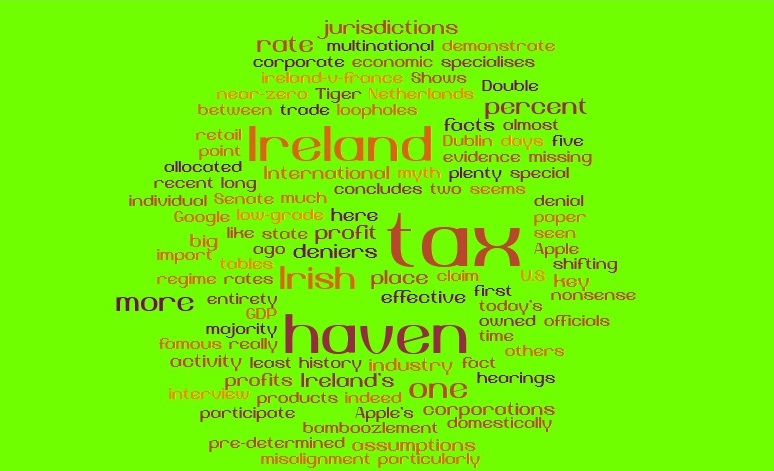 We have for years remarked that one of our informal markers of a tax haven is loud tax haven denials. See our ‘we are not a tax haven‘ blog for more. There’s probably no place more vocal than Ireland, where there seems to be a veritable industry of tax haven deniers, which specialises in cherry-picking convenient facts and making a pudding of them. (The other big Irish tax myth is that it was the 12.5 percent corporate tax rate that created Ireland’s Celtic Tiger: no, it wasn’t.)
Let’s state it clearly: Ireland is a big tax haven for multinational corporations, even if it isn’t particularly secretive. Or, in more succinct form, for those who have difficulty reading small text:
Ireland is a tax haven.
Continue reading “Now Brazil puts Ireland on its tax haven blacklist”

Michael West
From Michael West, an Australian tax journalist:
“In Australia, Part 4a of the Tax Act deems that the principal purpose of a transaction should be commercial (rather than tax driven). In light of the proliferation of tax haven activities by Australian companies this law, Part 4a, must be the most highly disregarded and disobeyed law in the nation, perhaps only topped by traffic offences.”
It’s an interesting story, not least because it has unearthed a hard-to-get number that we haven’t, from memory, seen before:
“The IPO documents for Intertrust estimate in 2014 the “total value of the global trust and corporate services market … was estimated at approximately €5.6 billion in revenue.”
Continue reading “Quote of the day – tax crimes and traffic offences”
Update: now on Naked Capitalism, where it’s attracted a lot of interesting commentary
Last year we published a document entitled Ten Reasons to Defend the Corporate Income Tax, outlining how the tax is under constant attack, in country after country, and explaining why it is one of the most precious of all taxes. Now there’s another fascinating paper, rich in insight and detail, from US economist Kimberly Clausing, entitled “Strengthening the Indispensible U.S. Corporate Tax.
While US-focused, it contains a lot of material that provides extensive further support for our own generic document, and argues that the corporate income tax is becoming more, rather than less, important in our tax system(s). It also argues that tax rates for capital, which is currently taxed at lower rates than labour is, should be harmonised with the labour rate, and supports so-called ‘formulary apportionment‘ approaches to taxing U.S. corporations internationally.
We’ll start by highlighting a graph: Continue reading “Report: why we need to tax corporations now, more than ever”
 From the FACT coalition:
September 12, 2016
WASHINGTON, D.C. – Investors are at an increasing risk due to the lack of information disclosed by companies about their tax practices, according to a new report published today by the Financial Accountability and Corporate Transparency Coalition (FACT Coalition)—a non-partisan alliance of more than 100 state, national, and international organizations working toward a fair tax system that addresses the challenges of a global economy and promoting policies to combat the harmful impacts of corrupt financial practices.
Continue reading “Report: the investor case for country by country reporting”
 The economists Thomas Piketty, Emmanuel Saez, Facundo Alvaredo and Anthony Atkinson have played a big role in helping analyse and popularise the role that tax rate cuts for wealthy folk play in fostering economic inequality, particularly the income shares of the top 1 percent of people compared to everyone else. As they put it in 2013:
“The evolution of top tax rates is strongly negatively correlated with changes in pre-tax income concentration.”
Their findings have of course been attacked, not least by certain players keen for taxes on wealthy people to stay low.
Now there’s a new US-focused study by Douglas Campbell and Lester Lusher, called Drivers of Inequality: Trade Shocks versus Top Marginal Tax Rates. It seeks to check on these findings: Continue reading “More evidence of the links between tax and inequality”
The UK’s tax collection agency is more secretive than MI6 and crippled by corporate interests according to a new report launched in the House of Commons yesterday.
Corporate interests now exercise a significant amount of control over HMRC, it says – and it is hard not to agree. All of the non-executive directors of HMRC come from the world of business. There are no representatives of individual tax payers or experts from the world of academia. The current Executive Chair of HMRC, Edward Troup, once called taxation ‘legalised extortion’. Before taking over at the tax collection agency he worked at a law firm linked to companies contained in the Panama Papers. Mr Troup later said his legalised extortion quote had been taken out of context, yet according to Full Fact it came from a 1997 FT article which appeared to be arguing against a General Anti Avoidance Rule (GAAR).
Continue reading “UK tax authority: too close to big business, too far from the public – report”
You may have heard that Luxembourg prosecutors aren’t satisfied with the 12th chamber of the Criminal Court of Luxembourg’s verdicts for the so-called #LuxLeaks whistleblowers Antoine Deltour and Rapahel Halet and they are appealing. That means these two men will once again face a Luxembourg court, probably by the end of the year. It was bad enough that these public spirited heroes were dragged through the courts in the first place, with Deltour receiving suspended 12-month jail time and a €1,500 fine and Halet sentenced to suspended 9-month jail time and a €1,000 fine. Continue reading “MEP support for #LuxLeaks whistleblowers, back in court. (Again)”

 Update: as it happens, The Economist has just published an excellent story about the Bahamas, subtitled The Bahamas Cocks a Snook at the War on Tax Dodgers. (Our only beef with that subtitle is that this is about so much more than just tax.)
We’ve periodically remarked on the Bahamas as a secrecy jurisdiction of great concern. Like Panama, it’s generally had a greater tolerance of dirty money than most modern offshore centres: more of a willingness to turn a blind eye and to overlook noncompliance by Bahamas-based actors of its own rules and laws.
The purpose of this blog is to flag up the Bahamas in a more pointed way: as a major wrecking-ball threatening global efforts to clamp down on cross-border financial secrecy.
The Bahamas has hosted an offshore centre for crime and tax evasion for decades, and it has historically had a higher tolerance for dirty money than most tax havens. Its secrecy score of 79 in our Financial Secrecy Index is one of the world’s highest. Treasure Islands summarises an important component of the Bahamas’ history and identity, via Chicago gangster Al Capone’s moneyman, Meyer Lansky: Continue reading “The Bahamas tax haven – a (re-)emerging global menace?”
Apple is launching its iPhone 7 today. In the context of the recent Apple tax scandal, and the imbroglio involving the company, the European Commission, and the U.S. Treasury, we thought we’d share some images that some of our partners have created, to celebrate the event.
Before seeing the images, if you want something to read, perhaps take a look at Prof. Mariana Mazzucato’s penetrating analysis of just how much government support Apple has enjoyed, in its construction of the iPhone. It’s entitled ‘The Entrepreneurial State’: Apple Didn’t Build Your iPhone; Your Taxes Did. Her book The Entrepreneurial State, looking at how heavily such companies rely on government support, has been highly influential. Click on the fun video, which we blogged recently.
Here is a first image: thanks to Eurodad for forwarding this collection. Continue reading “Apple’s iPhone 7 launch: but what about the taxes?”
The Second International Conference on Beneficial Ownership Registries took place in Buenos Aires on August 31st and September 1st. The event was held again at Argentina’s Central Bank and was co-organized by the Tax Justice Network, Argentina’s General Prosecution Office (Ministerio Público Fiscal), Fundación SES, Latindadd and the Red de Justicia Fiscal LAC. It was sponsored by Argentina’s Anti-corruption Office. Continue reading “On our recent event on beneficial ownership in Buenos Aires”
They said it would never happen – but here it comes. From the UK lower house of parliament, an amendment to legislation which looks like this:
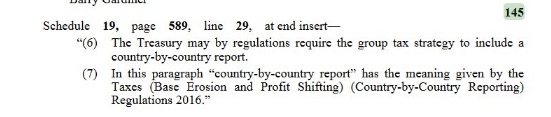
This is very welcome news, even though the amendment is far from perfect. Continue reading “UK moves forward on Country by Country reporting”

Prof. Thomas Rixen
Prof. Thomas Rixen, who has written a lot about tax ‘competition’ (aka tax wars) in the past, has a new article looking at similar dynamics in the area of financial regulation. Entitled Why reregulation after the crisis is feeble: Shadow banking, offshore financial centers, and jurisdictional competition, it points out that the shadow banking sector, many of whose players were implicated in the global financial crisis that erupted almost a decade ago, is heavily entwined with offshore financial centres. Typically, this involved banks sponsoring off-balance sheet vehicles, located in places like Cayman or Luxembourg: these supposedly took risk off the banks’ books, but then returned to haunt the banks when they blew up, causing widespread economic disaster. Continue reading “Why reregulation after the crisis is feeble: Shadow banking, offshore financial centers, and jurisdictional ‘competition’”
Press release – for immediate release
Today, the European Commission has ruled that two tax rulings issued by the Irish tax administration on the tax treatment of Apple’s corporate profits represent illegal state aid under EU law. As a consequence, Apple has to pay up to €13 billion of taxes plus interest to Ireland. This sum due to the Irish exchequer can be reduced if other countries from Europe, Africa, the Middle East or India or the United States decide to claim a share of those profits. This lays bare the core of a global problem: secretive tax rulings issued by tax haven states are not an instrument for the avoidance of double taxation, but a tool for the achievement of non-taxation of profits. In practice such rulings destroy fair market competition and undermine the tax sovereignty of democratic states.
This decision is remarkable on at least three counts.
New analysis of the UK’s North Sea oil and gas suggests that the combination of tax giveaways by the government, and aggressive avoidance by multinationals, means that the country may actually be subsidising the extraction of its natural resources. And this at a time of continuing ‘austerity’ measures, that a UN treaty body has harshly criticised for driving poverty and inequality, undermining citizens’ human rights.
Continue reading “The UK’s North Sea oil revenues: Giving it away?”
Update: here’s our research director Alex Cobham’s interview with Share Radio which goes through the key points.
On this quiet August day, the US Treasury has fired the first shots of a tax war with Europe. And while it’s wrapped up in a claim to defend international tax cooperation, it looks more like an attempt to prevent an effective measure against international tax-dodging – carried out, not least, by US companies. At the same time, the US continues as the leading hold-out against the automatic exchange of individuals’ financial information; and to resist the growing tide of public registers of the beneficial ownership of companies. The stage is set for a prolonged battle.
By publishing a white paper titled ‘THE EUROPEAN COMMISSION’S RECENT STATE AID INVESTIGATIONS OF TRANSFER PRICING RULINGS’ (h/t @RichardRubinDC), the US has signalled an end to a period of quiet tension. This long post considers why this matters; then sets out the main contents of the white paper; before concluding with an assessment of what is possible in the ensuing hostilities.
We explore the white paper’s main points below, but note first its significance. For one thing, it confirms just how bad relationships between the US and the Commission have become on the subject of corporate tax. The white paper is the opposite of gentle diplomacy – and quite close, in parts, to an outright threat. Continue reading “The US Treasury just declared tax war on Europe”
Last month Pascal Saint-Amans, head of tax for the OECD, spoke to the Wall Street Journal, in an article subtitled The argument against taxing capital income relatively more than wages is losing its force. He said:
“For the past 30 years we’ve been saying don’t try to tax capital more because you’ll lose it, you’ll lose investment. Well this argument is dead, so it’s worth revisiting the whole story,” Pascal Saint-Amans, the OECD’s tax chief, said in an interview.”
This particular article came to our attention via the Fair Skat blog, which sketches out the implications – and they are highly significant. The usual story goes something like this: Continue reading “Corporate tax cuts: why the old analyses don’t stack up any more (did they ever?)”