Outrage at Bermuda and Jersey removal from French blacklist

SONY DSC

French anti-tax haven protesters target Jersey

According to Mediapart the French government is under fire, again, this time over its decision to remove both Bermuda and Jersey from its blacklist of uncooperative tax havens.   Senior members of the government, including foreign affairs minister Laurent Fabius, are reported to be opposed to their removal.  Mediapart reports that Fabius has advised finance minister Pierre Moscovici that these removals are “not politically opportune.” Continue reading “Outrage at Bermuda and Jersey removal from French blacklist”

OECD: special tax rules for internet cos ‘unviable’

TUIYCInternet companies are running rings around our governments, free-riding on the backs of ordinary taxpayers and reaping large fortunes for relatively small numbers of well-connected insiders, some of them rich enough to buy entire global newspapers with their pocket change, and thus potentially influence us all. Continue reading “OECD: special tax rules for internet cos ‘unviable’”

The Bahamas – Another Captured State?

atlantis-722952-m

Atlantis Resort, Bahamas. Another behemoth, Baha Mar, is being built.

Written for TJN by someone with long experience of the Bahamas.

The Bahamas is a stunningly beautiful archipelago of more than 700 islands, cays and islets, a proud nation populated with vibrant, passionate, good-hearted people. The economy of this small island state, ranked at 35th position on the 2013 Financial Secrecy Index and assessed towards the top end of the secrecy scale, is heavily reliant on the offshore financial services industry; the Bahamas is in the throes of the Finance Curse, as a captured state. Continue reading “The Bahamas – Another Captured State?”

A week in Tax Justice: Jan 20

Our new website will bring you a weekly round-up of tax justice news: our personal selection from a wide array of stories about tax justice, A Week in Tax Justice will be sent out to all TJN subscribers and will soon also be available on our App, which we’ll be bringing out in the next month or so.

Here is the inaugural public edition of A Week in Tax Justice. Enjoy! Continue reading “A week in Tax Justice: Jan 20”

The Price of Offshore, Revisited

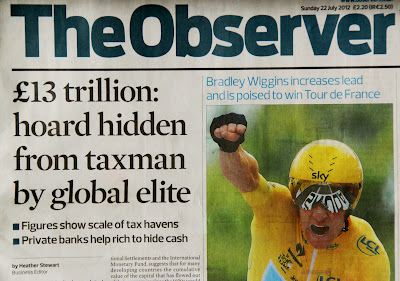
The ObsJuly 22, 2012

Update, June 2014: TJN responds to attacks on the report (pdf here).

MAIN REPORT 1 – The Price of Offshore RevisitedTJN’s in-depth and unprecedented study into the size of the offshore system of tax havens and/or secrecy jurisdictions. The report estimates that some $21-32 trillion is stashed offshore, in conditions of low or zero tax and substantial secrecy. Continue reading “The Price of Offshore, Revisited”

Welcome to the new Tax Justice Network website and blog

Welcome to the new Tax Justice Network website, with integrated blog.

Continue reading “Welcome to the new Tax Justice Network website and blog”

Big Newsweek exposé on human rights abuses in tax haven Jersey

From the Treasure Islands blog:

Newsweek1

I’ve just had an email from Stuart Syvret, a dissident former health minister in the British tax haven of Jersey, who has just got out of prison after challenging the island’s financially-dominated oligarchy. The email was in his characteristically forthright style:

“I and many of my former constituents have had our human rights monstrously abused in Jersey by corrupt Crown Officer holders. Continue reading “Big Newsweek exposé on human rights abuses in tax haven Jersey”

Public Eye Awards: Help put FIFA in the Hall of Shame

A while ago we wrote about this reprehensible item from world football’s governing body FIFA. This Tax Bubble that FIFA created around the South African world cup – despite FIFA’s being a gargantuan, unaccountable billionaire monopolist based in Switzerland – was a particularly shameful example of their anti-democratic rent-seeking behaviour.

And they are going to do it again and again.

Now the Public Eye Awards, which draw attention to particularly egregious corporate misbehaviour, have sent us this. Continue reading “Public Eye Awards: Help put FIFA in the Hall of Shame”

Quote of the day – Boeing

boeingFrom Citizens for Tax Justice:

“How worried should we be that Boeing argues it should get a tax break for performing safety tests on its new planes? Continue reading “Quote of the day – Boeing”

Release of offshore records draws worldwide response

The International Consortium of Investigative journalists last year began a rolling series of stories in partnership with media organisations around around the world, based on leaks of 2.5 million secret offshore records. Finding and releasing so much hard evidence on the subject that we have been so closely involved in for so many years has been tremendously influential in focusing politicians’ minds.

They have just published a very long list of changes that have happened in the offshore world since the leaks. Continue reading “Release of offshore records draws worldwide response”

Jersey: A Case Study in Path Dependence

[vc_row][vc_column][vc_column_text]

This blog is part of a series highlighting the narrative reports from a number of secrecy jurisdictions around the world, explaining how they became offshore financial centres.

Jersey ranked ninth on the 2013 Financial Secrecy Index.   Continue reading “Jersey: A Case Study in Path Dependence”

Offshore Corporate Profits: The Only Thing ‘Trapped’ Is Tax Revenue

From the Center for American Progress (hat tip: AABA), in the context of news reports of trillions of dollars in U.S. overseas profits “trapped” overseas, just waiting to be invested in the struggling U.S. economy – if only it could somehow be “unlocked” (such as through a corporate tax amnesty.) Our quote of the day:

“There is something trapped on the balance sheets of U.S. multinationals. But it is not corporate profits—it is federal tax revenue.”

Quite so. It’s important to understand what’s going on here.  This U.S.-focused issue afflicts many other capital-exporting countries too.

Just Money: how society can break the power of finance

From Commonwealth publishing:

An e-book by the acclaimed economist Ann Pettifor, Just Money: How We Can Break the Despotic Power of Finance. In it she explores the role of credit in the economy and its relationship with the money supply. She goes on to set out a set of policies to bring the economy back under substantial democratic control.

This is not, strictly speaking, a core tax justice issue. But we have recently been doing a lot of work on the political economy of financial centres – not least with our Finance Curse analysis. “Breaking the power of finance” is certainly something that interests us.

Available here (only, for the time being).

Quote of the day: fracking tax positions

From David Quentin’s Tax and Law blog, just mentioned in our Links:

Vodafone’s 2013 “Tax Risk Management Strategy” paper, for example, concedes in its small print that Vodafone happily adopts filing positions which “will not meet the more-likely-than-not standard but would still be tenable”.

If the mining of tax risk may be understood in extractive terms, a policy of habitually adopting merely “tenable” filing positions is about as sustainable and responsible as fracking.

Well said. And the whole post is well worth reading.

Architect behind Eurozone’s biggest tax haven wants to be EC president

This is a very dangerous development. From Euractiv:

“Former Luxembourg Prime Minister Jean-Claude Juncker, the EU’s longest-serving elder statesman, threw his hat into the ring yesterday (9 January) for the presidency of the European Commission to succeed José Manuel Barroso. Continue reading “Architect behind Eurozone’s biggest tax haven wants to be EC president”

The twilight of the international tax consensus

That’s the headline of a provocative article by U.S. rock star tax expert Lee Sheppard, Continue reading “The twilight of the international tax consensus”

Do tax cuts promote growth? Part MCXIV

The world’s economists have been arguing over this question for decades. Which is odd, because the evidence is rather clear on this point. Continue reading “Do tax cuts promote growth? Part MCXIV”

New report: how Finnish multinationals use tax havens

Our partners at Finnwatch have just published an important new report looking at the activity of Finnish multinational corporations in tax havens. Continue reading “New report: how Finnish multinationals use tax havens”

If Ireland is not a tax haven, what is it? A bagel?

From the Treasure Islands blog, reposted with permission.


Ireland continues to annoy me. Not Ireland the country, of course: it’s just the tax haven industry that has grown upthere. It annoys me because there are so many influential voices there that deny Ireland is a tax haven. All tax havens deny being tax havens, but Ireland seems to have taken it to extremes of huffing and puffing: a veritable industry of tax haven deniers has grown up there. I guess it is the sheer scale of the dishonesty that riles me. Continue reading “If Ireland is not a tax haven, what is it? A bagel?”

Towards Unitary Taxation of Transnational Corporations, by Sol Picciotto

Towards Unitary Taxation of transnational corporations, Prof. Sol Picciotto, Dec 2012.

Original link here.


A week in tax justice: Jan 13

TJN logo

Tax Justice: the week that was.

Are we finally making progress on tax havens?

Last week saw a number of stories and reports looking at how governments dealt with tax avoidance in 2013. The results are a mixed bag.

The EU Observer reports that the offshore data leaks story from the International Consortium of Investigative Journalists gave a boost to governments wanting to clamp down on illicit financial flows.  Among many other embarrassments the ICIJ revealed that French Prime Minister François Hollande’s campaign treasurer held shares in offshore businesses and that the CEO of Austria’s Raiffeisen Bank held secret offshore accounts in the Caribbean.

There were advances with the UK asking some its dependencies to sign up to a tax transparency initiative and Switzerland removing some banking secrecy. But Austria and Luxembourg dug their heels in and refused to sign up to an automatic exchange of information project in the EU.

Further fallout from the ICIJ was the sharp decline in company registrations in the British Virgin Islands in 2013.

But a nagging question remains: despite these changes, is the world’s stock of dodgy money simply finding new hiding places? Bahamian media, for instance, is reporting an influx of private wealth from Switzerland as the wealthy fret about the (minimal) reforms to bank secrecy there. And it’s not just the Bahamas.

The Financial Times reports that while the UK made some progress on shutting down a loophole where employees are paid through trusts, progress on massive tax avoidance perpetrated by US tech companies such as Apple, Google and Microsoft has been limited – despite intense public scrutiny of their financial activities.

The easy way to stop tax avoidance: stop taxing. 

Last week a debate flared up in the US on whether corporate income tax should be abolished. Proponents of the idea such as academic Laurence Kotlikoff even — astonishingly — try to dress up their arguments in terms of social justice.

At the Tax Justice Network we prefer facts, and proper research. As pointed out on our blog studies from the US Department of Treasury show that 83% of corporate tax is paid by the owners of capital. This makes corporation tax an extremely progressive tax.  Even more importantly, abolishing corporate income tax would open opportunities for increased tax avoidance as high income earners channel their income into companies rather than be paid as individuals.  Something we note they are rather adept at. And how many minimum wage workers do you know who chose to be paid though their Caribbean shell company?

And as we and Richard Murphy note, the impact on developing countries of such a proposal could be truly appalling.

China deals blow to UK’s bid to become offshore banking centre 

Last Autumn the UK Chancellor of the Exchequer George Osborne returned from his tour of China to announce with pride that the UK had signed a deal which he hoped would lead to London becoming the offshore banking centre for the Chinese economy.

But this week it began to dawn on some people that China may have very different ideas of offshore from the unbridled and potentially disruptive flows of capital favored by the financial elite in London.

The Telegraph reports this week that Yi Gang, director of the State Administration of Foreign Exchange has ordered a report into the implementation of a Tobin Tax for the Yuan. The UK’s Conservative-led government, encouraged by the City of London, have fought tooth and nail to stop similar proposals from the EU, who argue if implemented it will diminish the UK’s attractiveness as a financial hub.

But China’s policy makers are more concerned about the disruptive impact of an opening up of the economy to vast capital movements at a time when it is already struggling to control illicit and other destabilising financial flows.   Something our City friends very often seem to gloss over – since economy-destroying financial products have proved to be a nice little earner for London traders in the past.

Offshore overcooking Australia’s housing market? 

Illicit flows of capital from China show up in a number of unexpected places, such as inflation in property markets.   The problems of illicit financial flows into the London property market are well documented. Today 70% of new homes in London are bought by “foreign investors”, frequently through offshore vehicles which are designed to hide assets.

Londoners have started to complain that parts of the city have become ghost towns. And of course the vast amount of dodgy money flowing into the system pushes prices beyond reach for people buying a home for the simple purpose of having somewhere to live.

Now it seems Australia may be feeling the impact from similar flows of speculative cash from offshore.  Reports this week in the Australian Media quoted rises in house prices of 10% in 2013.

This sharp rise has partially been attributed to Chinese investors who are seeking somewhere to put their money as Beijing clamped down on their shadow banking industry last year.

A case of yuan thing after another.

 

Tax justice: a human rights issue

Tax justice: a human rights issue
Adrienne Margolis
November 2013

If you ask the question “Is tax justice a human rights issue?” you tend to get one of two responses. Some people say of course it is; others can’t see the link at all.

But if you say there is a relationship between tax and poverty, people often see it more clearly. Continue reading “Tax justice: a human rights issue”