Africa subsidises the rest of the world by over $40 billion in one year, according to new research

Global Justice Now press release:

Download the report

Much more wealth is leaving the world’s most impoverished continent than is entering it, according to new research into total financial flows into and out of Africa.  The study finds that African countries receive $161.6 billion in resources such as loans, remittances and aid each year, but lose $203 billion through factors including tax avoidance, debt payments and resource extraction, creating an annual net financial deficit of over $40 billion.

The research shows that according to the most recent figures available in 2015:

Tim Jones, economist from the Jubilee Debt Campaign, said:

“The African continent is rich, but the rest of the world profits from its wealth through unjust debt payments, multinational company profits and hiding proceeds from tax avoidance and corruption.”

Aisha Dodwell, a campaigner with Global Justice Now said:

“There’s such a powerful narrative in Western societies that Africa is poor and that it needs our help. This research shows that what African countries really need is for the rest of the world to stop systematically looting them.  While the form of colonial plunder may have changed over time, its basic nature remains unchanged.”

Martin Drewry, director of Health Poverty Action said:

“To end poverty we need to focus our efforts on preventing the policies and practices that are causing it.  That means we need to stop our tax havens facilitating the theft of billions, clamp down on illegal activities and compensate African countries for the impact of climate change that they did not cause. “

Bernard Adaba, policy analyst with ISODEC in Ghana said:

“’Development’ is a lost cause in Africa while we are haemorrhaging billions every year to extractive industries, western tax havens and illegal logging and fishing. Some serious structural changes need to be made to promote economic policies that enable African countries to best serve the needs of their people rather than simply being cash cows for Western corporations and governments. The bleeding of Africa must stop!”

The report Honest Accounts 2017: How the world profits from Africa’s wealth, published by a coalition of UK and African organisations, including Global Justice Now, Health Poverty Action and Jubilee Debt Campaign, makes a series of recommendations as to how the system extracting wealth from Africa could be dismantled. These recommendations include promoting economic policies that lead to equitable development, preventing companies with subsidiaries based in tax havens from operating in African countries, and transforming aid into a process that genuinely benefits Africa.

Notes

The research covers the 47 countries classified as ‘sub-Saharan Africa’ by the World Bank.

The research was published by Global Justice Now, Health Poverty Action, Jubilee Debt Campaign, Uganda Debt Network, Budget Advocacy Network, Afrika and Friends Networking Open Forum, Integrated Social Development Centre, Zimbabwe Coalition on Debt and Development, Groundwork and People’s Health Movement.

For more information please contact Kevin Smith:

T (+44) (0)20 7820 4913 or (+44) (0)7711 875 345.
[email protected]
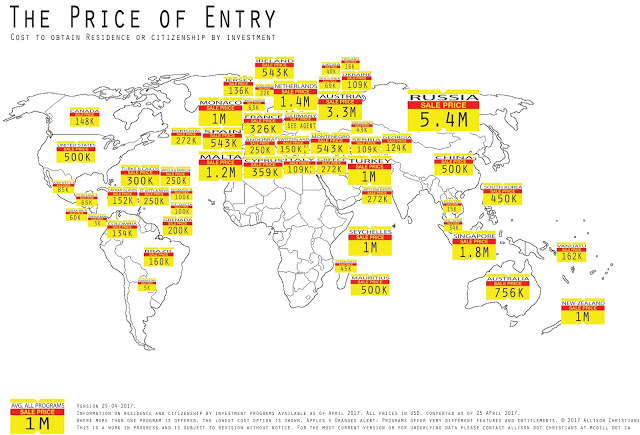
The Price of Entry: residence and citizenship by investment around the world

Many thousands of people a year risk their lives to cross borders into what they hope will be countries of greater safety, opportunity and quality of life. Yet for others who are wealthy enough, the borders are open. For those who can pay, nationality, residency and freedom of movement are theirs.

There are many concerns around the issues of residency (see our recent blog Faking residency on how the OECD’s Common Reporting Standard for automatic exchange of banking information leaves the door wide open for fraud).

Associate Professor Allison Christians, H. Heward Stikeman Chair in the Law of Taxation at the McGill University is currently doing some very interesting research on so-called ‘residence and citizenship by investment’, a handy kind of ‘fundraiser’ that many countries seem keen on implementing. Why does this matter? Well, there are many, many concerns about this, and as blogger Christian Wayne says of this research,

“The implications of the commodification of citizenship and access to immigration vis-à-vis pay-to-play visa programs has long been a hot-button issue for international tax scholars and political scientists alike. Most historical analysis, however, does not typically consider the role taxation dynamics between origin and host countries can play, nor how they impact the tax regime in terms of gross revenue or the distributional effect on the wider economy.”

And he goes on, Allison Christian’s interest in immigrant investment programmes

“is what she dubs “The Inequality Factor”—that is, how much can wealthier, more developed countries demand in terms of higher prices and more stringent requirements (such as actual residence in the host country) for entry, versus how much poorer, less developed countries can demand in price and commitments from their applicants. Christians cautions that her research is still ongoing, but “the answer seems to be that there appears definitely a ‘rich get richer’ quality to the distinctions among programs, but there are lots of details in the programs that require further thought.”

Those of you reading this who listen to our monthly podcast the Taxcast (also available here, here and on iTunes) will have heard us discuss the slippery world of ‘residence planning’ and specifically the ‘synthetic residency’ dodge offered by Dubai in our January 2017 episode (starting at around 6 minutes 57). And this shocking example really does highlight the issue of just how low these offerings can go and how far countries will compete in a race to the bottom. Regrettably, there are plenty more of these.

Now, here’s what Allison Christians has presented on her team’s findings so far on her blog, along with a very interesting graphic:

Price of Entry-25 April 2017 Continue reading “The Price of Entry: residence and citizenship by investment around the world”

Faking residency: OECD’s Common Reporting Standard leaves the door wide open for fraud

The OECD’s Common Reporting Standard (CRS) for automatic exchange of banking information leaves the door wide open for fraud. The OECD has recently made available a form to report potential avoidance schemes of the CRS. While this form is a first useful step – we’ve been sharing with them the loopholes and risks we’ve identified, and a suggestion on how to assess countries compliance with the CRS. However, we haven’t seen anything get fixed yet…

While the lack of access to automatic banking information by developing countries is our major concern with the CRS (all as a consequence of the OECD’s arbitrary conditions, such as the need for reciprocity or to be chosen in return through the ‘dating system’), for those countries that will manage to exchange information with each other, other risks prevail. Most notably, the need to (effectively) determine the residency of each account holder. Continue reading “Faking residency: OECD’s Common Reporting Standard leaves the door wide open for fraud”

Campaign victory disarms big tobacco’s lobby front in developing countries

Update: the Financial Times has covered the great news.

Below is a press release cross-posted from Tax Tobacco for Life, about a major campaign victory, which could save hundreds of thousands, even millions of lives in some of the poorest countries in the world. Here’s the quick story.

Big Tobacco has targeted lower-income countries as the only growth markets of the future, leading to projections of many millions of unnecessary deaths. Tobacco tax is perhaps the single most important tool to prevent this – and so the use of the International Tax and Investment Center (ITIC) to influence tax policy was a key part of the companies’ strategy for growth (that is, their strategy for death).

Following our joint campaign with many of the leading development and health cialis groups (see note 2 below), and a major media splash in November, ITIC has now decided to drop its tobacco board members and sponsors. Victory! Continue reading “Campaign victory disarms big tobacco’s lobby front in developing countries”

Evading Tax and Avoiding Tax Evasion: for decades British governments have shied away from tackling cross border crime

Guest blog authored by Dr Michael Woodiwiss (Arts and Cultural Industries, University of the West of England) and Dr Mary Alice Young (Bristol Law School, University of the West of England)

Al Capone: tax evader

Al Capone: tax evader

In the 1920s, an embryonic tax collecting organisation was steadily growing in the US. The Internal Revenue Service (IRS) was an agency ignored by the majority of Americans. However, the tide turned in 1931 when the IRS secured the conviction of Chicago gangster Al Capone for tax evasion. Continue reading “Evading Tax and Avoiding Tax Evasion: for decades British governments have shied away from tackling cross border crime”

Germany rejects beneficial ownership transparency

On 17 May 2017, the members of the Finance Committee of the Bundestag cast their votes for ultimate amendments to Germany’s anti-money laundering law. The governing conservatives CDU/CSU and Social Democrats SPD rejected amendments supported by the left and Green party that would have remedied three fundamental flaws in the law which prevent the public from accessing beneficial ownership information on German legal entities. These flaws consist of

The law will be voted on in its current form by the Plenary of the Bundestag in the evening of the 18th May, with no opportunity to change the text further. The only way to stop and/or amend the law would be through the Bundesrat, Germany’s upper chamber. However, after recent elections, this outcome appears to be less likely.

Despite severe critiques presented at the law’s public hearing in the finance committee on 24 April, none of the fundamental weaknesses identified by TJN, German Netzwerk Steuergerechtigkeit and Transparency International have been addressed by the amendments voted for by the governing coalition (TJN’s written statement can be read and downloaded here).

On the contrary, the law has been further watered down in at least two (relatively minor) aspects (one change involves exempting trusts, Treuhandstiftungen and limited partnerships from the obligation to document the steps taken for identifying a Beneficial Owner; another is extending a restricted obligation to report suspicious transactions which was applicable in the previous version of the law only to lawyers and auditors to all professions covered by professional confidentiality, e.g. tax advisers).

The three main problems persist which prevent the public from accessing beneficial ownership information of German legal entities. Two concern the watering down of the definition of the beneficial owner, the first of which relates to the senior manager opt-out clause, which the 4th EU AMLD is allowing, but which the UK did not implement and the EU-parliament in March 2017 actually rejected in its comment on the interim proposal for amending the 4th AMLD (and which we have analysed in depth here).

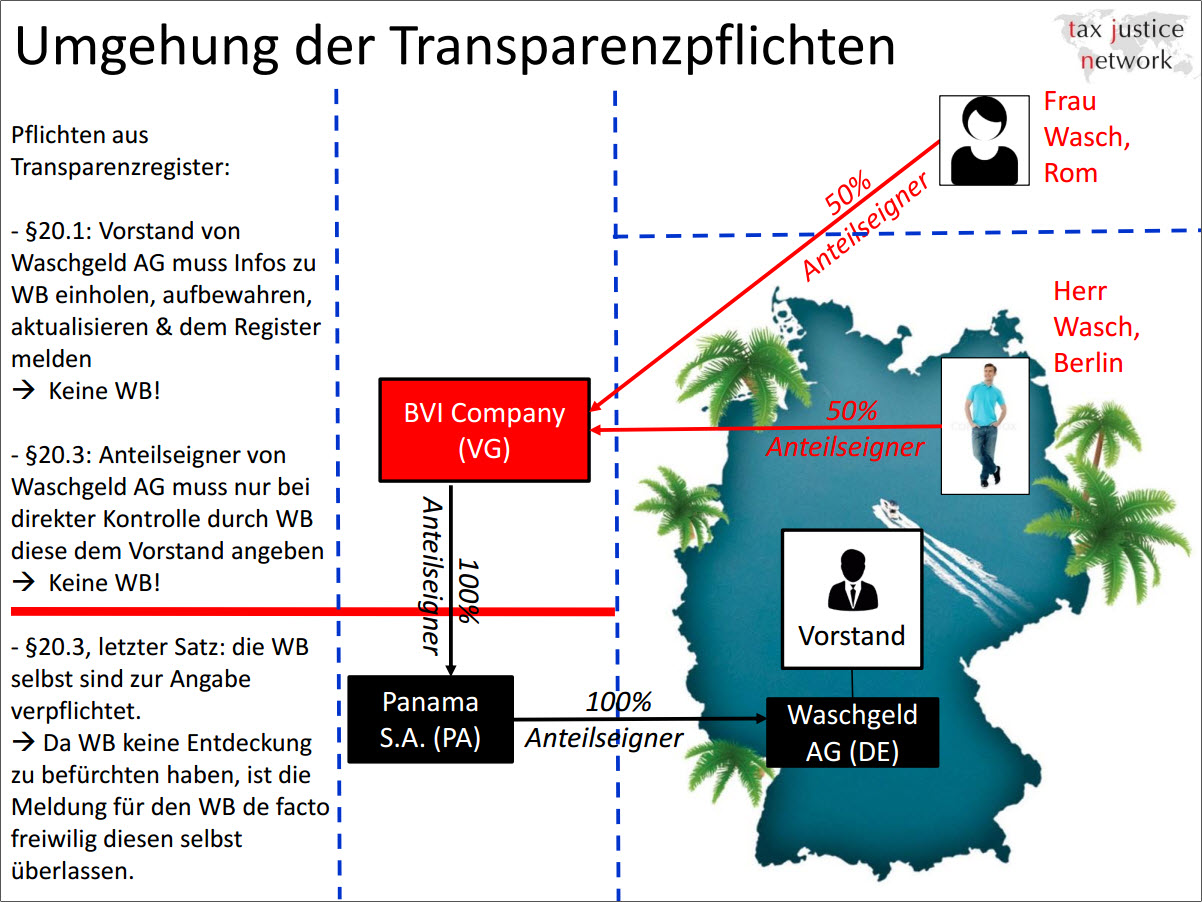
The second problem relates to the obligation to identify the beneficial owner for the purposes of the registry. The obligation to identify and report the beneficial owner of the company is limited to situations in which the German company or its shareholders are directly controlled by a beneficial owner. The graph below (or in the written statement on page 4) illustrates the problem.

Schaubild-Umgehung-Transparenzregister

Continue reading “Germany rejects beneficial ownership transparency”

Our May 2017 Spanish language Podcast: Justicia ImPositiva, nuestro podcast de mayo 2017

Welcome to this month’s latest podcast and radio programme in Spanish with Marcelo Justo and Marta Nuñez, downloaded and broadcast on radio networks across Latin America and Spain. ¡Bienvenidos y bienvenidas a nuestro podcast y programa radiofónica! (abajo en castellano).

In this month’s programme:

Continue reading “Our May 2017 Spanish language Podcast: Justicia ImPositiva, nuestro podcast de mayo 2017”

Jainism and Ethical Finance

“The financial crisis of 2008 has led to a re-evaluation of the role of financial institutions and their relationship with the wider economy and society. There is an increased questioning of both the conduct of business itself and the principles behind commercial and financial activities. Yet non-western voices have been notably absent from this debate, as have alternatives to the dominant western-derived economic ideologies.”

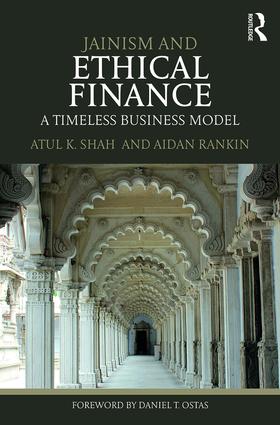
This is part of the description of a new book by Senior Lecturer in Accounting & Finance at the University of Suffolk, Atul K. Shah PhD (also author of ‘Celebrating Diversity’). His latest book is co-written with Dr Aidan Rankin and is called Jainism and Ethical Finance: A Timeless Business Model.

EthicalFinance Continue reading “Jainism and Ethical Finance”

The Achilles heel of effective beneficial ownership registration: Why is everyone fixed on 25%?

Civil society and allies are pushing for real (and useful) transparency when it comes to disclosing the beneficial owners (BOs) of companies, meaning the individuals who ultimately own and control the companies that operate in our economies, and that could be involved in illegal activities (e.g. tax evasion, corruption, money laundering, etc.).

After many scandals, including the Panama Papers, the international community is moving in that direction, with the G20, the OECD, the Global Forum, the EU and many countries starting to regulate and require beneficial ownership registration. index Continue reading “The Achilles heel of effective beneficial ownership registration: Why is everyone fixed on 25%?”

The U.K. post-general election: strong, stable and still kind to criminals

The British Prime Minister Theresa May has called a snap general election. We’d like to share with you the thoughts of Dr Mary Alice Young (Bristol Law School, University of the West of England) and Dr Michael Woodiwiss (Arts and Cultural Industries, University of the West of England) on the implications for the UK’s secrecy jurisdictions or satellite havens and for corruption opportunities globally: Continue reading “The U.K. post-general election: strong, stable and still kind to criminals”

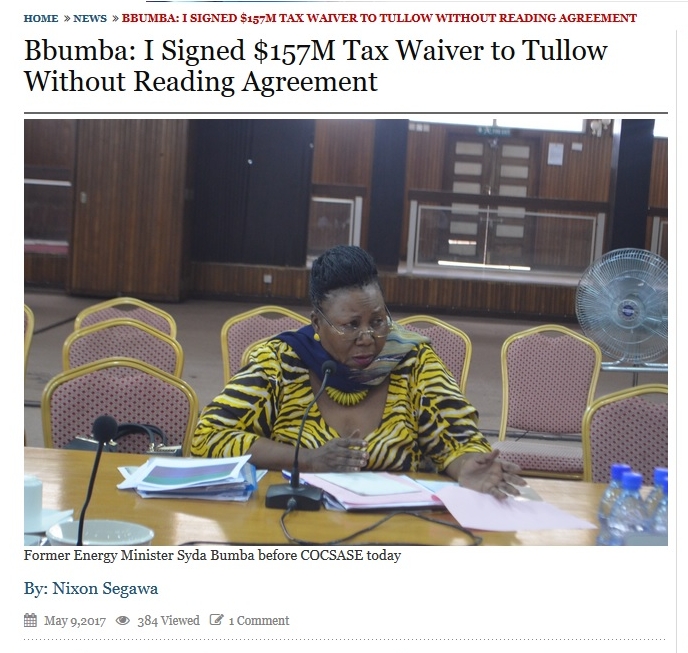
Bbumba: I Signed $157M Tax Waiver to Oil Company Without Reading Agreement

From TJN’s Department of ‘You Couldn’t Make This Up’: the East African press is reporting that Uganda’s former Energy Minister, Syda Bhumba, has confirmed that she signed a tax waiver agreement with UK company, Tullow Oil, without reading the document.  The waiver, which exempted both income and capital gains from tax, is being disputed by the Uganda Revenue Authority on the grounds that she had no authority to sign such a waiver since authority in this area lies with the Finance Minister.

Clipboard01 Continue reading “Bbumba: I Signed $157M Tax Waiver to Oil Company Without Reading Agreement”

Sweden’s recipe for success: high taxes, strong unions, and equal distribution of wealth

While recent elections in France, U.K. and the U.S.A. have shown the results of globalisation gone bad, Sweden has successfully adapted its development model to make globalisation work for the majority of its people.  Continue reading “Sweden’s recipe for success: high taxes, strong unions, and equal distribution of wealth”

Forthcoming book: Tax Havens and International Human Rights Law

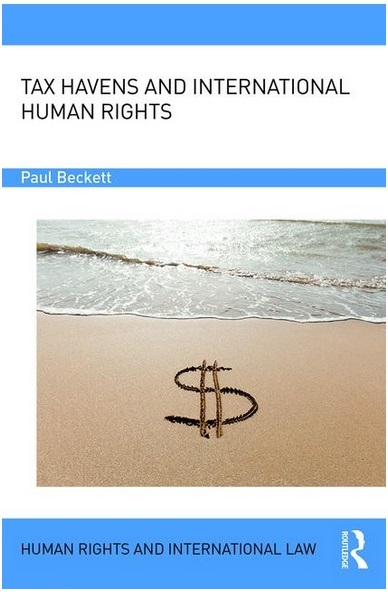
yTax havens cause enormous damage, not least because they block governments from fulfilling their human rights obligations.  When rich people and powerful businesses evade paying taxes by using offshore tax havens they deprive states of the revenues they need to deliver on their commitments to provide education, health, justice and security.  In this forthcoming book, Isle of Man-based lawyer Paul Beckett takes a human rights-based approach to the uses of tax havens and considers how the governments of tax havens actively connive with the process of breaching human rights.  Continue reading “Forthcoming book: Tax Havens and International Human Rights Law”

Developing countries’ access to CbCR: Guess who’s (not) coming to OECD dinner

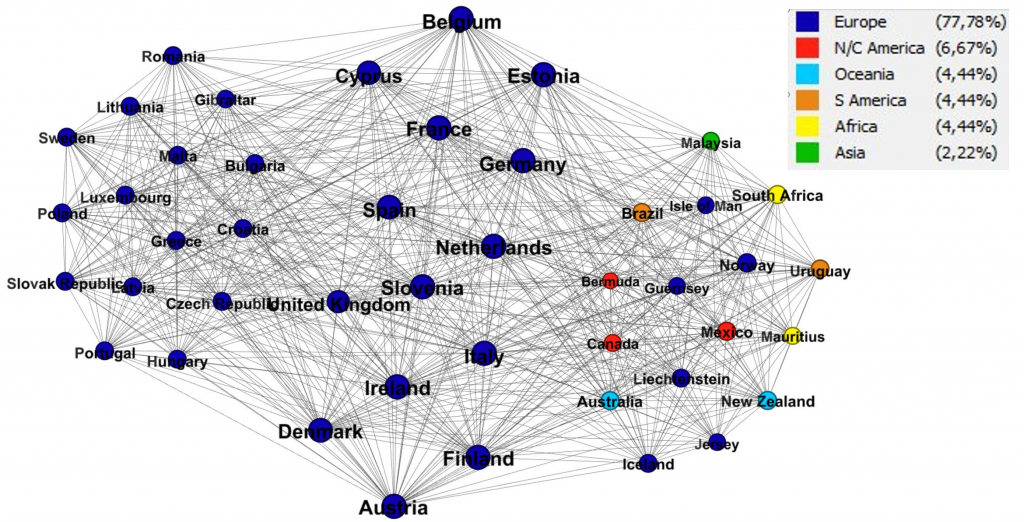
It’s said that if you’re not at the table, you’re on the menu. Well, the OECD has just made available the list of activated relationships to automatically exchange country-by-country reports between countries. They use big figures like 700 relationships, but don’t get fooled by those numbers – simply look at the image below to see who really has access to CbCR.

Oh, by the way, there’s nothing wrong with your eye-sight. Developing countries are just not there…

phdskat cbcr relationships may17

Source: Rasmus Christensen (https://twitter.com/phdskat/status/860093952992608256?s=09), by kind permission

The problem is that instead of requiring a fully multilateral approach, the OECD has allowed bilateral relationships to the automatic exchange of CbCR. This makes it harder for more jurisdictions to exchange CbCR, and more costly to arrange – and in practice results in the exclusion of nearly all lower-income countries:

Some jurisdictions also continue to work towards agreeing bilateral competent authority agreements for the automatic exchange of CbC Reports with specific partners under Double Tax Conventions or Tax Information Exchange Agreements

Now, think of a major country that doesn’t appear on the image and is definitely choosing the bilateral approach when it comes to non-OECD countries. Hint 1:  its very many multinationals (MNEs) have aggressively pursued profit shifting, so that the misalignment of their global profits away from the locations of their real economic activity has gone from just 5% in the 1990s to more than 25% now. Hint 2: this country won’t be joining the CRS (the global framework for automatic exchange of banking information) either.

Continue reading “Developing countries’ access to CbCR: Guess who’s (not) coming to OECD dinner”

Paying a ‘Fair Share’: new brief on taxing multinational companies

yIn this new brief just published by the Sheffield Political Economics Research Institute authors John Mikler and Ainsley Elbra address the issue of global corporate tax avoidance and consider how multinational corporations can be made to pay their fair share of tax. Continue reading “Paying a ‘Fair Share’: new brief on taxing multinational companies”

Coming Soon: The Spider’s Web – a film about Britain’s tax haven empire

y-1-768x146

#RogueLondon

Film maker Michael Oswald and TJN’s John Christensen have co-produced a new film about Britain’s tax haven empire.  Titled The Spider’s Web: Britain’s Second Empire, the film is ready for release. It draws heavily on Nick Shaxson’s ground-breaking book Treasure Islands and uses historical footage to show how successive British governments have put tax havenry at the heart of Britain’s development strategy for over half a century.

You can get the opportunity to see this by attending the Tax Justice annual conference GLOBAL TAX JUSTICE AT A CROSSROADS: SOUTHERN LEADERSHIP AND THE CHALLENGES OF TRUMP AND BREXIT in London on 5th and 6th July where we will screen the film. You can register for the conference here. We’ll be publishing the finalised programme of speakers very soon.

Continue reading “Coming Soon: The Spider’s Web – a film about Britain’s tax haven empire”

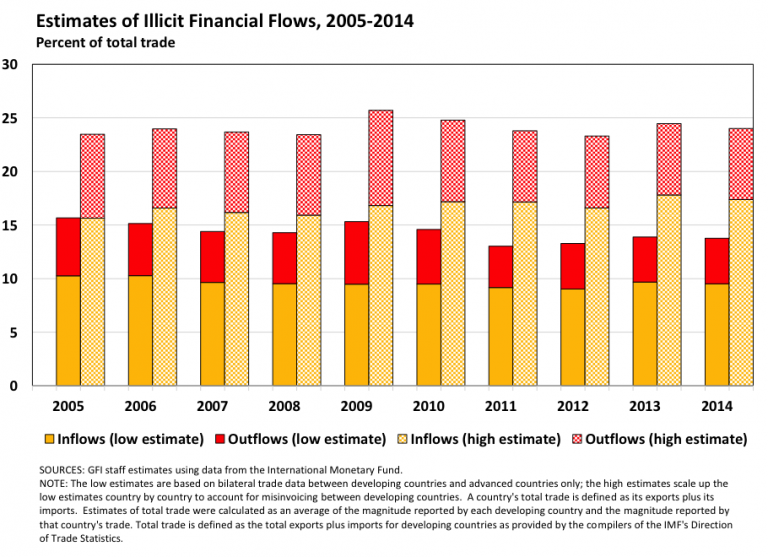
Estimates on illicit flows to and from developing countries

Our friends at Global Financial Integrity have released their latest report on what they estimate to be the latest figures from 150 countries on illicit financial flows to and from developing countries for the period 2005-2014. Most of these flows arise from fraudulent trade mis-invoicing which, as they point out, adversely affects the lives of real people:

“The massive flows of illicit capital shown in this study represent diversions of resources from their most efficient social uses in developing economies and are likely to adversely impact domestic resource mobilization and hamper sustainable economic growth.”

Flows

Interestingly, in addition to the estimated outflows GFI has looked at, this report also estimates illicit inflows to developing countries:

“Illicit inflows frequently occur when imports are under-invoiced for the purpose of evading customs duties and VAT taxes. The magnitude of estimated illicit inflows in the latest year (2014) ranges from $1.4 to $2.5 trillion. This large range reflects the fact that more precise calculations are difficult to make using available data.”

Continue reading “Estimates on illicit flows to and from developing countries”

The Independent Commission for the Reform of International Corporate Taxation is hiring

The Independent Commission for the Reform of International Corporate Taxation is hiring. As part of the coalition that initiated ICRICT, we’re sharing the details with you below. Please see the job description below for full details and if you want to apply, please send your CV and a covering letter to: [email protected] by the closing date of 21 May 2017. Please put “ICRICT media” as the subject of the e-mail when applying. Continue reading “The Independent Commission for the Reform of International Corporate Taxation is hiring”

Do you want to know how much tax multinational companies pay?

Yes, so would we… And now there’s an action today on twitter which we can all take to help this become reality.

All EU banks have been obliged to report their profits and tax paid on a country by country basis since 2015. And not just to tax authorities behind closed doors, but publicly. Because of that we now know for example that “Europe’s 20 biggest banks are registering over a quarter of their profits in tax havens – well out of proportion to the level of real economic activity that occurs there.” We also now know that Barclays (the 5th biggest European bank) registered €557m of its profits in Luxembourg and paid only €1m in taxes in 2015 – an effective rate of 0.2%. You can read more on all this in Oxfam’s report Opening the Vaults: The use of tax havens by Europe’s biggest banks.

Bringing these facts into the daylight creates considerable pressure on governments to take action. But now we need to extend *public* country-by-country reporting urgently to all multinationals. It is unacceptable in the 21st century that multinational companies can continue to obscure the real contributions they make to the societies from where they make their profits.

Continue reading “Do you want to know how much tax multinational companies pay?”

Research shows UK’s Finance Curse grip tightening in next five years

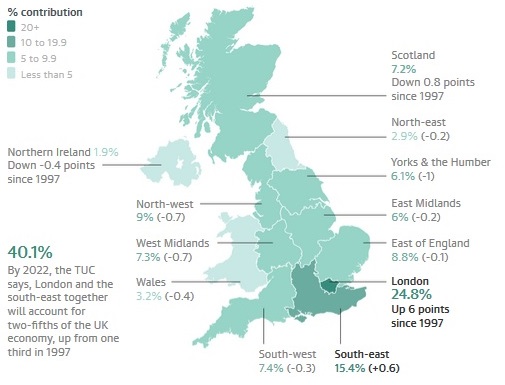
Graphic: Guardian newspaper. Date sources: Office of National Statistics and Trade Unions Congress

Graphic: Guardian newspaper. Date sources: Office of National Statistics and Trade Unions Congress

Britain’s Trade Unions Congress has published projections showing the increasingly unbalanced growth of the UK economy.  As you can see from this map, economic activity is skewed in the direction of England’s south-east region, which includes London. It’s forecast to produce 40.1 percent of the UK’s gross domestic product by 2022.  Given the importance of the City of London’s offshore financial centre to the region, this is a vivid demonstration of the Finance Curse in action.

Continue reading “Research shows UK’s Finance Curse grip tightening in next five years”

Why taxation STILL isn’t theft…

It came to our attention recently that a blog written for us by Associate Professor of Philosophy at Central European University Philip Goff prompted extensive discussion. The blog was called No, it’s not your money: why taxation isn’t theft. This concept that taxes paid by individuals and companies, used by government for the provision of public services are somehow ‘theft’ seems to excite a lot of people. Continue reading “Why taxation STILL isn’t theft…”

President Trump visits La-La-Laffer Land

Inspired by Mad magazine

        Inspired by Mad magazine

Taken as a whole, the tax plans just announced by US President Donald Trump, which include abolition of the inheritance tax, could represent the largest tax cut for billionaires and millionaires in US history.  According to the President, this will stimulate growth and job creation.  There’s no evidence to support this; in fact the evidence suggests the exact opposite. Continue reading “President Trump visits La-La-Laffer Land”