


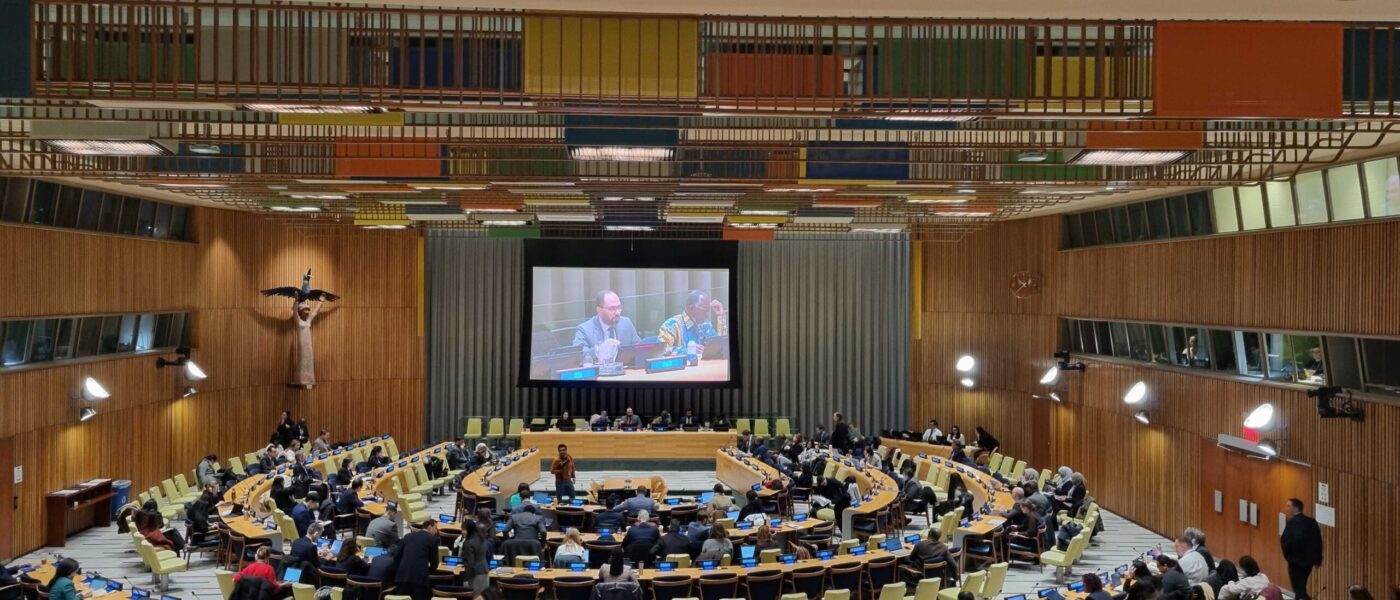
The fourth session of negotiations on a world-first UN Framework Convention on International Tax Cooperation concluded last week in New York, bringing countries significantly closer to a consolidated zero draft ahead of the August negotiation session.[1] Over eight days, governments progressed from scoping core elements of the Convention to examining more detailed options, including possible draft text, across the Convention and its two protocols.
Two paths for global tax rule-making
The session highlighted a stark contrast in global tax rule-making. While countries negotiated openly and transparently at the United Nations, a number of governments had moved in parallel behind the closed doors of the OECD to agree a “side-by-side” arrangement exempting US multinationals from elements of the global minimum tax.[2] The divergence underscores what is at stake: whether global tax rules will be shaped through inclusive multilateral cooperation, or fragmented through selective exemptions and political bargaining.
This contrast extended beyond process to substance, shaping how ambition was defined within the UN negotiations themselves.
Tensions surfaced early in the session over stakeholder participation, after Russia and Türkiye objected to the inclusion of certain civil society organisations and associations of parliamentarians. Participation was ultimately upheld, reinforcing the open and multilateral character of the UN process.
Debates on sustainable development revealed political fault lines over what a “high-level” framework should mean in practice. Some delegations argued that Article 4 should remain broad and principle-based, with operational detail developed later through protocols. Others warned that without clearer standards and guardrails in the core text, sustainable development would remain aspirational rather than enforceable. Jamaica cautioned that leaving the text unchanged risks turning sustainable development into “a fleeting illusion to be pursued but never attained,” explicitly invoking Bob Marley’s song War, itself based on a famous anti-colonial speech delivered at the United Nations by Ethiopian leader Haile Selassie.[3]
The question of how much substance should sit in the Convention itself, and how much be deferred to future protocols, exposed a broader struggle over the depth of change. The dispute over what a “high-level” framework should contain was not merely semantic; it reflected a contest over whether the Convention would embed enforceable standards in its core text or postpone substance to later negotiations. And that contest did not unfold only between governments. As delegations negotiated the boundaries of ambition inside the room, corporate actors were actively seeking to shape those boundaries from the outside.
Corporate lobbying and contested ambition
During the session, the International Chamber of Commerce mounted an unusually visible lobbying push, circulating and promoting a report claiming that proposed UN rules on taxing cross-border services would leave global South countries worse off. The proposal in question, for global implementation of Article 12AA of the UN Model, would allow countries to apply withholding taxes on certain payments to foreign service providers as a way to curb profit shifting and protect domestic tax bases. Several OECD delegates publicly praised the ICC report in the room, elevating its claims within the negotiations.[4]
A review by the Tax Justice Network found that the report relies on a model so deeply flawed that “the results are meaningless at best, if not deliberate distortions to serve a lobbying agenda.” [5] First, the report claims to present findings for the global South despite excluding from its sample the majority of those countries and including barely a fifth of African Group members. Second, the report’s findings rest on the claim that the global South is a net exporter of services, a claim that rests entirely on the aggregation of a sample group including China and India and that is false for most individual countries. In addition, the report fails to account for the benefits of the revenues that the proposal would raise and makes unsupported assumptions about foreign investment impacts in order to obtain its finding.
The gravest problem with the ICC report, however, is a much simpler one. The model and its findings rest on a recent study from the International Monetary Fund. That study directly contradicts the ICC report’s headline claims, making it difficult to see how such a mistake could have been made.
The intensity of corporate lobbying and parallel OECD manoeuvres reflected the scale of change under discussion. Proposals tabled at the UN would rebalance taxing rights, strengthen source-country claims and embed capacity building as implementation infrastructure rather than optional assistance — shifts that would materially alter how multinational corporations are taxed.
Alex Cobham, chief executive at the Tax Justice Network, said:
“First, it’s impressive that we’re seeing such rapid progress in the UN negotiations. Detailed discussions on article after article have laid the basis for the full draft text that will be tabled for the August negotiation session. And the ambition of the commitments in the terms of reference agreed at the UN General Assembly remains fully intact.
But this session also made clear the conflicts that need to be resolved. Many OECD countries, despite having just given up billions in tax revenue by being forced to exempt US multinationals from the global minimum tax, appear still to be dragging their feet over an ambitious deal. It’s as if they think that the current tax rules still protect them at the expense of countries of the global South, when the evidence is overwhelmingly clear that OECD members, including the UK and EU, have become the biggest losers under this failed system.
These negotiations are not a zero-sum game. Almost every country in the world stands to gain, and handsomely, from a collective defence of tax sovereignty.
Meanwhile, the business lobby, in the form of the International Chamber of Commerce, has shown how seriously it is taking the talks. For three days, OECD countries were singing the praises of what was quickly revealed to be a shockingly misleading piece of research. The ICC consultants produced a model based on an International Monetary Fund study and contrived to reverse the central result of that study in order to make their case. Perhaps Canada and other cheerleaders will be a little more cautious next time.”
Competing visions for the global tax system
Across the session, negotiations advanced under Protocol 1 on cross-border services, including discussion of how taxing rights should be triggered and applied in a digitalised economy. Delegates debated nexus rules based on payment, market engagement and physical presence, as well as the balance between gross withholding and net taxation. Divisions remained over how the Protocol should interact with existing bilateral tax treaties, with some countries supporting an automatic, multilateral override of conflicting treaty provisions, and others favouring a more cautious opt-in approach similar to the OECD Multilateral Instrument.
Throughout the session, many of the most substantive reform proposals originated from the African Group and other G77 members. These included expanded nexus rules reflecting digitalised economies, stronger monitoring of harmful tax practices, clearer commitments on illicit financial flows [6], and embedding capacity building as implementation infrastructure rather than optional assistance. By contrast, several OECD members focused primarily on safeguards, legal certainty and preserving existing treaty balances.
A consistent divide emerged over the scale of reform required. Structural proposals came largely from countries long disadvantaged by the current system, while others emphasised restraint and incremental adjustment. A striking passage of discussion saw some OECD countries highlight the scale of change, with the possibility of more than 3,000 bilateral tax treaties being renegotiated or overridden. A delegate from the African Union noted that this would only be the case if it were accepted that all of these treaties resulted in an unfair allocation of taxing rights between countries, which would simply illustrate the necessary scale of change.
In the workstream negotiating Protocol 2, governments confronted longstanding asymmetries in dispute prevention and resolution. Mutual agreement procedures emerged as the common baseline, while views on arbitration remained sharply divided. Nigeria, India and Zambia led opposition to both mandatory and optional arbitration on grounds of sovereignty and cost, while several high-income countries favoured retention of arbitration as an option.
Delegates further examined harmful tax practices, illicit financial flows, sustainable development and capacity building. Many developing countries stressed that capacity building must be embedded as implementation infrastructure rather than treated as optional assistance, ensuring that the Convention does not reproduce existing inequalities in administrative capacity or access to information. Further discussions lie ahead on the full range of information to be exchanged, and on the types of information to be collated centrally and regularly published by Convention subsidiary bodies. This information will be key to the accountability of the Convention and its signatories, ensuring that a fair allocation of taxing rights is the ultimate and visible outcome.
Liz Nelson, director of advocacy and research at the Tax Justice Network, said:
“The 4th UNFCITC session continued to move along a policy reform tightrope. The negotiations advanced discussions on triggering and applying taxing rights under Protocol 1 on taxing cross-border services, while discussions on Protocol 2 addressed current asymmetries in dispute resolution.
Looking ahead, a shift in power towards multilateral tax cooperation lies within reach. This seismic reform would establish tax sovereignty for all countries. A collective wobble, however, would risk a business-as-usual scenario with a compromised, fragmented and less effective UN framework convention, where inequalities between North and South are entrenched and the majority in all countries pay the price for political short-termism.
The balance hinges on collective political nerve, where cooperation among all countries becomes paramount to defend the tax sovereignty of each. Above all, we need OECD governments to stop throwing away their people’s current and future revenues out of some misplaced belief that they can appease this US administration and its corporate lobby. By acting with the global South instead, they can deliver ambitious outcomes to the benefit of all: for equality, sustainable development and human rights.”
The decision ahead
With zero draft texts now in preparation, the next negotiation phase will test whether governments translate the ambition of the Terms of Reference into enforceable commitments. Over eight days, Member States grappled with the practical implications of redesigning international tax cooperation, revealing not only technical disagreements but fundamentally different visions of how power, certainty and sovereignty should be distributed in the global system. Negotiations are advancing in the open at the United Nations, even as political resistance and corporate lobbying intensify in parallel.
The coming months of intersessional talks will determine first full draft texts to be tabled before the August negotiation session and ultimately whether global tax rules are reshaped through inclusive multilateral cooperation or constrained by exemptions, side deals and a damaging insistence by OECD countries on defending the failed status quo.
-ENDS-
Notes to editor
- For updates, summaries and analysis of the UN tax convention negotiations, see our dedicated webpage here. You can see more detailed information on specific elements being negotiated in this section of the webpage.
- Read the OECD’s announcement here.
- Article 4 of the draft Convention concerns sustainable development. For a recap of the discussion on sustainable development, see the corresponding dropdown in the “Build-a-Convention” tracker section of our dedicated webpage. More details of Bob Marley’s song War and the speech on which it is based can be found here.
- The International Chamber of Commerce report refers to analysis of Article 12AA of the United Nations Model Double Taxation Convention between Developed and Developing Countries. Article 12AA would allow source countries to apply withholding tax on certain cross-border service payments in order to protect domestic tax bases from profit shifting. The ICC report is available here.
- The Tax Justice Network’s review of the International Chamber of Commerce report identifies significant methodological flaws, including the exclusion of most African Group countries from the modelling, reliance on an International Monetary Fund study whose findings contradict the report’s conclusions, failure to account for additional tax revenues raised under Article 12AA, and unsupported assumptions regarding foreign investment effects. Our review and a one-page summary are available here.
- See this blog for more information about these discussions on illicit financial flows and their implications.