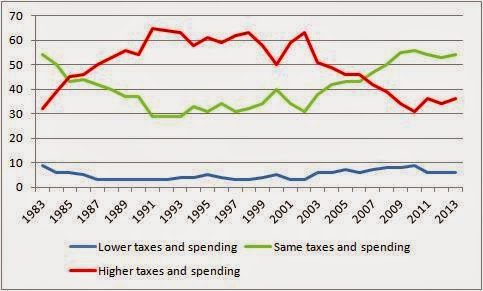
Well, that clearly depends on the country, and the time of day. Britain is reputed to be one of the more conservative, lower-tax ones, at least among OECD countries. But this graph, from Oxford economics professor Simon Wren-Lewis about UK attitudes on the size of the state, should certainly give its politicians pause for thought.
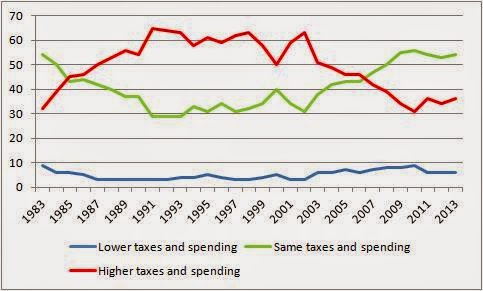
The graph, which draws on data from the British Social Attitudes Survey 2014, kind of speaks for itself, but he summarises:
“The interesting result is how few people want lower taxes – always below 10%. The changes involve shifts between more spending and taxes to no change, rather than to lower spending and taxes.”
Rather like TJN, in fact. It’s not correct to say that we generally advocate “higher” taxes (which begs the question, ‘higher than what?’) We just like to push back steadily against the evidence-free assertions, routinely peddled by corporate shills and politicians, that tax cuts are the route to a brighter future, always.
Just saying.
The author

Related articles

UN tax convention hub – updates & resources

UN Framework Convention – Roundup of the Fifth Session of Negotiations
Notes on the UN tax convention draft protocol on dispute prevention and resolution
11 September 2026

The European Court of Justice strikes against transparency again. Our response should be to call for an end to corporate limited liability
Report of the Fifth Session of negotiations on the UN tax convention
4 September 2026
Submission to Workstream I on Co-Lead’s Zero Draft of UN Framework Convention on International Tax Cooperation (post-Fifth Session)
28 August 2026
Submission to Workstream II on Taxation of Income from Cross-Border Services (post-Fifth Session)
26 August 2026
Strengthening public resource mobilization through tax justice
25 August 2026
Submission to Workstream III on Dispute Prevention and Resolution (post-Fifth Session)
24 August 2026

From data to policy: Building Africa’s evidence ecosystem for better tax reform