

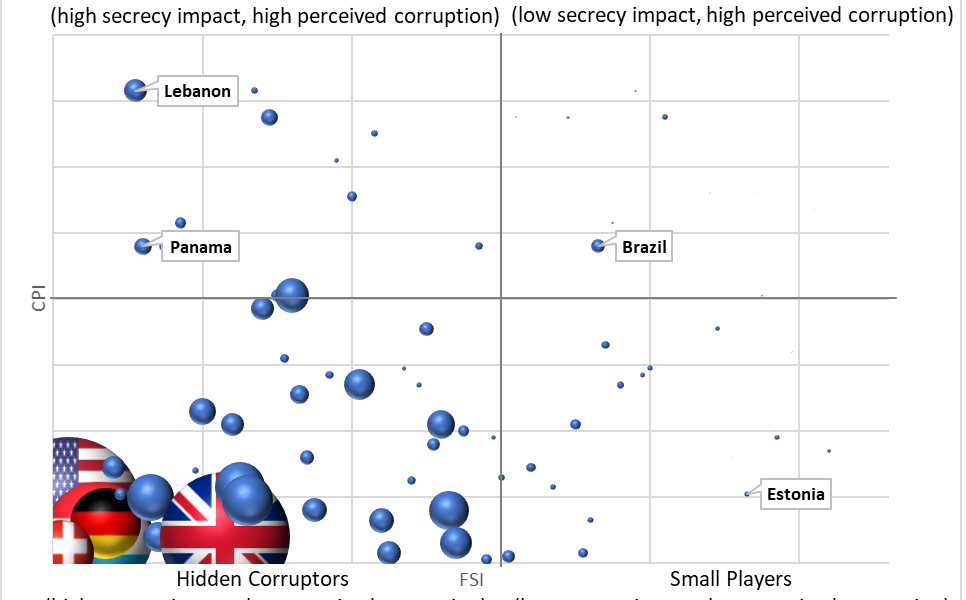
On February 22nd, 2018, Transparency International published the latest edition of the Corruption Perception Index, less than a month after the publication of TJN’s Financial Secrecy Index.
Comparing Transparency International’s Corruption Perception Index (CPI) and TJN’s Financial Secrecy Index (FSI) may be like comparing apples to oranges. Not only do they measure different things, but the way they measure them is completely different: the Corruption Perception Index, as its names indicates, it’s based on people’s perceptions. The FSI in contrast, considers objectively verifiable criteria, such as a country’s actual laws or whether a country signed relevant multilateral conventions or whether they comply with international standards (e.g. anti-money laundering).
Nevertheless, visually, both indexes reveal an interesting story.
The Corruption Perception Index suggests that Africa, Latin America and Asia are perceived as the most corrupt (dark red), by the international and country experts who participate in the surveys that are aggregated in the CPI. If local corruption in those countries were actually as bad as this small group of people perceive it to be, it would raise the question: who is enabling that corruption? Who benefits? Where might the crimes and the proceeds be hidden? The Financial Secrecy Index answers that question: countries in Europe and North America, where local corruption is perceived to be low, are objectively the worst offenders in enabling global corruption and illicit financial flows.
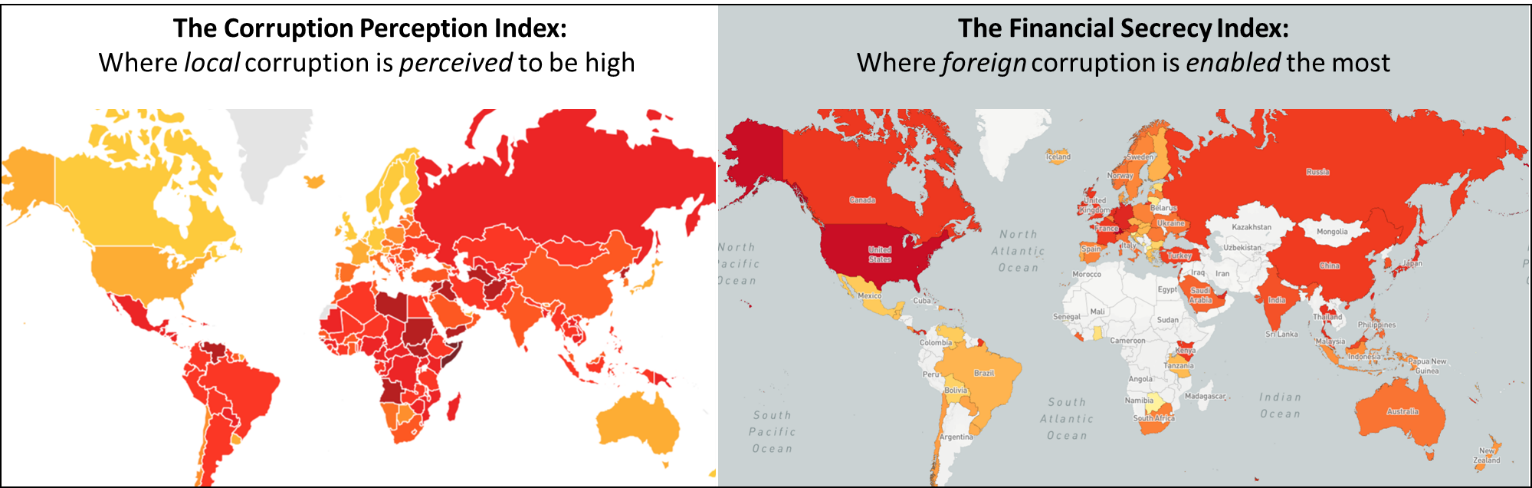 Source: Author’s elaboration based on Transparency International’s map and 23degrees’s map of TJN’s Financial Secrecy Index
The author

Related articles
UN tax convention hub – updates & resources

The ‘wealth exodus’ was manufactured by the press. The press complaints body IPSO must investigate or step aside.

Review: Bloomberg’s reporting of an exodus of billionaires worth $160 billion does not hold
Launching a new tool to reveal the global extent of illicit financial flows and how to tackle them

UN Framework Convention – Roundup of the Fifth Session of Negotiations
Notes on the UN tax convention draft protocol on dispute prevention and resolution
11 September 2026

The European Court of Justice strikes against transparency again. Our response should be to call for an end to corporate limited liability
Report of the Fifth Session of negotiations on the UN tax convention
4 September 2026
Submission to Workstream I on Co-Lead’s Zero Draft of UN Framework Convention on International Tax Cooperation (post-Fifth Session)
28 August 2026
Submission to Workstream II on Taxation of Income from Cross-Border Services (post-Fifth Session)
26 August 2026
Strengthening public resource mobilization through tax justice
25 August 2026