



Published:
5 November 2026Reading time:
7 minToday, the Tax Justice Network updated its Corporate Tax Haven Index with new data for two indicators. The index ranks countries by evaluating how much scope for corporate tax abuse their laws provide and by monitoring how much financial activity conducted by multinational corporations enters and exits their economies. Laws are evaluated against 18 indicators.
In this batch update, we focused on two of the indicators from the indicator group on transparency gaps. These two indicators are ‘transparency of company accounts’ and ‘reporting of tax avoidance schemes’.
In this blog, we’ll do a deep dive into the latter indicator, ‘reporting of tax avoidance schemes’. The indicator assesses two complementary transparency policies: the mandatory disclosure of potentially abusive tax planning arrangements and the reporting of uncertain tax positions. Both provide tax administrations with valuable information to identify and address tax compliance risks. Our focus in this blog is on the mandatory disclosure policy.
Mandatory reporting of tax avoidance schemes: what to report?
Mandatory disclosure rules (MDR) have been around for many years. The first country to adopt the policy was the United States in 1984. Initially, the US MDR’s disclosure obligation only fell on intermediaries (‘promoters’) who offered tax shelters for sale that yielded substantial tax savings. As of 2000, the US MDR regime was expanded by also requiring taxpayer-side disclosures of ‘listed transactions’ and later also of transactions with certain pre-defined features, known in the current MDR lingo as ‘hallmarks’.
Other early adopters of MDR, such as Canada, South Africa and the United Kingdom, also use hallmarks to define the scope of reporting obligations by identifying the features of tax schemes that may indicate potentially abusive tax planning. These hallmarks can be of a general nature, like ‘confidentiality’ (requiring the reporting of a scheme if a taxpayer is required to keep the scheme confidential) or ‘contingent fee’ (requiring the reporting of a scheme if the intermediary is paid for the advice proportionally to the tax savings achieved). The use of general hallmarks is typically combined with more targeted hallmarks that identify particular listed transactions or specific types of reportable aggressive or abusive transactions, such as schemes exploiting tax loss facilities or schemes converting highly-taxed income into low-taxed capital gains.
In 2015, as part of its BEPS Action Plan, the OECD tried to streamline and mainstream MDR policies among OECD countries and beyond. With BEPS Action 12, the OECD recognised the benefits of MDR regimes as a tool for enhancing transparency and helping tax administrations and tax policy makers to identify tax risks. By qualifying the BEPS Action 12 outputs as ‘best practices’ rather than a ‘common approach’ or a binding ‘minimum standard’, the OECD set the bar for the universal roll-out of MDR regimes painfully low.
As a consequence, very few countries took up the Action 12 recommendations and turned them into new national policies.
This has changed with the adoption by the European Union of ‘DAC6’, the fifth extension of the EU’s Directive on Administrative Cooperation (DAC). DAC6 requires the EU Member States to enact Action 12-style mandatory disclosure regimes in their domestic law while also requiring the automatic exchange of disclosed arrangements involving other EU member countries. As such, DAC6 goes well beyond the OECD’s recommendations in Action 12, which contemplate but do not provide clear pathways to effective information exchange. The only exception is the exchange of information regarding the specific case of CRS avoidance arrangements, for which the OECD/Global Forum has developed a dedicated instrument for automatic exchange of information. For countries’ adoption of this instrument (the MDR-MCAA), see the indicator on Automatic Exchange of Information of the Financial Secrecy Index.
The indicator on the reporting of tax avoidance schemes covers only the domestic aspect (and not the exchange element), namely the adoption of a mandatory disclosure regime.
Who reports: intermediary and/or taxpayer?
Mandatory disclosure regimes need to identify the person who is obliged to disclose under the regime. In its BEPS Action 12 Report, the OECD lists two available approaches: (1) both the intermediary and the taxpayer have the obligation to disclose separately; or (2) either the intermediary or the taxpayer has the obligation to disclose.
Under EU DAC6, the second option has been taken: intermediaries report first, and the obligation shifts to the taxpayer only where either there is no intermediary (as in the case of in-house tax planning), or the (only) intermediary is located outside the EU or relies on legal privilege not to disclose.
For the purpose of our indicator, we endorse the first option and give the best score to MDR regimes that require reporting both by the intermediary and by the taxpayer. There are a number of reasons why it is desirable to have both actors reporting. First, the chances that tax administrations effectively obtain information on dubious schemes are significantly higher when taxpayers and intermediaries are both made to report, in comparison to schemes reported only by either of them. This also provides back-up reporting in case one actor fails to fulfil their obligation to report, be it in bad faith or out of negligence. Moreover, the information provided by each can complement that provided by the other.
Our data shows that few MDR countries impose reporting obligations on both taxpayers and intermediaries. Most MDR countries, including most EU countries under DAC6, impose only a primary reporting obligation on the intermediary.
The data confirms: the patient has no more heartbeat
Our updated data for the indicator reveals an even more concerning trend: not only has the adoption of mandatory disclosure regimes stalled, with no new countries introducing such regimes since 2021, but the number of countries with MDR regimes has begun to decline. After the implementation of disclosure regimes by the ‘early adopter’ countries, the only spike in implementation of MDR was triggered among EU countries through the implementation of DAC6. For the remainder of the 70 jurisdictions tested, the implementation curve has mostly flatlined.

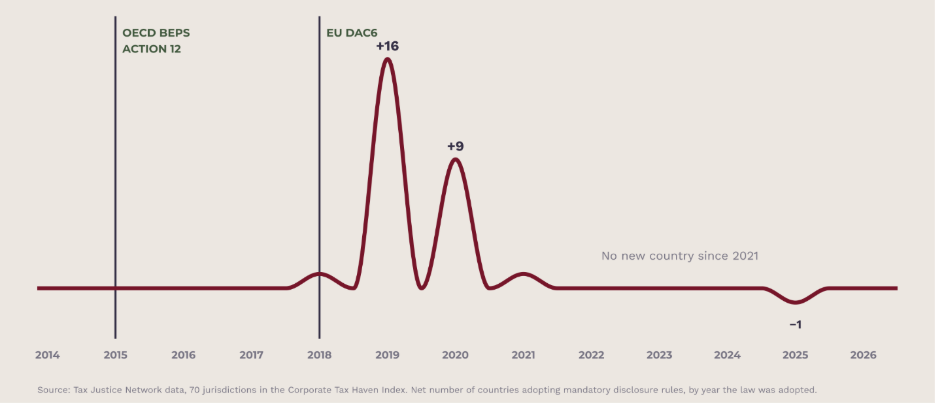

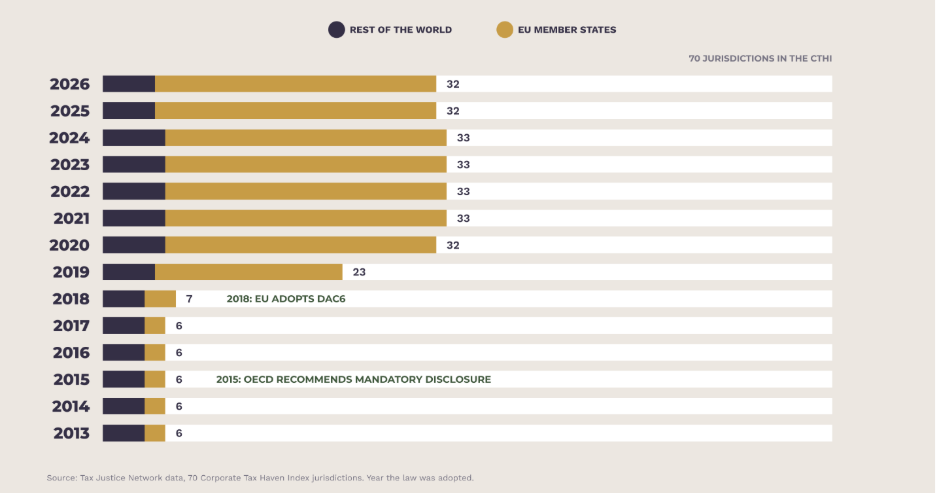
The abolition of Argentina’s domestic MDR regime for intermediaries in 2022 and for taxpayers in 2025 lowers the total number of countries with MDR regimes, as of October 2026, to 32 out of 70.
DAC6 recast, or miscast? The AI-generated elephant in the room
The data further confirms that the appetite for MDR regimes is not shared globally. Meanwhile, in the EU, DAC6 has been in the crosshairs of proponents of ‘tax simplification’, a euphemistic term used for the EU’s new deregulation agenda.
In June 2026, the EU Commission presented its plans for a general ‘recast’ of the DAC. The plans entail various changes to the EU’s Directive on administrative cooperation in the field of taxation, including DAC6’s provisions that govern the EU Member States’ MDR regimes.
The EU Commission’s plans include narrowing the scope of mandatory reporting by excluding the largest companies, whose cross-border tax avoidance risks are now considered to be addressed by the global minimum tax rules, while drastically simplifying reporting requirements for the smallest companies. In other words, in the future, EU MDR is expected to apply only to taxpayers that are not too big and not too small to be bothered with mandatory reporting.
The EU Commission also suggests deleting DAC6’s generic hallmarks, a move that would drastically curtail the effectiveness of MDR regimes in the EU: according to the EU Commission’s own impact analysis, approximately 35% of all reporting under DAC6 is currently attributable to the generic hallmarks.
At the EU Council, country delegations have largely been supportive of the EU Commission’s proposal to downsize DAC6, while emphasising the importance of effectiveness by retaining hallmarks which present the greatest risk of tax avoidance.
The world is on the brink of being overrun by AI agents, who also turn out to be excellent tax avoidance planners. In our view, the European Commission’s plan to reduce the DAC6 hallmarks rather than strengthen mandatory reporting to address the emerging challenges posed by AI risks turning the upcoming DAC reform into a ‘miscast’ rather than a ‘recast’.
As is not uncommon in the recent history of AI, the people most vested in the new technology are often the first ones to sound the alarm bells about its risks. Benjamin Alarie, CEO of Blue J Legal, a leading AI-powered tax and legal technology company, concluded a while back in an opinion piece on ‘AI and the future of tax avoidance’ that: “[t]ax authorities will need to scrutinize the use of AI in tax planning to prevent it from facilitating illegal activities like tax evasion. Tax professionals using AI systems must exercise due diligence to ensure compliance and avoid legal ramifications. The innovative tax avoidance strategies discovered by AI may blur the lines between lawful tax planning and illegal evasion, potentially leading to contentious legal disputes and a demand for clearer regulatory guidance regarding AI’s permissible use in tax matters.”
AI doing tax planning is no longer an abstract idea. In an experiment set up by Blair-Stanek, Holzenberger and Van Durme in 2025, the authors created a dataset named ‘Shelter Check’, which compiled 36 known US tax-avoidance strategies, including 29 strategies marked as ‘listed transactions’ under the US MDR regime. The authors tested the ability of various publicly available large language models (LLMs) to understand, evaluate and apply known tax minimisation strategies, and asked them to generate new ones. Not only were most LLMs able to fill any gaps deliberately left in the tax planning arrangements, but one of the LLMs even generated a brand new and legally sound avoidance strategy, something which the authors point out normally requires extensive effort from highly specialised and expensive tax lawyers.
In a follow-up paper, the same authors note that the LLM’s novel avoidance strategy would most likely be caught by the MDR regime as a strategy that was ‘substantially similar’ to listed reportable transactions and therefore itself a reportable transaction. But the authors draw important conclusions. First, they argue LLMs will only become more capable in both legal reasoning and retrieving relevant legal information. Second, accounting and law firms will be able to use AI to create tailored tax avoidance strategies for their clients, based on their clients’ unique background and facts. Such strategies will be more sophisticated and harder to detect by tax authorities.
For these reasons, Blair-Stanek et al. conclude that MDR regimes should make AI-generated strategies reportable transactions. The exact scope of an ‘AI hallmark’ will need to be carefully deliberated: a few tax lawyers working on a shared MS Word document with AI functionality should not count. But in the authors’ view, the alternative of not acting may yield a silent decline in tax revenues as AI increasingly allows taxpayers to optimise their tax affairs with bespoke strategies.
We share this last concern. While MDR adoption has flatlined in recent years, as shown in our data, the rise of AI may make it crucial for countries to resuscitate the patient. A re-envisaged MDR may very well turn out to be an important tool to preserve countries’ continued ability to raise tax revenues and ensure tax fairness in the age of AI.
The author

Related articles

Review: Bloomberg’s reporting of an exodus of billionaires worth $160 billion does not hold

Launching a new tool to reveal the global extent of illicit financial flows and how to tackle them

The European Court of Justice strikes against transparency again. Our response should be to call for an end to corporate limited liability
Strengthening public resource mobilization through tax justice
25 August 2026

From data to policy: Building Africa’s evidence ecosystem for better tax reform

New IMF AML Guidance pushes for beneficial ownership transparency and tackles risks from major financial centres

Public finance is feminist terrain

New Tax Justice Network reports on real estate transparency
Beneficial Ownership of Real Estate Around the World
7 July 2026
Integrating the Collection, Use and Exchange of Real Estate Ownership Information
7 July 2026