Published:
17 June 2026Reading time:
7 minTags:
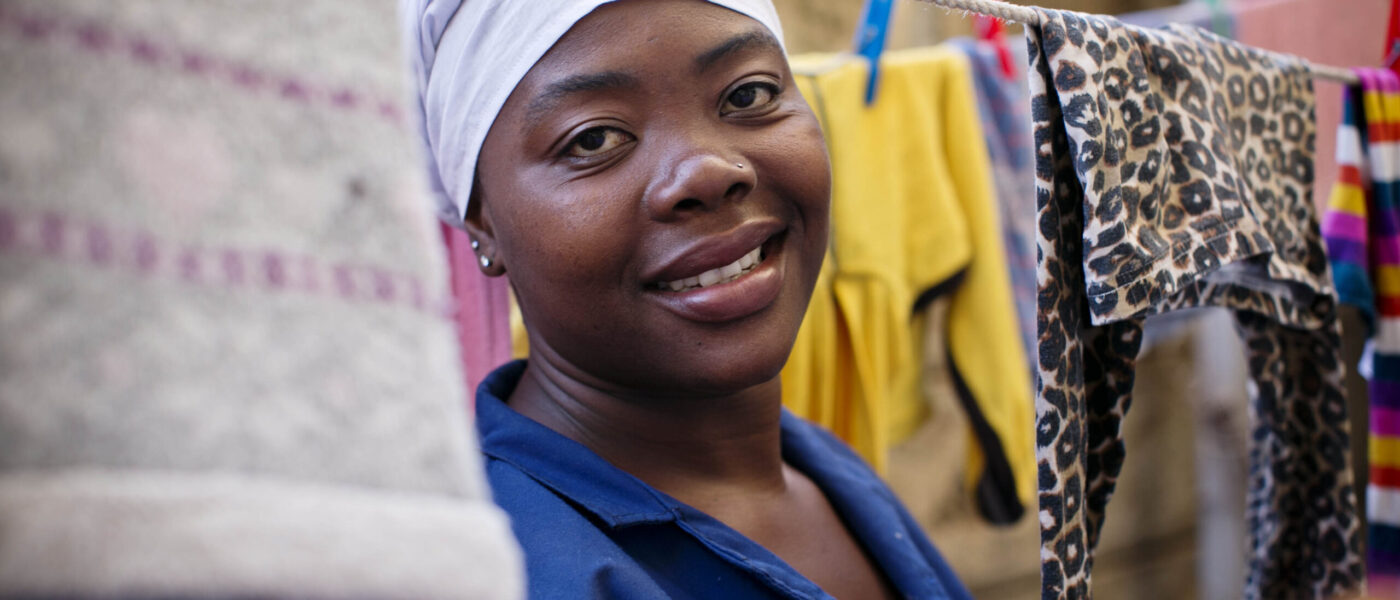
We’re pleased to share this blog from the Tax Justice Network chair Lyla Latif (Pan-African lawyer, academic, and policy strategist) on how domestic work platforms are replicating colonial labour exclusions in digital form. As Lyla writes: “This is not simply an administrative inefficiency. It is a form of structural injustice with fiscal mechanisms.” You can read the original blog here in The Elephant which provides African analysis, opinion and investigation. The image is Lucy Nyangasi, domestic worker, Kenya by Solidarity Center, licensed under CC BY 2.0.
There is a woman who crosses Johannesburg before dawn. She takes two taxis, changes in Bree Street, and arrives at a house in Sandton by seven. She will spend eight hours cleaning floors, scrubbing bathrooms, washing laundry, and caring for children who are not her own. She booked this job through an app on her phone, a platform that promises convenience to homeowners and flexibility to workers. By six that evening, she will be on her way home, exhausted, with R250 deposited into her bank account and nothing else to show for her labour. No Unemployment Insurance Fund contribution. No Compensation for Occupational Injuries and Diseases coverage. No formal tax record that would make her visible to the state as a worker deserving of protection. She is economically active, socially essential, and fiscally invisible.
This is the situation of hundreds of thousands of women working through domestic service platforms across Africa. SweepSouth, the largest such platform in South Africa, has over 1.2 million domestic cleaners registered on its app. The company’s own annual reports document that 92 per cent of these workers are women, the vast majority are Black, and 83 per cent are the sole financial providers for their families, and they are supporting an average of four dependents each. They are, in the language of economics, essential workers. In the language of the fiscal system, they do not exist.
To understand why this matters, one must go further back than the app, further back even than the post-apartheid constitutional settlement. The exclusion of domestic workers from labour and fiscal protection in South Africa was never accidental, it was a design feature of a colonial labour economy that needed Black women’s reproductive and care labour to be cheap, abundant, and invisible. The Natives (Urban Areas) Act of 1923, the Women’s Enfranchisement Act of 1930, and successive pass laws constructed a legal architecture in which Black women moved through cities as necessary to service white domestic life but were denied the civic status that would have made that service legally cognizable as work. They could not vote. They could not own urban property. They were excluded from the Unemployment Insurance Act of 1946 and from the Workmen’s Compensation Act of the same year on precisely the grounds that domestic service was not “real” employment within the meaning of those statutes. These were not neutral administrative decisions. They were the fiscal expression of a racial political economy that required the extraction of labour without the obligations of reciprocity.
The post-apartheid settlement has progressively extended formal protections to domestic workers through the Basic Conditions of Employment Act in 1997, the extension of Unemployment Insurance Fund coverage in 2002, the landmark Constitutional Court ruling in Mahlangu v Minister of Labour in 2021, which finally extended Compensation for Occupational Injuries and Diseases Act coverage to the domestic sector after a decades-long legal battle. Each of these victories was hard won and significant. Yet each has also been partial, operating at the margins of a fiscal and labour architecture that was built around the formal male waged worker as its normative subject. The platform model did not create this problem. It inherited it, systematized it, and gave it a new interface.
The promise of platform work was supposed to be different. The app would bring work to your fingertips. No more walking from house to house looking for “piece jobs”. No more uncertainty about whether you would earn anything today. The algorithm would match you with clients, the platform would handle payment, and everything would be documented, transparent, modern. Yet what has actually happened is something more troubling: the formalization of informality, the digitization of invisibility. The problem is not that these women are unregistered with the tax authority. Many of them are. The problem is that the entire fiscal architecture of the South African state was built around a model of the formal employee, someone who has an employer who deducts taxes at source, contributes to the Unemployment Insurance Fund, registers the worker with the Compensation Fund, and generates the documentary record of economic participation that makes a person legible to state institutions. The platform model deliberately avoids triggering any of these obligations by classifying workers as “independent contractors” rather than employees.
This classification is a legal fiction that merits examination under any honest application of the common law tests of employment. SweepSouth sets the prices. SweepSouth allocates the bookings. SweepSouth rates the workers and removes those whose ratings fall below the threshold. The platform controls every meaningful dimension of the working relationship, that is, the terms on which labour is offered, the discipline mechanism by which workers are sanctioned, the data through which their performance is assessed. But by calling these workers contractors, the company transforms what would be employer obligations into worker burdens. The woman cleaning the house in Sandton is now responsible for registering herself as a provisional taxpayer, filing biannual returns, and navigating a system designed for accountants and professionals. The results are predictable in that, according to SweepSouth’s own data, 77 per cent of domestic workers surveyed are not registered for Unemployment Insurance Fund. Only 12 per cent fully understand their rights under the Compensation for Occupational Injuries and Diseases Act. When a platform worker is injured cleaning a client’s home, she falls through a gap in the law: she is not an employee of the homeowner, and the platform denies that she is its employee either. The 2021 Mahlangu ruling, which extended the Compensation for Occupational Injuries and Diseases Act coverage to domestic workers, has not reached her.
The discipline of fiscal sociology, which traces the relationship between taxation, state formation, and social legitimacy, has long argued that a tax system encodes the political priorities of the state that designs it. Rudolf Goldscheid, writing in 1917, described the state budget as “the skeleton of the state stripped of all misleading ideologies”. More recently, scholars working in the tradition of feminist political economy, such as Kathleen Lahey and Miranda Stewart, have documented how tax systems systematically undervalue care work and reproduce gender hierarchies through apparently neutral rules. The South African fiscal system is an example of this dynamic in unusually sharp relief: a state that formally committed itself to gender equality and substantive transformation through its constitution continues to operate a tax and social insurance architecture that cannot see the economic contribution of the majority of women who work within its borders, precisely because those women do not work in the forms the system was built to recognize. Platform companies have understood this architecture better than the legislators who are supposed to regulate them, and they have designed their business models accordingly.
What makes this particularly urgent is that the model is replicating across the continent. Kenya has Lynk which operates with the same basic architecture of contractor classification and algorithmic management in the domestic and skilled trades sectors. Nigeria has Eden Life. Egypt has FilKhedma. Each of these platforms interacts with national fiscal systems that were not designed to see informal workers in the first place. These are systems inherited from or shaped by colonial administrations that likewise excluded domestic and care workers from formal fiscal recognition. The colonial and apartheid-era exclusions were constructed through explicit statutory text. The platform-era exclusions are constructed through contractual design and data architecture. The technical form has changed. The structural outcome has not. In each case, the state loses the fiscal data it would need to extend social protection, the worker loses the social protection to which she would otherwise be entitled, and the platform company captures the economic value of the labour without assuming the legal responsibilities of the employer.
The European Union has recognized this structural problem and moved to address it. The EU Platform Work Directive, which came into force in October 2024, establishes a rebuttable presumption of employment for platform workers across member states. This means that platforms like SweepSouth, were they operating in Europe, would be required to demonstrate that their workers are genuinely self-employed rather than placing the burden on exhausted, low-income women to prove that they have employment relationships they often do not fully understand. The Directive is imperfect; it took years of lobbying by platform companies to weaken its enforcement mechanisms, and transposition into member states’ national law will be contested. But it represents a legislative acknowledgement that the contractor classification model is a legal fiction incompatible with social protection obligations, and it places the burden of proof where the informational and legal power actually lies, that is, with the company. African states have no equivalent protection, and it is not sufficient to argue that African economies are “different” or that informality is somehow culturally embedded. Informality in Africa is structurally produced – by colonial labour law, by structural adjustment programmes that dismantled social protection systems in the 1980s and 1990s, and now by platform architectures that exploit the regulatory gaps those earlier transformations created.
Why does this matter beyond the individual hardship it produces? Because taxation is not merely about revenue collection. It is about the social contract between state and citizen, the mechanism through which economic contribution is recognized and social protection is earned. When a woman works for years through a platform, paying for transport, wearing out her body cleaning other people’s homes, and generating nothing that the fiscal state can see, something has fractured in the relationship between economic contribution and social protection. She is sustaining households. She is enabling the productivity of formal-sector workers who would otherwise have to provide their own childcare and domestic labour. She is performing work that the society she lives in cannot function without, and the systems that are supposed to recognize and reward economic contribution have no category for her existence. This is not simply an administrative inefficiency. It is a form of structural injustice with fiscal mechanisms.
The solution is not to extend the reach of existing systems without reconsidering their design premises. Fiscal systems built around the formal male waged worker cannot be made to see care work by simply adding a new registration category. They need to be redesigned on the premise that care work is economically valuable, that informal economic activity is legitimate economic activity, and that fiscal citizenship should not depend on participation in formal employment structures that were never designed to include the majority of those who work. This requires statutory reform in at least three directions: first, a rebuttable presumption of employment for platform workers that mirrors the EU approach but is adapted to African institutional contexts; second, care-adjusted social insurance contribution frameworks that account for the interrupted, part-time, and multi-employer nature of domestic and platform work; and third, algorithmic impact assessments for fiscal and labour systems, so that states can identify and remedy the discriminatory outcomes that digital management systems produce without anyone having consciously intended them. None of this is technically complicated. It is politically contested, because it would require platforms to assume costs they have successfully externalized onto workers and the public purse, and because it would require states to acknowledge that their fiscal architectures have reproduced, in digital form, the exclusions they formally committed themselves to dismantle.
This research forms part of Project TERRA (Technology, Equality, Regulatory Risk Assessment), a programme investigating how algorithmic systems interact with fiscal architectures to produce exclusion across Africa. The project is supported by Luminate and has enabled sustained research into the mechanisms through which digital transformation is reshaping how gender bias and fiscal policy interact across Africa. The woman crossing Johannesburg before dawn is not a marginal case. She represents the majority of those who labour in African economies, and her fiscal invisibility is not an oversight but an outcome, produced by specific legal choices that specific states have made or failed to make. The app did not create her invisibility. But it has perfected it, and the tax system is being asked to see her in a language it was never designed to speak.
Donate to Tax Justice Network
We rely on donations from people like you who value our research and campaigning to keep our work going. Help us do more work like the work above with a donation.
The author

Related articles
Public finance is feminist terrain

Four definitions to change the world: Struggles over meaning in the UN tax convention negotiations
Joint submission: International financial architecture, debt and the right to education
20 May 2026

Taxing Ethiopian women for bleeding
Tax justice and the women who hold broken systems together

What Kwame Nkrumah knew about profit shifting
The last chance
2 February 2026
The tax justice stories that defined 2025

Let’s make Elon Musk the world’s richest man this Christmas!