Published:
10 June 2026Reading time:
3 minI was often told that ending poverty required economic growth.
Grow the economy. Create more wealth. Raise incomes. And poverty will eventually disappear.
Yet after decades of growth-centred policymaking, poverty remains widespread, inequality continues to rise, and governments around the world struggle to fund the public services people depend on.
What if poverty is not just the result of economies growing too slowly? What if it is also shaped by political choices about who benefits from economic activity, who accumulates wealth, and who is expected to pay for the systems that keep societies functioning?
These are some of the questions explored in the Roadmap for Eradicating Poverty Beyond Growth, launched in April following a three-year collaborative process led by Olivier De Schutter’s team and involving hundreds of participants from civil society organisations, trade unions, research institutions, UN agencies and governments around the world.
The roadmap challenges the idea that economic growth alone can deliver social progress. Instead, it asks what would be needed to build economies centred on human wellbeing, social justice and ecological sustainability.
For the Tax Justice Network, the launch of the roadmap marks the culmination of a process we have been part of since 2024.
A shared process
Our involvement began when the UN Special Rapporteur on Extreme Poverty and Human Rights launched a call for inputs on eradicating poverty in a post-growth context.
In our 2024 submission, we argued that discussions about poverty cannot be separated from questions of tax abuse, wealth concentration and governments’ ability to raise revenue.
In 2025, we contributed again through a second call for inputs. This time, we focused on what tax justice looks like in a post-growth economy, including the role of corporate taxation and the unequal distribution of taxing rights between countries. We joined hundreds of organisations, researchers and advocates in contributing to the roadmap’s development from different areas of work and expertise.
Over the following year, the roadmap evolved through consultations, exchanges and discussions involving organisations working across a wide range of issues, from labour rights and social protection to climate justice and human rights.
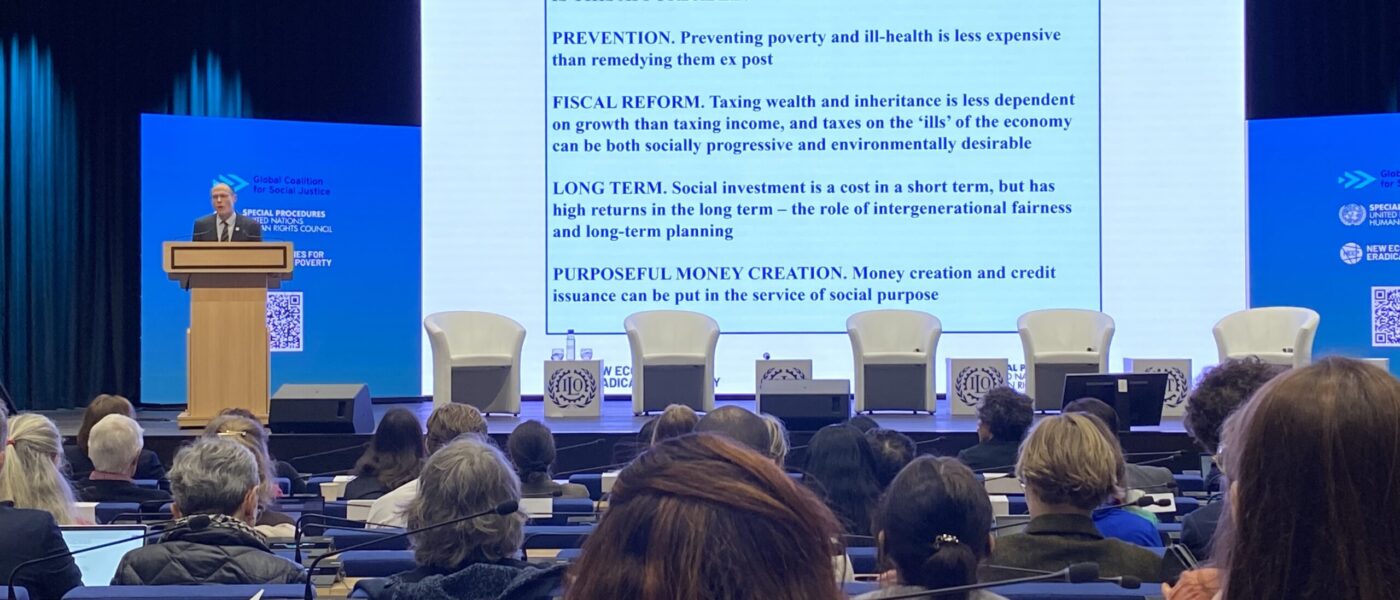
In April, many of those contributors gathered in Geneva for the roadmap’s launch conference to reflect on the process and discuss the next steps.
Tax justice in the roadmap process
One thing that stood out throughout the consultation process was how often discussions about poverty led to questions about public revenue.
Participants approached the conversation from very different perspectives – social protection, labour rights, public services, care work, climate action and human rights. Yet many of these discussions returned to a common challenge: how can governments reduce poverty and inequality if they lack the resources needed to invest in people?
For the Tax Justice Network, that question inevitably leads to tax.
Every year, governments lose an estimated US$492 billion to tax abuse by multinational corporations and wealthy individuals. These are resources that could otherwise be invested in healthcare, education, social protection and other measures aimed at reducing poverty and inequality.
Governments are currently negotiating a UN Framework Convention on International Tax Cooperation (UFCITC), which could reshape the global rules that determine where profits are taxed and who gets to tax them.
While the roadmap focuses on poverty eradication and the convention focuses on international tax cooperation, both processes raise related questions about economic governance, inequality and governments’ capacity to act. How can countries secure the revenues needed to fund public services? How can they curb cross-border tax abuse? And how can international rules better reflect the needs and priorities of all countries, particularly those that have historically had less influence over global tax rule-making?
What comes next?
The roadmap will be presented to the Human Rights Council on June 25, 2026. In addition, a series of policy briefs will now explore different aspects of the roadmap in greater depth. One of these, written by the Tax Justice Network and due to be published later this month, focuses on corporate taxation and the role it can play in supporting poverty reduction and more equitable economies.
Together, these briefs will deepen the evidence base underpinning the roadmap by exploring how different policy domains can contribute to a post-growth transition. By linking broad principles with concrete policy measures, they aim to support informed debate and help identify pathways towards more equitable and sustainable economies.
As this work move forward, we also welcome the appointment of Ms Elena Carolina Díaz Galán, as the new Special Rapporteur on Extreme Poverty and Human Rights. We look forward to continuing to support this agenda and helping hold governments and institutions accountable for the delivering the commitments needed to tackle poverty and inequality.
Donate to Tax Justice Network
We rely on donations from people like you who value our research and campaigning to keep our work going. Help us do more work like the work above with a donation.
The author

Related articles

The European Court of Justice strikes against transparency again. Our response should be to call for an end to corporate limited liability
Strengthening public resource mobilization through tax justice
25 August 2026
From data to policy: Building Africa’s evidence ecosystem for better tax reform

A heartfelt farewell to our dear Óscar

Public finance is feminist terrain

Four definitions to change the world: Struggles over meaning in the UN tax convention negotiations

Fiscal hell or mirage? What Spain’s wage debate gets wrong
The European Court of Human Rights has upheld the weaponisation of privacy to restrict tax authorities’ access to banking data
Q&A on California’s proposed legislation on Worldwide Combined Reporting (WWCR)
27 May 2026