Published:
7 June 2017Reading time:
2 minToday sees the signing ceremony of a new multilateral instrument (MLI) to limit the extent to which bilateral tax treaties create the conditions for large-scale multinational tax avoidance. The OECD’s Pascal Saint-Amans told the Financial Times (£) that “treaty shopping will be killed”. Treaty shopping describes the practice of multi-national companies in comparing and selecting which jurisdictions offer them treaties with the greatest possibilities for minimising their tax bills and maximising other sweeteners, thereby pitting one nation against another, driving a race to the bottom that harms everyone. It allows them to route investments through third countries to acquire the protection of investment treaties that investors would not otherwise have in their home state jurisdiction.
Deloitte’s Bill Dodwell called this new multilateral instrument “a big deal”, predicting that companies would see tax rises of 8-10%. The Financial Times article quotes our Alex Cobham who welcomes it while expressing some caution. Here’s the full statement:
A great many tax treaties reflect the imbalance of power between the signatories, and end up exacerbating the existing inequalities in taxing rights. Recent work on Irish and Dutch treaties, for example, highlight costs for lower-income country signatories; and our colleagues at Tax Justice Network – Africa has gone so far as to take the Kenyan government to court over the damage done by their treaty with Mauritius. While the MLI is not perfect, it does offer the prospect of removing a significant element of the discretion that allows the respective political power of the signatories to determine who will benefit.
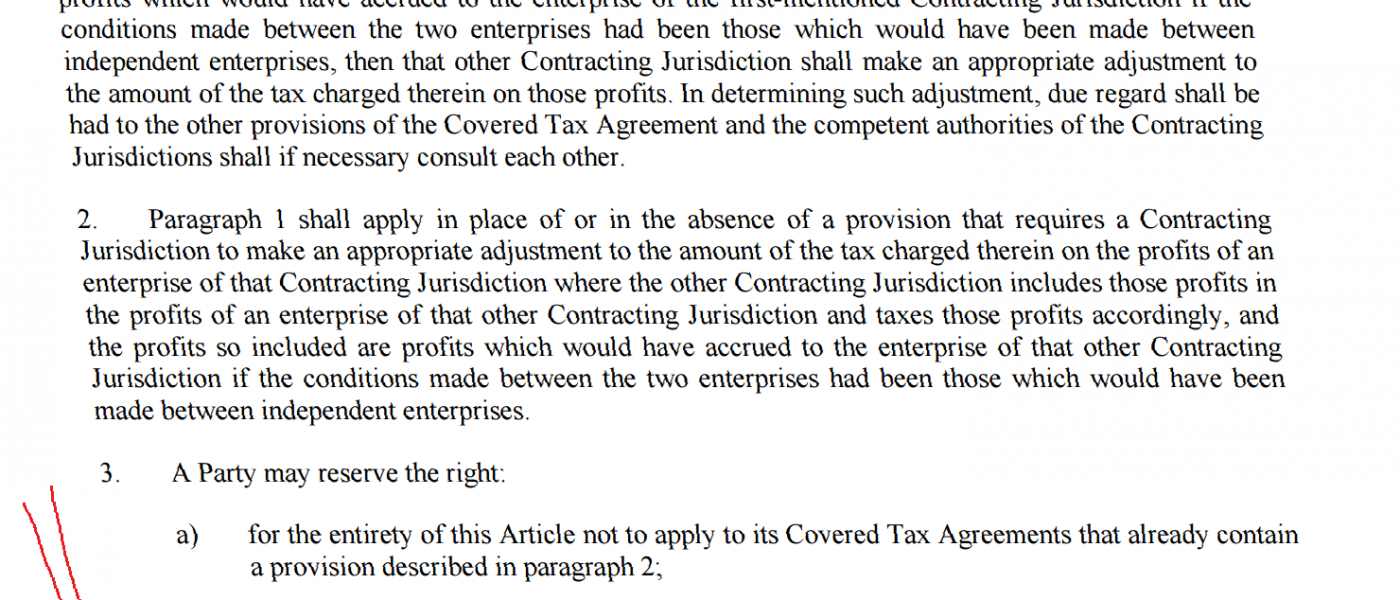
So while the OECD is somewhat over-optimistic in claiming this will end treaty shopping, it certainly tilts the balance back towards lower-income countries, because most of the provisions would strengthen source taxation. Countries can, and most certainly should, choose to opt out of the two particularly threatening provisions – namely Article 17 on the obligation to give a corresponding transfer pricing adjustment, and Part VI on mandatory binding arbitration, which would be dramatically disempowering to developing countries for no serious benefit.
A broader concern is the illegitimacy of the OECD as a members’ club, to impose this as a global deal on a take it or leave it basis. But lower-income countries would be well advised to sign up now, while opting out of Article 17 and Part VI – and then continue the fight for a globally representative tax body.
 So while the OECD is somewhat over-optimistic in claiming this will end treaty shopping, it certainly tilts the balance back towards lower-income countries, because most of the provisions would strengthen source taxation. Countries can, and most certainly should, choose to opt out of the two particularly threatening provisions – namely Article 17 on the obligation to give a corresponding transfer pricing adjustment, and Part VI on mandatory binding arbitration, which would be dramatically disempowering to developing countries for no serious benefit.
For a detailed analysis, the full report of the BEPS Monitoring Group is well worth reading.
And for further reading, we blogged about TJN Africa takng the Kenyan government to court over the Mauritius treaty here. Another blog of interest is Developing countries and tax treaties: learning from mistakes. And finally, we talk in more detail about tax treaties here.
The author

Related articles

UN tax convention hub – updates & resources

UN Framework Convention – Roundup of the Fifth Session of Negotiations
Notes on the UN tax convention draft protocol on dispute prevention and resolution
11 September 2026

The European Court of Justice strikes against transparency again. Our response should be to call for an end to corporate limited liability
Report of the Fifth Session of negotiations on the UN tax convention
4 September 2026
Submission to Workstream I on Co-Lead’s Zero Draft of UN Framework Convention on International Tax Cooperation (post-Fifth Session)
28 August 2026
Submission to Workstream II on Taxation of Income from Cross-Border Services (post-Fifth Session)
26 August 2026
Strengthening public resource mobilization through tax justice
25 August 2026
Submission to Workstream III on Dispute Prevention and Resolution (post-Fifth Session)
24 August 2026

From data to policy: Building Africa’s evidence ecosystem for better tax reform