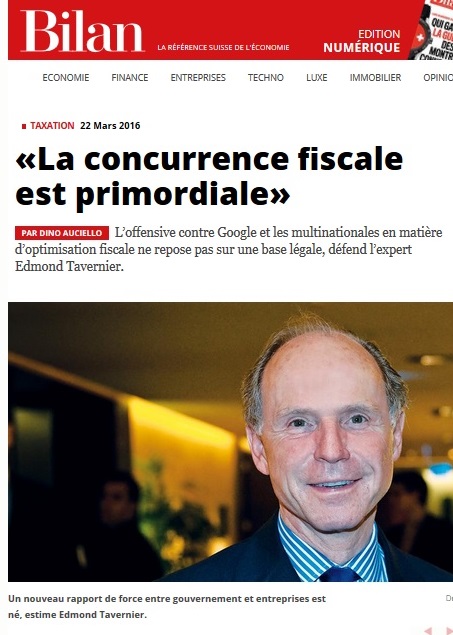
 This blogger has just been reading an article about tax competition in the Swiss Bilan magazine citing tax laywer Edmond Tavernier (who, BTW, has the dubious distinction of representing Lillian Bettencourt and Jérôme Cazuhac in their respective cases). What caught my attention was the expansive quote used as a headline: “La concurrence fiscale est primordiale” (Tax competition is primordial), which doubtless sounds deeply philosophical but when stripped down to its basics is dangerous ideological nonsense reflecting a particular worldview that is fundamentally anti-democratic and anti-social.
The key sentence in the article reads as follows:
“Alors qu’elle soutient la libre concurrence dans tous les autres domaines, l’OCDE veut éviter à tout prix la concurrence en matiere fiscale entre les etats, pourtant primordiale”
Which translates as follows:
“While supporting free competition in all other areas, the OECD wants to avoid at all cost competition in tax matters between the states, however vital”
Well that’s where Monsieur Tavernier needs to make his case, since as we have argued time and again, tax competition is a misnomer – tax wars more accurately describes the phenomenom he refers to – and there’s nothing whatsoever vital or primordial about the process. Let us spell it out clearly: tax competition is harmful in every respect. In dismissing, as he does, legitimate public concerns about tax dodging as populist and not engaging with the realities of tax systems, Tavernier appears oblivious of, or indifferent to, the widespread concerns about economic distortions caused by unnecessary tax reliefs, by economic free-riding, and by the activities of tax havens and their clients.
A decade ago this blogger published his first blog, also addressed to a tax haven-based lawyer with an obsessive interest in tax competition and no understanding of political economics. Neither Tavernier, nor Jersey’s Philip Bailhache, appear to have the slightest insight into how so-called tax competition undermines genuine competition by creating micro-economic market distortions that favour multinational businesses and disadvantage small and micro enterprises. Nor do they address the ways in which so-called tax competition nullifies Ricardian economic theory.
At the time of the earlier blog TJN invited Bailhache to publicly debate with us. He didn’t accept the invitation.
This time round we invite Tavernier to take up the challenge. We look forward to hearing from him (but won’t be holding our breath!)
The author

Related articles

UN tax convention hub – updates & resources

Launching a new tool to reveal the global extent of illicit financial flows and how to tackle them

UN Framework Convention – Roundup of the Fifth Session of Negotiations
Notes on the UN tax convention draft protocol on dispute prevention and resolution
11 September 2026

The European Court of Justice strikes against transparency again. Our response should be to call for an end to corporate limited liability
Report of the Fifth Session of negotiations on the UN tax convention
4 September 2026
Submission to Workstream I on Co-Lead’s Zero Draft of UN Framework Convention on International Tax Cooperation (post-Fifth Session)
28 August 2026
Submission to Workstream II on Taxation of Income from Cross-Border Services (post-Fifth Session)
26 August 2026
Strengthening public resource mobilization through tax justice
25 August 2026
Submission to Workstream III on Dispute Prevention and Resolution (post-Fifth Session)
24 August 2026