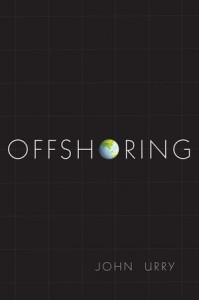
 From a useful long review of John Urry’s book Offshoring, which was published a year ago and tackles issues close to us:
“Whether it is the work of capital or governments, ‘offshoring and democracy are in direct conflict’ . Urry wisely refuses to entertain the idea that offshoring’s antipathy to regulation represents the promise of freedom. Offshoring in itself has no redeeming qualities. It entails the triumph of private greed over the commons, the externalization of costs and the production of ignorance. It reveals corporate capital and criminal capital becoming ‘progressively undifferentiated’, such that ‘members of the contemporary bourgeoisie behave more and more like criminals’. Ultimately, offshoring helps the ‘rich class’ to become richer while also allowing them to disentangle themselves from the fates of most of those with whom they share a planet.”
We can agree with all of that, and it’s a good summary of what’s gone wrong with the world economy. Essential reading for those exploring this area.
The author

Related articles
UN tax convention hub – updates & resources
Preparing for Nairobi: Navigating the new draft of the UN Framework Convention on International Tax Cooperation
26 November 2026

COP31 failed in Antalya. Nairobi is where we can start fixing it
The State of Tax Justice 2026
24 November 2026
What should we be worried about? Estimating bilateral illicit financial risk envelopes for major developed and developing economies
10 November 2026
What does the global FDI network actually look like? Opening the black box of offshore investment
10 November 2026
Mapping illicit financial networks linked to actors in countries with weak rule of law: A global investment census approach
10 November 2026

Indicator deep dive: Reporting of tax avoidance schemes

The ‘wealth exodus’ was manufactured by the press. The press complaints body IPSO must investigate or step aside.

Review: Bloomberg’s reporting of an exodus of billionaires worth $160 billion does not hold