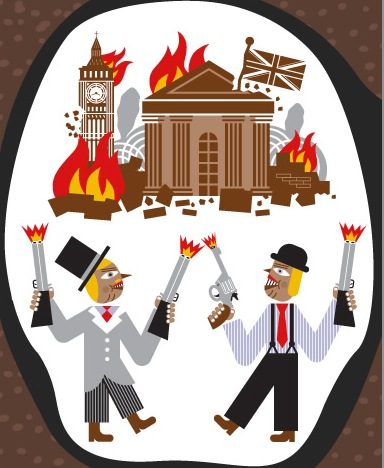
What the Finance Curse looks like, in practice
Update: another piece of research here.
From Project Syndicate, an article with an identical headline to ours by Howard Davies, former Chairman of the UK’s Financial Services Authority (FSA).
The article focuses on what the iconoclastic economist Andrew Haldane of the Bank of England has described as the financial sector’s
“ability to both invigorate and incapacitate large parts of the non-financial economy.”
Its an ability that we have described as a Finance Curse, analogous though not identical to the well-understood “Resource Curse” that afflicts mineral-rich countries, where billions or trillions of dollars wheeling into and through an economy from the dominant sector don’t seem to translate into better living standards for ordinary folk. The dominant sector, far from being a goose that lays the golden eggs that everyone imagines it to be, turns out to be a cuckoo in the nest.
It’s quite uncanny how close Davies’ analysis is to our way of viewing all this – all he’s missing, really, is to make the link with the Resource Curse. It’s one of those things where once you see it, it’s so obviously right.
Read on: it’s a really good article.
hat tip: dan Hind.
The author

Related articles
UN tax convention hub – updates & resources

UN Framework Convention – Roundup of the Fifth Session of Negotiations
Notes on the UN tax convention draft protocol on dispute prevention and resolution
11 September 2026

The European Court of Justice strikes against transparency again. Our response should be to call for an end to corporate limited liability
Report of the Fifth Session of negotiations on the UN tax convention
4 September 2026
Submission to Workstream I on Co-Lead’s Zero Draft of UN Framework Convention on International Tax Cooperation (post-Fifth Session)
28 August 2026
Submission to Workstream II on Taxation of Income from Cross-Border Services (post-Fifth Session)
26 August 2026
Strengthening public resource mobilization through tax justice
25 August 2026
Submission to Workstream III on Dispute Prevention and Resolution (post-Fifth Session)
24 August 2026
From data to policy: Building Africa’s evidence ecosystem for better tax reform