

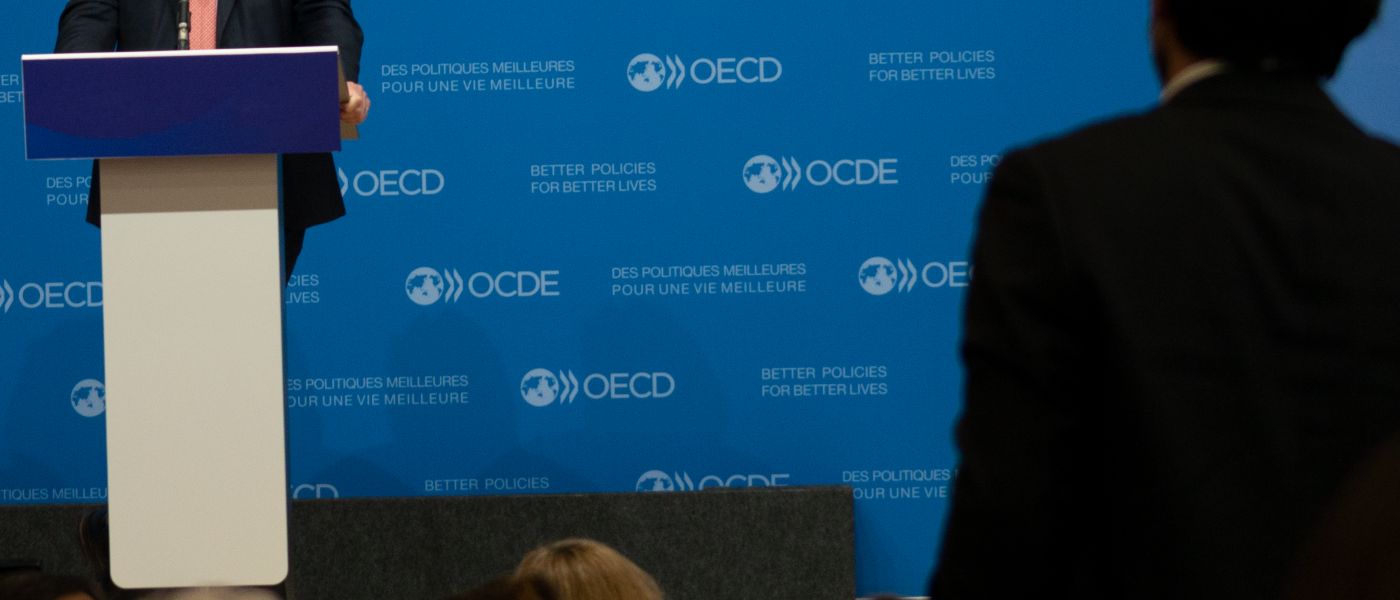
The OECD announced today the “side-by-side system” negotiated by member countries exempting the US from OECD’s Pillar 2 tax reform.1
Alex Cobham, chief executive at the Tax Justice Network, said:
“OECD countries, including EU countries and the UK, just forfeited to Donald Trump their sovereign right to tax businesses operating within their own borders. This is an alarming subjugation of state sovereignty – and yet it is being spun as a landmark tax deal.
“By the Tax Justice Network’s assessment, France for example is already losing $14 billion a year to tax cheating US firms, Germany is losing $16 billion and the UK is losing $9 billion.2 Today’s bending of the knee to Trump will cost countries billions more. But how much more? Tellingly, the OECD, which has delivered this shameful result, and OECD members have not put a number on the scale of tax losses that will result.
“It is baffling that no quantitative figures have been published by the OECD on the agreement it claims countries have reached. Either they are unwilling to tell the taxpaying citizens of countries how much the ‘deal’ is costing them, or they simply haven’t bothered to work it out. Either way, it is a complete dereliction of the organisation’s duty. On top of that, the organisation is so opaque that we cannot know how this decision was reached, or which countries supported or opposed it – because the OECD has no system, rules or procedures for collective decision-making, and simply claims that ‘consensus’ has been reached.
“Every government bending the knee to Trump today must be made to answer the question, how much tax revenue did the US bully you into giving up? If you’re not going to stand up for your people, at least be honest with them about how much you’re giving up. And if governments actually opposed this cave-in at the OECD, they should be shouting about it today.
“US multinational corporations today are shifting twice as much profit out of foreign countries and into the US as they were in 2016, when work at the OECD leading today’s deal first began. US multinationals are now responsible for just under a third of all countries’ losses to corporate tax abuse.
“Not only that, but the American people themselves lose the most to tax cheating by US firms. That’s right – this great victory for Trump will cost his own people the most.3
“This latest failure by the OECD to get a US government to respect the tax sovereignty of other countries was seen coming from a mile away by non-OECD countries, which is why they moved tax negotiations to the UN instead last year. More progress was made by non-OECD countries in a year of tax talks at the UN in 2025 than a decade of process at the OECD. While the US was up to its stale stall-then-ditch negotiation tricks at the OECD, the rest of the world at the UN moved one step closer to finally flipping ‘Rule 1’ of the global tax system and ending the era of global tax abuse.4
“We’ve seen this pattern play out for decades now, where the US and OECD stall countries from fixing tax rules by promising the US will come on board with reforms if they’re watered down and agreed at the OECD, only for the US to then side-step the reforms entirely after it gets others to delay and weaken them.
“Only this time the real talks on tax reform are happening at the UN, where the US has been absent. The most recent round of negotiations on a world-first UN tax convention last November put to debate the 100-year-old cornerstone of the global tax system. Countries already committed in the lead up to the negotiations to replace the cornerstone with a modern basis, but November’s talks made it clear that there is wide support in the UN to go far beyond what the OECD ever could on this. The little opposition remaining mostly came from OECD countries who have today forfeited their tax rights to Trump.
“Rule 1 of the global tax system is you tax multinational corporations where they declare their profits. This is the ‘pay-where-you-say’ approach and all other global tax rules are based on it. Modern multinational corporations exploit the ‘pay-where-you-say’ approach by moving profits into tax havens before declaring them, and as a result underpay $348 billion in tax every year. Countries must replace this with a ‘pay-where-you-play’ approach that taxes multinationals where they employ workers and sell goods and services. This would make tax havens – including, increasingly the US itself – obsolete overnight and improve the lives of people everywhere. The UN tax talks moved the world closer than it’s ever been to finally flipping that switch.5
“While the OECD tries to spin the US’s side-stepping of its decade-long process as a landmark deal, the UN is taking steps forward that were long thought impossible at the OECD. This is the last, best chance for governments to claw back the revenues they have given up today – and perhaps some self-respect too.”
-ENDS-
Notes to Editor
- Read the OECD’s announcement here.
- The State of Tax Justice 2025 report reveals a dramatic escalation in tax abuse by US multinational corporations set loose by Trump’s 2017 Tax Cuts and Jobs Act. US multinational corporations are now shifting twice as much profit out of the countries where they operate in and into the US, but are paying even less tax in the US than they were before Trump’s tax cuts were introduced. US multinationals did not bring their jobs stateside in return for the tax surrender.
- See note 2.
- Read about the latest round of negotiations on the UN tax convention here.
- Arguably, the most consequential feature of the current global tax system was established in the 1920’s by the League of Nations. This is the “arm’s-length-principle” which has served as the basis on which multinational corporations are taxed for a century. The principle treats the individual parts of a multinational corporation – its subsidiaries, headquarter, holding companies, etc – as separate businesses and taxes them separately. Each country taxes the parts located within its borders. This is the key principle that multinational corporations exploit when they shift profits out of one part of the corporation in one country and to another part in a corporate tax haven in order to underpay tax. We refer to this approach to tax as “pay-where-you-say” because it taxes multinational corporations based on where they declare their profits on paper – which can often be in a corporate tax haven where the only presence the corporation has is a mailbox it rents. The alternative to this approach is unitary taxation with formulary apportionment. This approach treats all the parts of multinational corporation as one entity, and requires the corporation to be taxed on the profit it makes as whole. Each country in which the multinational corporation operates – where it employs workers, makes goods and services and sells them – taxes a slice of the profits. The size of this slice is proportional to the slice of the multinational corporation’s operation that takes place within the country’s borders. So if a quarter of a multinational corporation’s workforce and sales are in Kenya, then a quarter of all the profit it declares, wherever it declares it, must be taxed by Kenya. Kenya taxes this profit in accordance with its corporate tax rate. We refer to this approach as “pay-where-you-play”. By requiring a multinational corporation’s profits to be proportionally taxed across the countries where it genuinely does real business, where each country can tax its allotted share of profit as it sees fit, unitary tax makes corporate tax havens redundant. A corporate tax haven may still choose to have a corporate tax rate of 0%, but if a multinational corporation doesn’t do real business in the tax haven and only rents a mailbox there, the share of the multinational’s profit that the tax haven can tax will be very small to non-existent. The OECD’s failed two-pillar proposals sought to narrowly implement unitary tax on a very few multinational corporations, but with deeply biased rules for how proportionality would be allotted that benefitted the richest countries and European tax havens. In 2024, the UN committed to a “fair allocation of taxing rights” in the Terms of Referenceof the UN Framework Convention on International Tax Cooperation, which is broadly understood to be best achieved by replacing the arms-length principle (pay where you say) with unitary tax (pay where you play). In 2025, the UN published the draft framework convention, which included Article 4 stating: “The States Parties agree that every jurisdiction where a taxpayer conducts business activities, including jurisdictions where value is created, markets are located and revenues are generated, have a right to tax the income generated from such business activities.” The November 2025 tax talks saw most countries, particularly countries from the global south, support the draft text of Article 4. The article would, in effect, flip the basis of the international tax system to a “pay-where-you-play” approach.