Published:
24 November 2026Reading time:
7 minThe world woke up this week to headlines declaring COP31 in Antalya a failure. What exactly failed, and who is to blame, is already in dispute. The European Union and a group of other countries opposed the cover decision, the overarching political text that sums up a COP’s main outcomes, because it made no mention of fossil fuels, the main driver of climate change. Other voices point to the failure elsewhere: to the unwillingness of rich countries to put a meaningful climate finance offer on the table, one in line with the urgency of the crisis and with their historical responsibility for causing it.
Both stories matter, but the second goes to the heart of why COP31 fell apart: without the means of implementation, above all finance from the countries most responsible for the crisis, even the strongest commitment to move away from fossil fuels stays on paper. Tackling the main cause of climate change is essential. Just as important is that low- and middle-income countries can do so in a way that underpins their own development, reducing their dependence on fossil fuels without trading it for new green extractivism. A transition that is not paid for remains a promise that the countries least responsible for the crisis cannot afford to keep. Every COP that ends without a credible answer on finance erodes the trust any future deal depends on.
Where is the money? Much of it is lost to tax abuse
If finance is at the heart of COP31’s failure, the fix cannot come from climate talks alone. Closing the climate finance gap will take action on several fronts at once: developed countries delivering on their obligations, debt relief, and reform of the international financial architecture. The rules on who gets to tax what, and where, are one of the key spaces where that gap has to be addressed. In just a week, countries will gather in Nairobi for a new round of negotiations on the UN Framework Convention on International Tax Cooperation, where they will discuss how these rules can be rewritten. The final text is due in July 2027.
The stakes are spelled out in our State of Tax Justice 2026 report. Every year, countries lose US$583 billion to cross-border tax abuse. Most of it, US$475 billion, comes from multinational corporations shifting profits out of the countries where they actually do business and into tax havens, where little or no tax is paid. Profit shifting passed US$3 trillion in 2023 alone, despite years of OECD reforms. Another US$109 billion is lost to wealthy individuals hiding their wealth offshore.
Put that next to the climate finance goal agreed at COP29 in Baku: high-income countries committed to take the lead in mobilising at least US$300 billion a year for middle- and low-income countries by 2035. The world loses almost twice that amount to tax abuse every single year. That is no reason for climate finance to wait on new tax revenues: developed countries’ commitments stand on their own. But it shows the money is there, and that leaving it on the table is a political choice.
Fixing the rules would pay off for everyone. If multinationals had been taxed where their real economic activity took place, the world would have collected 23% more corporate tax from them. G77 countries would have collected 31% more, and the African Group almost twice as much. Meanwhile, lower-income countries, largely locked out of the systems rich countries use to exchange information on offshore accounts and deprived of key transparency tools the UN tax convention could adopt, such as a Global Asset Registry and public country-by-country reporting, have seen their losses to hidden wealth and corporate tax abuse grow.
So why does so much money stay on the table? Not because the gains are uncertain, but because those who enable tax abuse hold ambition back, putting corporate interests ahead of their own people. Many of the same rich countries that host tax havens or shield financial secrecy are resisting a strong outcome at the UN tax negotiations, just as they resist a meaningful finance offer at the UNFCCC. Breaking that pattern means bringing the two conversations together.
Tax: the missing conversation at COP31
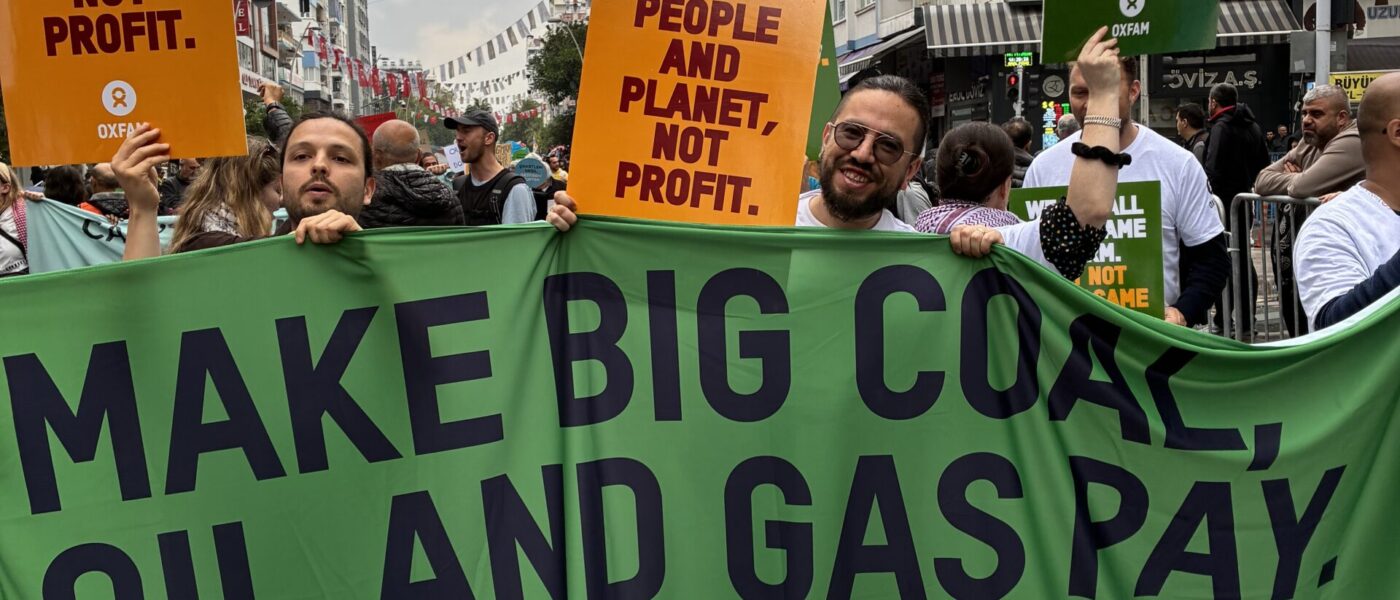
We at the Tax Justice Network went to Antalya to make exactly this point. We presented our work at the interregional meeting of Trade Unions for Energy Democracy (TUED), at an official side event organised by faith-based groups, and at the People’s Summit. We joined thousands of people for the People’s Climate March. On the final day of COP, we joined climate and tax organisations to convene a cross-movement dialogue between the two communities.
Yet taxes were barely discussed in the official talks. Economist Lucas Chancel made the point at a COP31 event on solidarity levies and taxation convened by the Global Solidarity Levies Task Force. Given how closely tax and climate are linked, he regretted that the UN tax convention was hardly mentioned at COP31, and that climate is hardly mentioned at the UN tax negotiations. “We need to have negotiators from both spaces speaking to each other,” he said.
The bridges are starting to be built. The Task Force’s new report, Raising Revenue, Building Resilience, calls the tax convention negotiations the most significant development in international tax cooperation, noting that “for the first time, governments are negotiating a universal framework” under UN auspices. It sees the convention as a platform to apply the polluter-pays principle to the fossil fuel sector. The report on implementing the Baku to Belém Roadmap to 1.3T, published by the COP30 Presidency, goes further. It estimates that a robust outcome to the tax negotiations could raise an additional US$500 billion every year, citing our research on global unitary taxation.
What a UN tax convention can do for climate action
Taxation matters for climate action in many more ways than raising revenue. Tax systems shape prices and investment decisions. They can end the subsidies and incentives that lock in fossil fuels, make polluters pay, and steer capital towards clean energy. Designed progressively, they can make sure the costs of the transition do not fall on workers and poorer households, and reduce inequality both between and within countries. The co-hosts’ report from the first Conference on Transitioning Away from Fossil Fuels in Santa Marta makes the link explicit. It treats tax as central to countries’ sovereign capacity for the transition, calling for “expanding fiscal space, including transformative action on tax and debt”, and names tax cooperation among the areas where greater coherence is needed for a just, orderly and equitable transition.
The most direct link sits in Article 4 of the draft convention, on sustainable development. Today it is a single, high-level sentence: countries agree to pursue tax cooperation that contributes to sustainable development in its economic, social and environmental dimensions. Strengthening it with an operative commitment to cooperate on tax measures that address environmental challenges, consistent with countries’ obligations under climate and environmental agreements, would make the regimes pull in the same direction. Tax rules would stop undercutting climate goals, and the future tax body would have a clear mandate to work with the climate regime instead of in parallel to it.
But the climate dividend does not depend on Article 4 alone. It runs through the core of the convention:
- Fair allocation of taxing rights. Taxing multinationals where their real economic activity takes place, as the strengthened Article 5 of the latest draft now points towards, would benefit both Global North and South nations and return revenue to the countries that host extraction, production and consumers, many of them on the front line of the climate crisis.
- Taxing high-net-worth individuals. The very richest have the largest carbon footprints and the most mobile wealth. A commitment to tax them effectively through cooperation would raise revenue while tackling inequality, which sits at the root of the crisis.
- Combating tax-related illicit financial flows. Every dollar hidden through tax evasion and avoidance is a dollar that never reaches adaptation, resilience, compensation for loss and damage or a just transition.
- Curbing harmful tax practices. The race to the bottom on tax rates and incentives drains public budgets and too often rewards polluting investment. Common principles and standards to identify and deter harmful tax practices, as the draft convention foresees, would stop countries being played off against each other to attract capital.
- Mutual cooperation on tax matters, including exchange of information. Giving every country, not only the richest, access to information on offshore wealth and corporate activity would let lower-income countries collect what they are already owed.
- Fair and effective governance. For the first time, every country would have an equal seat where global tax rules are set. A Conference of the Parties with decision-making rules that let progress continue when consensus fails, and with adequate and predictable resources, would give the convention the capacity to keep pace with crises like climate change rather than lag behind them.
Fixing Antalya starts in Nairobi
However the outcome in Antalya is read – whether as a failure of nerve on fossil fuels or a failure of responsibility on finance – one thing is clear. Climate finance will not be fixed at climate COPs alone. It also depends on the places where the world decides who pays tax, where, how much and which countries benefit the most, and the UN tax convention is one of the most important of them.
The call is getting louder beyond the negotiating rooms. On 21 November, the UN tax convention also featured in discussions at the First Paris Summit Against International Oligarchy, which brought together academics, policymakers and civil society voices from around the world, working on issues from taxation to the media and artificial intelligence. Their common thread: extreme wealth means extreme power, and tax justice sits at the core of any fight against that concentration. The summit launched the Paris Manifesto against the international oligarchy, now signed by more than 150 researchers and public figures. The same day, Thomas Piketty argued in Le Monde that the tax convention has the potential to change the world.
If the international community is serious about repairing the failures of COP31 that fill today’s headlines, it needs to look to the UN tax convention negotiations and raise its ambition in Nairobi. The money for a just transition is not missing. Much of it is lost to tax abuse every year, and the convention is one of the strongest tools we have to recover it. But its promise goes further: a fairer share of taxing rights for the countries where economic activity takes place, effective taxation of the super-rich, cooperation on tax measures that make polluters pay and end incentives that lock in fossil fuels in coherence with climate commitments, and an equal seat for every country where the rules are set. That is how tax systems can work for people and the planet.
Some will read Antalya as proof that multilateralism no longer works. They draw the wrong lesson. The climate regime has never agreed on rules for voting, so every decision needs consensus and a handful of countries can block progress for everyone else. The UN tax convention can learn from that by building fair decision-making rules in from the start, and by working in coherence with the climate and other conventions rather than in silos. A failed COP is not an argument against multilateralism. It is an argument for reinvigorating multilateralism, and Nairobi is a good place to start.
The author

Related articles
The State of Tax Justice 2026
24 November 2026
Launching a new tool to reveal the global extent of illicit financial flows and how to tackle them
UN Framework Convention – Roundup of the Fifth Session of Negotiations
Notes on the UN tax convention draft protocol on dispute prevention and resolution
11 September 2026

The European Court of Justice strikes against transparency again. Our response should be to call for an end to corporate limited liability
Report of the Fifth Session of negotiations on the UN tax convention
4 September 2026
Submission to Workstream I on Co-Lead’s Zero Draft of UN Framework Convention on International Tax Cooperation (post-Fifth Session)
28 August 2026
Submission to Workstream II on Taxation of Income from Cross-Border Services (post-Fifth Session)
26 August 2026
Submission to Workstream III on Dispute Prevention and Resolution (post-Fifth Session)
24 August 2026