Published:
15 October 2026Reading time:
8 minTax havens and secrecy jurisdictions facilitate the movement of trillions in illicit financial flows around the world, undetected and untaxed. A new tracker, launched by the Tax Justice Network at an event at City St George’s, University of London, on 17 September 2026, reveals how much tax revenue countries lose and which jurisdictions facilitate these losses.
Illicit financial flows are hidden by design. That is what makes them so damaging and so hard to measure. The UN defines them as flows that are “illicit in origin, transfer or use, that reflect an exchange of value and that cross country borders.” This includes the proceeds of corruption and crime, as well as the financing of terrorism. It also includes tax abuse: not only outright tax evasion, but also practices such as multinational companies shifting profits across borders to underpay tax. Illicit does not necessarily mean illegal: some of these practices are technically lawful but nevertheless undermine the purpose of the law.
Because these flows are deliberately concealed, they cannot be observed directly. But researchers have developed a range of methods to estimate their scale from the traces they leave in trade, financial and corporate data. The Tax Justice Network’s Illicit Financial Flows Tracker brings these estimates together in one place. It shows what we know about the scale of the problem, where the losses occur and where gaps in our knowledge remain. Every country has committed to significantly reducing illicit financial flows by 2030 under Sustainable Development Goal target 16.4. That commitment means little if we cannot measure what we are trying to reduce.
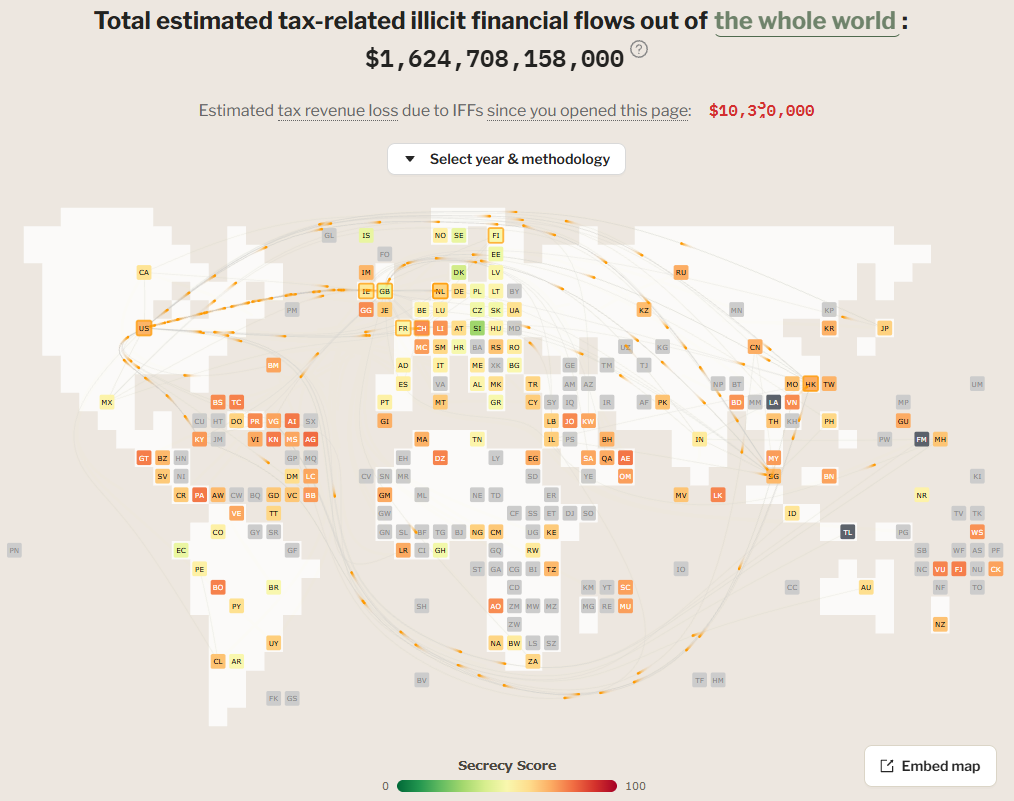
The tracker’s landing page displays a world map showing estimated tax-related illicit financial flows from affected countries to the countries responsible for facilitating them. The tracker covers two channels that account for the bulk of illicit financial flows, including most tax-related flows: corporate profit shifting and hidden offshore wealth (see Baker, 2005; Cobham & Janský, 2020; United Nations, 2022).
The tracker’s main estimate puts the combined value of these flows at US$1.62 trillion in 2022, the latest year for which data is available. Users can explore estimates dating back to 2016, the first year with reliable data. Although estimated illicit financial flows peaked at US$1.96 trillion in 2021, the overall trend has been upward. Users can also examine corporate profit shifting and hidden offshore wealth separately by switching either channel off.
Advanced users can select alternative estimation methods. Using the abnormality method for both channels, the estimated total rises to US$4.11 trillion. Differences between methodologies reflect the data sources and econometric techniques used to estimate illicit financial flows. The tracker’s methodology page explains these technical differences in greater detail. For most users, we recommend keeping the default methodology.
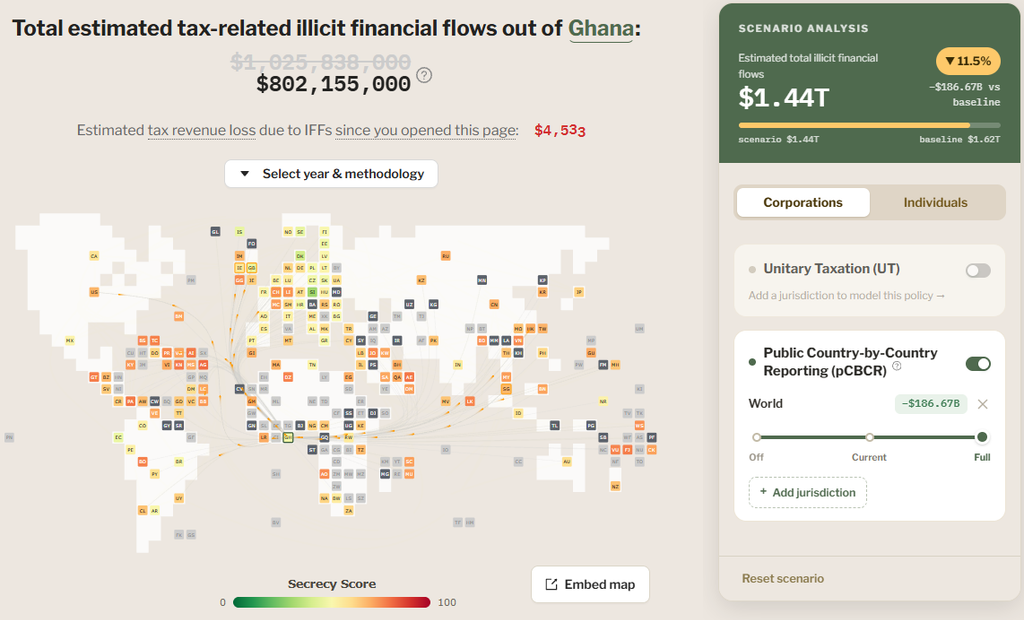
The world map, which can be embedded in other websites, is just the starting point. Users can also explore individual country profiles. For example, selecting Ghana reveals outward illicit financial flows estimated at US$1bn in 2022, with most flowing to Ireland, the UK, Singapore, Switzerland and Hong Kong (all of which rank highly on our Corporate Tax Haven Index and Financial Secrecy Index). Ghana loses between US$22m and US$38m in tax revenue annually to each of these jurisdictions facilitating the flows. The tracker therefore reveals not only how much tax revenue a country loses, but also which jurisdictions facilitate those losses. Each country profile also shows how illicit financial flows have changed over time, with the underlying data publicly available to download.
What sets the tracker apart is that it allows users to simulate how different policies could affect illicit financial flows. Four policies, two targeting corporate profit shifting and two targeting hidden offshore wealth, can be switched on or off for each country individually. These are automatic exchange of information, beneficial ownership, public country by country reporting (which together form the ABC of tax justice) and unitary taxation.
The methodology page explains the best available estimates of how these policies could affect illicit financial flows. For example, implementing public country by country reporting globally is estimated to reduce illicit financial flows by 11.5 per cent, with outward flows from countries such as Ghana falling by nearly a quarter. Similarly, implementing automatic exchange of information globally is estimated to reduce hidden offshore wealth by US$200bn. The tracker’s policy sliders illustrate both the potential impact of these reforms and why illicit financial flows remain a problem. Despite the availability of policy solutions, international coordination on their implementation remains insufficient, in part because these reforms would threaten the unfair tax advantages enjoyed by wealthy individuals and large multinational corporations.
This matters now because the opportunity for reform is greater than ever. In 2024, the UN General Assembly adopted the terms of reference for a UN Framework Convention on International Tax Cooperation, despite opposition from a handful of OECD members. These terms of reference commit the negotiations to addressing tax-related illicit financial flows, alongside tax abuse, tax evasion and harmful tax practices. For the first time, international tax rules are being negotiated in a forum where every country has a seat at the table. Final texts are due in 2027.
Launch event
On 17 September 2026, the Tax Justice Network launched the tracker at a full-day workshop at City St George’s, University of London, bringing together academics, civil society representatives and policy experts.
Alex Cobham, chief executive of the Tax Justice Network, opened the workshop with an overview of the history of illicit financial flows. He highlighted key milestones, including the adoption of global targets to reduce illicit financial flows under the UN Sustainable Development Goals in 2015, the agreement on a statistical definition five years later, and the inclusion of commitments to tackle illicit financial flows in the terms of reference for the UN tax convention in 2024.
Miroslav Palanský, head of research at the Tax Justice Network, officially launched the tracker and demonstrated its features. Tijmen Tuinsma, research fellow at the Tax Justice Network, presented a working paper detailing one of the methodologies used to estimate illicit financial flows, showing a strong relationship between these flows and countries’ tax haven and financial secrecy scores. Moran Harari, index lead at the Tax Justice Network, examined the role of real estate in facilitating illicit financial flows and how beneficial ownership registers can help tackle the problem by improving transparency in property ownership.
Professor Daniel Haberly from the University of Sussex collaborated with the Tax Justice Network on the illicit financial flows project and presented research identifying key countries and nationalities of actors involved in global illicit financial flows. His findings show that offshore foreign direct investment is driven largely by China, the US and Western Europe as source countries. He also noted that “the sun still hasn’t set on the British empire in offshore finance”, with the UK, its overseas territories and crown dependencies playing a major role in facilitating illicit financial flows. His research further found that, for non-tax-related illicit financial flows, the most secretive jurisdictions, including the UAE, Panama, Guernsey and Switzerland, have ten times the risk of the least secretive jurisdictions. Actors from countries with the weakest rule of law, such as Somalia and Venezuela, were associated with 300 times the risk of those from countries with the strongest rule of law.
Diana Camerini, associate statistician at UN Trade and Development (UNCTAD), examined Sustainable Development Goal target 16.4, which calls on countries to “significantly reduce illicit financial and arms flows, strengthen the recovery and return of stolen assets and combat all forms of organized crime” by 2030. She also discussed indicator 16.4.1, which measures progress towards this target through the total value of inward and outward illicit financial flows. UN Trade and Development has developed a statistical framework for measuring tax and commercial illicit financial flows, while the UN Office on Drugs and Crime has published guidelines for measuring crime-related flows. These frameworks outline recommended measurement processes, alongside ongoing efforts to strengthen developing countries’ capacity to produce estimates of illicit financial flows. Camerini presented case studies from Burkina Faso and Zambia illustrating how these approaches are being applied.
Alanna Markle, senior manager for policy and research at Open Ownership, presented research on shareholder and beneficial ownership registers, which are often maintained as separate systems, potentially limiting opportunities to understand ownership networks. Case studies from Estonia and Zambia revealed significant overlaps between the two. Shareholder data generally captures simple, direct ownership structures that are also reported in beneficial ownership registers. However, beneficial ownership registers remain essential for identifying indirect, cross-border and non-share-based forms of control, as well as providing broader coverage of entity types. Recommendations for registrars included analysing overlaps and aligning reporting requirements, reducing duplicate data collection and strengthening cross-border access to both shareholder and beneficial ownership data.
Matti Kohonen, executive director of the Financial Transparency Coalition, examined illicit financial flows linked to deforestation in Cameroon and Brazil. Using trade mispricing analysis, he identified US$2.1bn in illicit financial flows in Brazil between 2013 and 2023, mostly concentrated during Jair Bolsonaro’s presidency. In the state of Mato Grosso, 48 per cent of soy production and 15 per cent of beef production are linked to unlawful logging. In Cameroon, he identified US$3.1bn in illicit financial flows over the same period. The US and Europe continue to import sanctioned timber without it being seized. Enforcing sanctions and deforestation regulations requires publicly available beneficial ownership information and greater transparency over land ownership and crop production.
Branislav Hock, professor of economic criminology at the University of Portsmouth, examined the compliance industry through the concept of legal endogeneity. When regulations set ambiguous standards, such as “adequate procedures” or a “risk-based approach”, regulated entities fill the gaps with their own policies, checklists and risk models. Regulators then treat these measures as evidence of compliance, effectively allowing those being regulated to shape how the law is interpreted and enforced. Hock argued that this dynamic has extended into academia, where researchers often reproduce established anti-money laundering and counter-fraud narratives without sufficiently questioning them. Breaking this cycle requires a more critical examination of compliance frameworks, beginning in education, to ensure that compliance remains focused on outcomes rather than procedures.
Professor Rowland Atkinson from the University of Sheffield explored the role of cities in illicit finance, drawing on anomie theory, which examines the breakdown of social and legal norms. He introduced the concept of the “dark city”, an urban economy where the pursuit of private wealth takes precedence over social investment, with financial, legal, corporate and real estate institutions facilitating both licit and illicit flows. Atkinson highlighted London as a prominent example, where 1.25 per cent of all property is owned offshore, representing £58bn in value, with the proportion rising to 15 per cent at the top end of the market. He argued that welcoming such flows reinforces a system that rewards asset owners while harming urban populations through underfunded public services and care, corruption and deteriorating infrastructure.
Professor Ronen Palan from City St George’s, University of London, closed the day with a presentation on his book, Profit and Power: Arbitrage in the Era of the Multinational Corporation. He outlined how multinationals operate, advocating for the term “centrally coordinated multicorporate enterprises”. These are networks of legally independent yet interconnected firms that use their intangible assets and gaps between national legal systems to maximise profits, underpay tax, circumvent regulations and increase their corporate power.
The diverse audience also included representatives from the All-Party Parliamentary Group on Anti-Corruption and Responsible Tax, the Foreign, Commonwealth & Development Office, the Finance Innovation Lab, HMRC Risk and Intelligence Service, the Home Office, Janes and Tax Justice UK, as well as researchers from the University of Sussex, Università di Milano-Bicocca, King’s College London and Coventry University.
The workshop featured insightful presentations from a range of perspectives and active audience participation. The Tax Justice Network thanks all presenters, attendees and those who helped organise the event. For those who missed it, the full agenda and publicly available presentation slides can be found on the event webpage.
The author

Related articles
UN Framework Convention – Roundup of the Fifth Session of Negotiations
Notes on the UN tax convention draft protocol on dispute prevention and resolution
11 September 2026

The European Court of Justice strikes against transparency again. Our response should be to call for an end to corporate limited liability
Report of the Fifth Session of negotiations on the UN tax convention
4 September 2026
Submission to Workstream I on Co-Lead’s Zero Draft of UN Framework Convention on International Tax Cooperation (post-Fifth Session)
28 August 2026
Submission to Workstream II on Taxation of Income from Cross-Border Services (post-Fifth Session)
26 August 2026
Strengthening public resource mobilization through tax justice
25 August 2026
Submission to Workstream III on Dispute Prevention and Resolution (post-Fifth Session)
24 August 2026
From data to policy: Building Africa’s evidence ecosystem for better tax reform