
Published:
18 August 2026Reading time:
5 min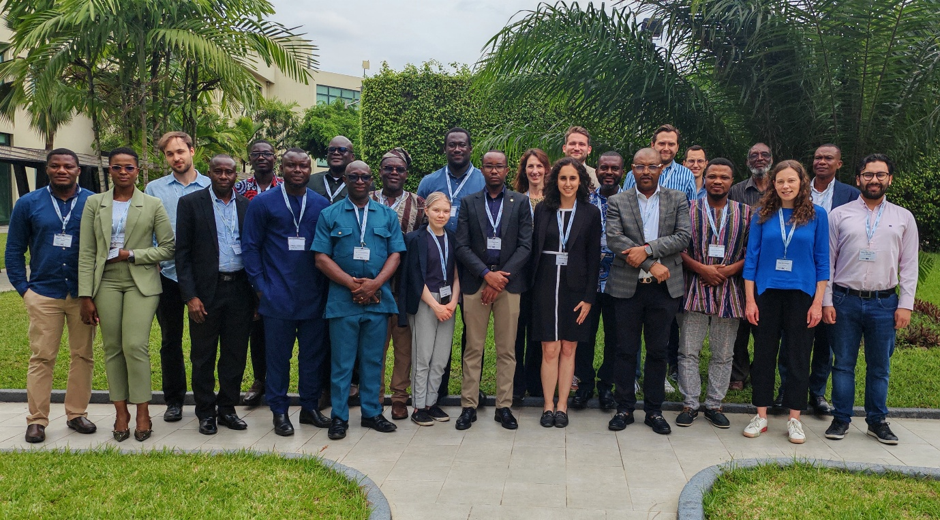
Participants at the Administrative Data and Tax Policy Analysis Workshop in Africa, Accra, Ghana (11–12 June 2026).
The global financing landscape for development is changing fast. Foreign aid is falling, debt servicing costs are rising, and demands on public finances are growing. Bilateral aid to Africa fell sharply in 2025, with the IMF estimating a decline of 26 per cent, while interest payments on sovereign debt reached 27.5 per cent of government revenue in 2024, the highest share in more than a decade (Afreximbank, 2025). As a result, developing countries, especially those in Africa, must find sustainable sources of development finance.
Against this backdrop, strengthening domestic revenue mobilisation, a country’s ability to raise money from its own tax base, matters more than ever for building fiscal resilience and financing Africa’s long term development. The international community has long recognised this, including through the Addis Ababa Action Agenda. Governments must now turn these commitments into action by broadening tax bases, improving compliance, and designing tax policies that raise revenue fairly and efficiently while supporting growth and building public trust.
Building such tax systems requires robust evidence. Decision makers need to know which reforms improve compliance, which incentives deliver value for money, where revenue leaks away, and how taxpayers respond to policy changes. This evidence matters even more now, as African countries take a bigger role in negotiations on the proposed United Nations Framework Convention on International Tax Cooperation and other reforms to the global tax system. Insights from African tax systems can help the African Group build shared priorities, back up its positions, and show the international community where existing tax rules succeed and where they fall short. Administrative tax data1 provide exactly that evidence, letting tax authorities and researchers evaluate reforms, strengthen compliance, spot revenue risks, and design policies based on how taxpayers actually behave.
But turning administrative data into evidence takes more than a single research project; it takes a strong evidence ecosystem connecting revenue authorities, researchers and policymakers. Revenue authorities provide secure, sustained access to administrative data; researchers turn that data into rigorous, policy relevant evidence; and policymakers put the findings into tax design and implementation. By building these relationships into lasting institutions, African countries can keep improving their tax systems, strengthen domestic revenue mobilisation, and bring evidence grounded in African realities to international tax negotiations.
Recognising this broader need, the Administrative Data and Tax Policy Analysis in Africa Workshop was one practical step toward building this evidence ecosystem. Held in Accra, Ghana, on 11–12 June 2026, the workshop brought together researchers, tax administrators and development partners to showcase ongoing research, strengthen collaboration, and accelerate the use of administrative data for evidence-based tax policy across the continent. The Tax Justice Network organised the workshop in partnership with the Ghana Revenue Authority, the International Growth Centre, and Skatterforsk – Norwegian Centre for Tax Research.
Administrative data as a policy tool
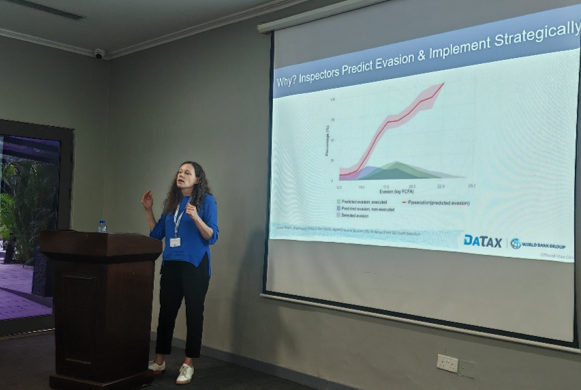
Anne Brockmeyer, Global Lead for Tax Data Analytics at the World Bank, delivering the opening keynote on the role of administrative data in evidence-based policymaking.
The opening keynote by Anne Brockmeyer carried a simple yet powerful message: administrative data are among policymakers’ most valuable assets. When collected, linked and analysed effectively, they let governments evaluate policy using evidence drawn from their own tax systems.
This message echoed throughout the workshop: administrative data are no longer just records collected for tax administration. They are strategic public assets that can improve tax policy, customs, compliance, investment policy and public finance more broadly.
Evidence addressing real policy challenges
Four thematic sessions showcased research from Ghana, Kenya, Nigeria, South Africa, Rwanda, Eswatini and Zambia, all tackling real policy questions with administrative data. Three themes stood out across the papers.
Taxing small firms and the informal economy: How can tax systems reach micro and small businesses without overwhelming them? Presenters examined simplified and presumptive tax regimes, the use of third-party data to improve turnover taxation, and the trade-offs these approaches create between revenue, fairness and compliance costs. Evidence on taxpayer education showed that what small businesses know about the tax system shapes how they engage with it, a reminder that compliance is built through knowledge as much as enforcement.
Confronting international profit shifting: A second cluster of papers tackled the international side of revenue loss. Drawing on corporate tax returns, audit records and customs data, researchers examined what audits reveal about profit shifting by multinational companies, how that shifting can be detected across countries, how treaty shopping and the digital economy strain existing rules, and how price-filter methods can flag suspicious import values. Together, these studies illustrate that administrative data give African revenue authorities the tools to measure and start recovering revenue lost to cross-border tax abuse.
Strengthening tax administration, compliance and enforcement: A third theme focused on the machinery of revenue collection itself: managing tax arrears, the effects of risk-based audits, compliance certification at customs, and how VAT registration thresholds are set. Papers also looked at how firms respond to shocks, including climate shocks, and what that means for the tax base’s resilience. The common thread: administrative data let revenue authorities test and refine their own tools, rather than importing solutions designed elsewhere.
Although the topics differed, the conclusion was consistent: better evidence leads to better policy.
From evidence to policy
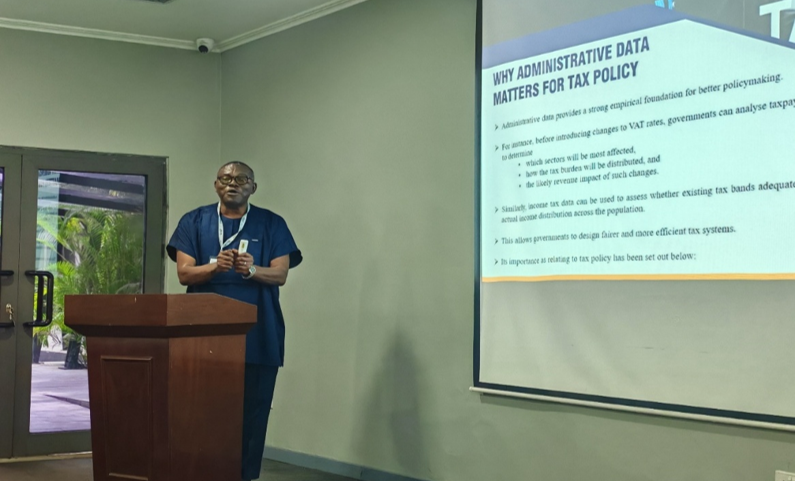
Abdallah Ali-Nakyea emphasised the legal and institutional foundations of evidence-based tax policy.
The second keynote, from Abdallah Ali-Nakyea of the University of Ghana, made a similar point: evidence alone isn’t enough unless it’s translated into sound legislation and practical reforms. That takes strong collaboration between researchers, revenue authorities and legal experts.
Building an evidence ecosystem
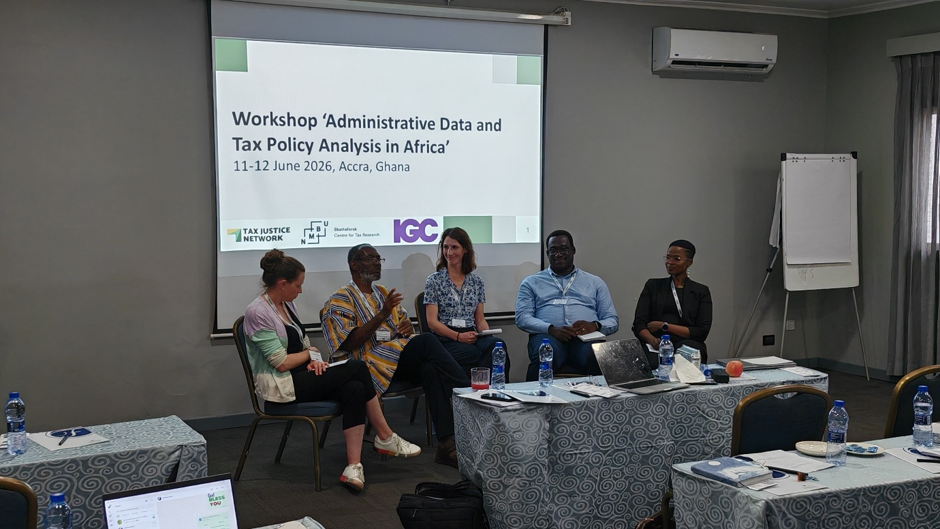
Panel discussion on strengthening collaboration between researchers, tax administrations and development partners.
Perhaps the workshop’s most important message, summed up in the closing policy panel, was this: sustainable domestic revenue mobilisation begins with building an evidence ecosystem. That ecosystem goes beyond individual research projects; it means tax administrations, universities, research institutes, policymakers and development partners working together over the long term.
Looking ahead
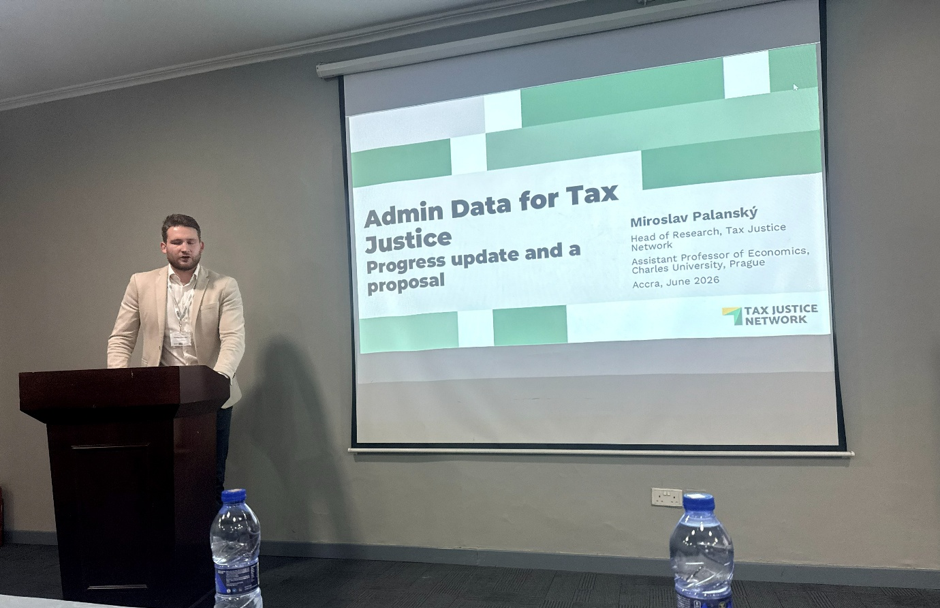
Miroslav Palansky, head of research at the Tax Justice Network, giving an update on the Admin Data for Tax Justice Initiative.
The Accra workshop forms part of a broader agenda under the Administrative Data for Tax Justice initiative, launched by the Tax Justice Network in December 2025. Through it, we are working with revenue authorities to expand secure researcher access to administrative tax data and to build a growing, publicly documented body of evidence on tax policy.
Our ambition is for this workshop to become Africa’s leading annual forum for evidence-based tax policy, bringing together researchers, revenue authorities, policymakers and development partners to strengthen the continent’s evidence ecosystem. Achieving this requires sustained partnerships, long-term investment and a shared commitment to building research capacity across the continent. We invite development partners, foundations, universities, tax administrations and individuals who share this vision to join us in supporting the 2027 edition. Whether through financial sponsorship, institutional collaboration or strategic partnerships, your support will help advance evidence-based tax policymaking and ensure that rigorous research continues to inform policies with lasting public impact.
To discuss how you or your organisation can get involved, please get in touch at [email protected].
- Administrative tax data are the records that taxpayers generate when they register, file returns and meet their tax obligations. Because they cover most formal taxpayers, are updated continuously and capture actual reported transactions, they provide a rich source of evidence for tax policy analysis and research. ↩︎
The author

Related articles
Launching a new tool to reveal the global extent of illicit financial flows and how to tackle them

UN Framework Convention – Roundup of the Fifth Session of Negotiations
Notes on the UN tax convention draft protocol on dispute prevention and resolution
11 September 2026

The European Court of Justice strikes against transparency again. Our response should be to call for an end to corporate limited liability
Report of the Fifth Session of negotiations on the UN tax convention
4 September 2026
Submission to Workstream I on Co-Lead’s Zero Draft of UN Framework Convention on International Tax Cooperation (post-Fifth Session)
28 August 2026
Submission to Workstream II on Taxation of Income from Cross-Border Services (post-Fifth Session)
26 August 2026
Strengthening public resource mobilization through tax justice
25 August 2026
Submission to Workstream III on Dispute Prevention and Resolution (post-Fifth Session)
24 August 2026