
Published:
3 August 2026Reading time:
10 minUnder unitary taxation, multinational companies are treated as what they are: single businesses. Their global profits are aggregated, and the right to tax them is allocated among countries according to where the group’s economic activity takes place. Economic activity is usually measured using a formula that captures the factors contributing to multinational profits. Under a formula based on employment and sales, for instance, a country hosting 10% of a multinational’s employees and accounting for 10% of its sales would be allowed to tax 10% of the group’s global profits at its own rate. This would end profit shifting, create a level playing field between domestic and multinational companies, and allow the countries and societies on which multinational profits depend to tax a fair share of those profits. In a study published with with Public Services International, we estimate what this would be worth: between US$300bn and more than US$500bn in additional revenue worldwide, in every year we examine.
Is it really that simple? We treat multinationals as single companies, allocate taxable profits using a formula, and almost all the problems we have been trying to solve for years are gone? As we show in our study, the answer is yes and no. Yes, because that is exactly what unitary taxation can achieve. No, because we need to get a few things right for it to deliver. Two of them come down to something as mundane as measurement, and getting the measurement wrong hurts precisely those countries that stand to gain most from unitary taxation in relative terms: low- and lower-middle-income countries.
Both core ingredients of unitary taxation – aggregating profits and apportioning them with a formula – require measurement. First, which global profits do we aggregate? Second, how do we measure economic activity? As our report shows, the answer to the first is “all of them, except those arising from resource extraction”. Ours is the first study to give countries’ rights over their own natural resources priority over taxing rights before profits are apportioned. Without this step, resource-rich countries can appear to lose from a reform designed to help them. The answer to the second is “the formula is a political compromise – but sales should be measured where the customer is located”. Our study is also the first to provide unitary taxation estimates in which sales are consistently measured where customers are actually located, and a large part of what lower-income countries stand to gain depends on that single choice. This blog explains why both measurement choices matter.
Which global profits to aggregate? All but extractive profits.
Multinationals do not generate their profits in a vacuum. They use land and water, draw on forests, fisheries, minerals and energy resources, and may leave behind pollution, degraded ecosystems and climate damage. Their profits therefore rest not only on workers’ effort, machinery and customers’ payments – the economic activity usually captured by standard apportionment formulas – but also on natural wealth that belongs to the people of the countries in which it is found.
Resource-rich countries already claim part of the value generated by their natural resources. This is done most systematically in the extractive sector, where royalties and licence fees, taxes on extractive profits, production-sharing arrangements and state equity participation have evolved alongside one another over decades. For their interaction with unitary taxation, it matters how a country claims its share. Claims paid before profit is calculated – such as royalties and licence fees, which companies deduct as costs – are unaffected by how global profits are reallocated.
But most resource-rich countries also rely on claims paid out of reported profit, in particular taxes on extractive profits and returns from state participation. If extractive profits are now simply added to the global profit pool and apportioned using a formula based on assets, employees or sales, they are allocated away from the country where the resources are located and towards the places where extractive multinationals hold assets, employ people and make sales. The associated taxing rights move with them, stripping the resource-rich country of its resource rights.
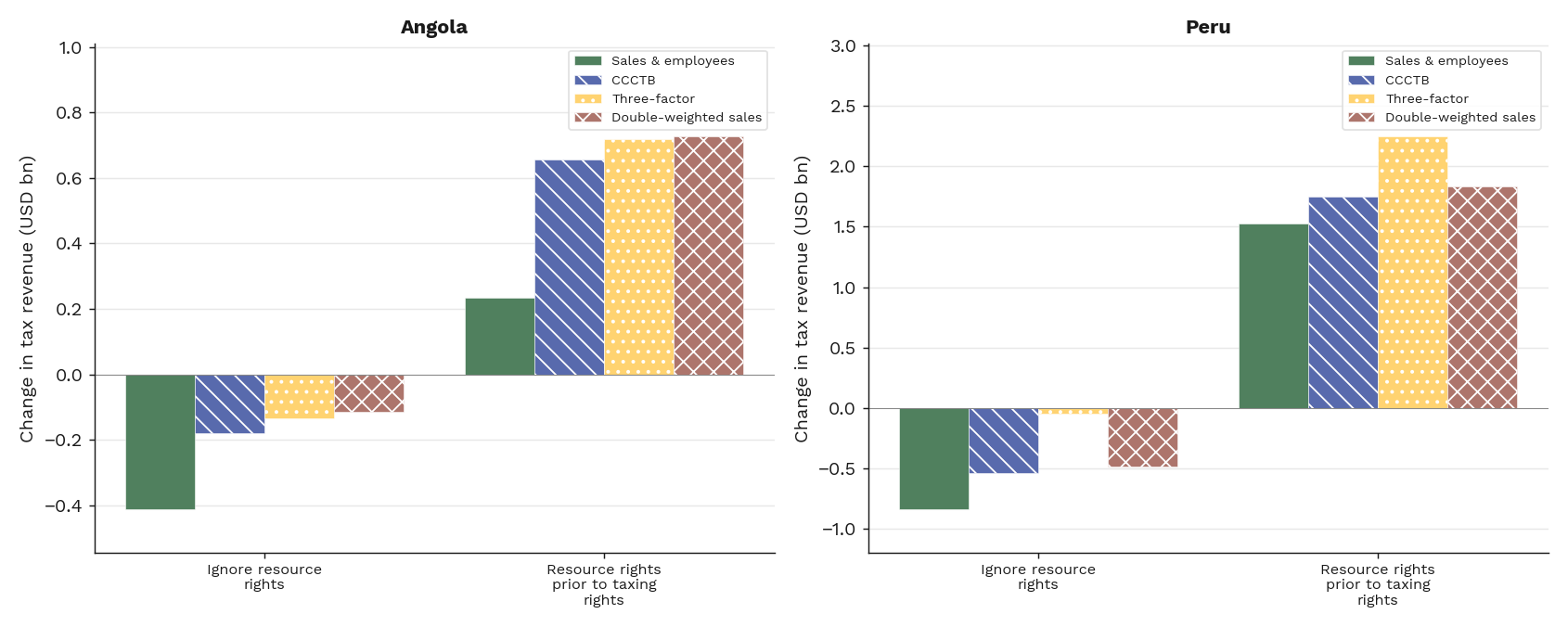
The examples of Angola and Peru show what this can mean for resource-rich countries. In Angola, oil accounts for around 95% of exports and more than 30% of GDP (Reuters, 2025; IMF, 2024, 2025a); in Peru, mining – dominated by copper and gold – accounts for more than 60% of exports and roughly one tenth of GDP (Chin et al., 2025; MINEM, 2024; IMF, 2025b). Much of the profit that multinationals report in both countries therefore stems from resource extraction. Royalties and licence fees have already been deducted before these profits are reported and remain unaffected. But the resource rent that Angola and Peru currently capture through taxes on extractive profits would be reallocated under a system of unitary taxation that ignores resource rights. As a result, both countries appear to lose: under the sales and employees formula, Angola by around US$410m a year and Peru by around US$835m (Figure 1, left-hand panels).
In principle, this problem could be addressed within the formula by adding a resource factor that allocates part of the profits to the country of extraction. But reliance on natural resources varies greatly across multinationals, making sector-specific formulas necessary. Besides increasing complexity, such formulas could invite manipulation. They would also treat countries differently depending on how they capture resource rents: countries relying mainly on royalties would already have secured their claims before profits enter the unitary pool, while countries relying more heavily on taxes on extractive profits would need the formula to restore taxing rights that had first been taken away.
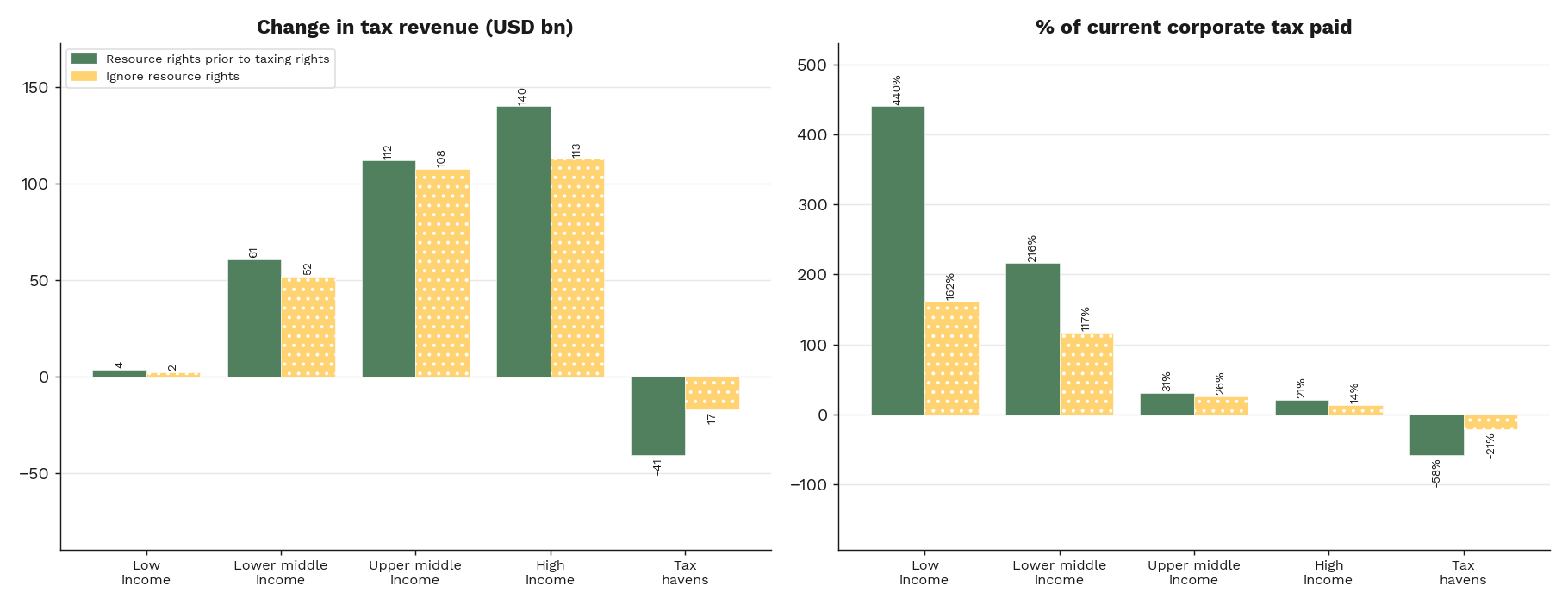
A better solution than trying to weave resource rights into unitary taxation is to treat them strictly as prior to taxing rights. This means reserving for the resource-rich country the extractive profits on which it currently levies taxes or receives returns, before the remaining profits enter the unitary pool. Only value arising directly from extraction is protected in this way; refining, processing, transport and sale remain fully within the unitary tax base. To estimate the revenue effects of unitary taxation, we apply this correction using EITI data, UNU-WIDER’s Government Revenue Dataset, Orbis and a manually compiled database of resource fiscal regimes. Once resource rights are treated in this way, resource-rich countries that would otherwise appear to lose under unitary taxation become net winners. For Angola and Peru, the results are shown in the right-hand panels of Figure 1. Angola gains about US$233m a year and Peru about US$1.5bn under the sales and employees formula, and both countries gain under every formula we model. More generally, as shown in Figure 2, ignoring resource rights reduces the gains of low-income countries by 35%, those of lower-middle-income countries by 15%, and those of high-income countries by 20%. It also understates the losses of tax havens, because profits arising from natural resources are treated as if they legitimately belonged wherever they are currently reported.
How should economic activity be measured? The formula is a political compromise – but sales should be measured where the customer is located
The second important measurement choice concerns the definition of “real economic activity”: which factors should enter the formula, and with what weights? There is some general guidance. A good formula should capture both the input and output sides of profit generation, work reasonably well across sectors so that no sector-specific solutions are needed, rely on factors that can be measured consistently and assigned clearly to countries, be difficult to manipulate, and avoid creating strong incentives for relocation. No formula satisfies all these criteria perfectly. But even if one did, the choice of factors and weights would remain political: each combination distributes taxing rights differently across countries, so choosing a formula also means choosing who gains more and who gains less.
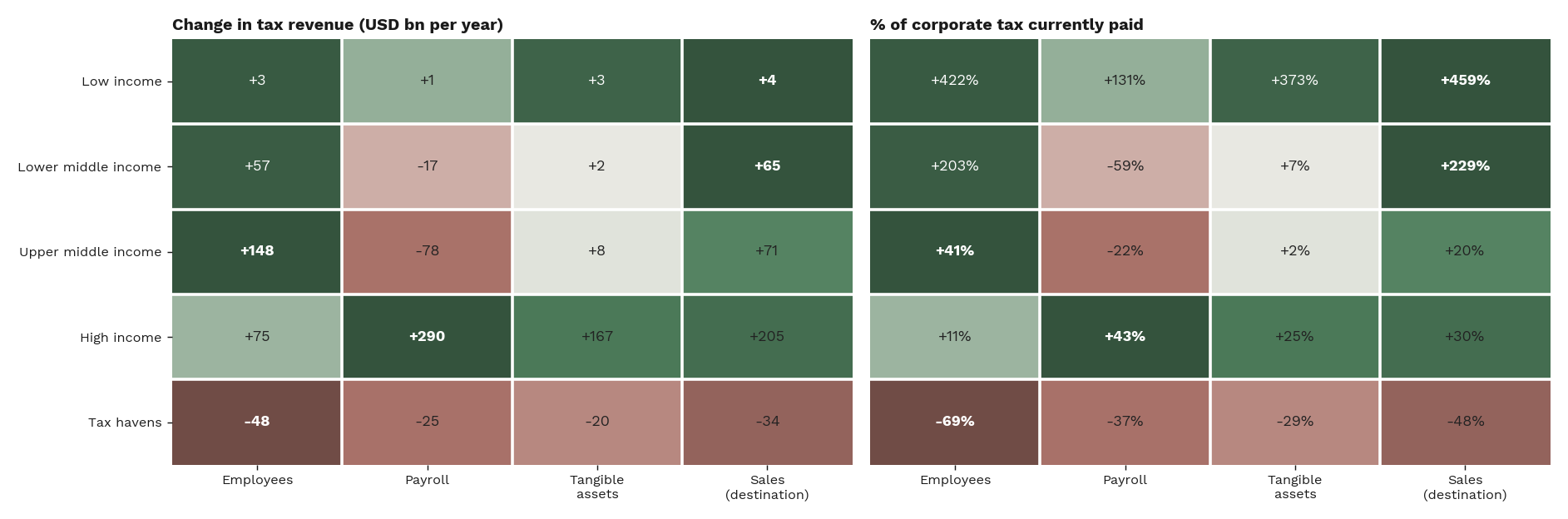
To allow for a systematic comparison of these distributional effects, Figure 3 shows how giving full weight to a single factor would change revenues.[1] Two factors benefit every income group except tax havens: sales to customers and employee headcount. Sales produces the largest relative gains for low- and lower-middle-income countries. Employee headcount shifts substantial taxing rights towards middle-income countries with large workforces, while still leaving high-income countries better off than they are today.
The other two factors – payroll and tangible assets – create clearer conflicts between income groups. Payroll delivers the largest gain of any factor to high-income countries, but lower- and upper-middle-income countries lose revenue under it, simply because the same work is paid less there. Tangible assets benefit low-income countries, whose capital stocks are large relative to the very small profits currently reported there. But assets are also the factor that is easiest to place strategically. This is visible in the figure: they shift less revenue away from tax havens than any other factor, because a country with almost no workers or customers can still hold assets. Employee headcount, by contrast, shifts more taxing rights away from tax havens than any other factor, precisely because a workforce is harder to relocate for tax reasons than a balance sheet.
Even once the formula has been agreed, its factors still have to be measured. For sales, this is where much of the outcome is decided, without anyone appearing to make a distributional decision at all. Under current rules, sales are attributed to the seller rather than the buyer: to the origin of the sale, not its destination. That is also how they appear in the country by country reporting data usually used to estimate the effects of unitary taxation, so most estimates defaults to an origin-based measure unless the sales factor is constructed separately.
What does “origin” mean in practice? Under an origin-based measure, a sale is recorded in the country where the multinational’s subsidiary that books the sale is located, even if the customer is elsewhere. A multinational may, for example, route sales through a related trading or marketing subsidiary in another country. That subsidiary books the sale, while the country where the customer is located may record little or none of it. The gap is widest in digital business models. A cloud, software or platform company can serve customers in dozens of countries through only a handful of contracting subsidiaries. Its revenue is then recorded in those few countries, while the countries where its customers are located may show no sales at all.
Origin-based measurement therefore fails on three counts. First, it reintroduces precisely the arrangements that unitary taxation is meant to eliminate: multinationals no longer shift profits directly, but they can still shift the factor determining where those profits are taxed. Second, it systematically allocates less profit to lower-income countries, since selling into a market often leaves no trace in the seller’s own accounts there. Third, it defeats the purpose of including sales in the first place. If the factor is meant to capture the consumption side of profit generation, measuring it where the seller sits simply measures production a second time.
Instead, sales must be measured where the customer is located. Unfortunately, this information is not available from existing country by country reporting data, because multinationals are not currently required to report it. To estimate it, we draw on two sources. First, we use the local sales of multinationals across all sectors from the OECD’s Analytical AMNE database, which captures what is sold to customers through a local presence (OECD, 2020). But this misses everything that reaches a market without such a presence. We therefore add a second component: each country’s imports of digitally deliverable services from the OECD-WTO Balanced Trade in Services database, counting only the share that multinationals are likely to supply (Amaro and Picciotto, 2026). This matters because a growing share of what multinationals sell into a market – cloud services, software, licensing, professional and information services – reaches customers without a local affiliate at all. Estimating destination sales from local presence alone therefore smuggles a physical-presence assumption into the numbers and understates precisely those markets that are served remotely.
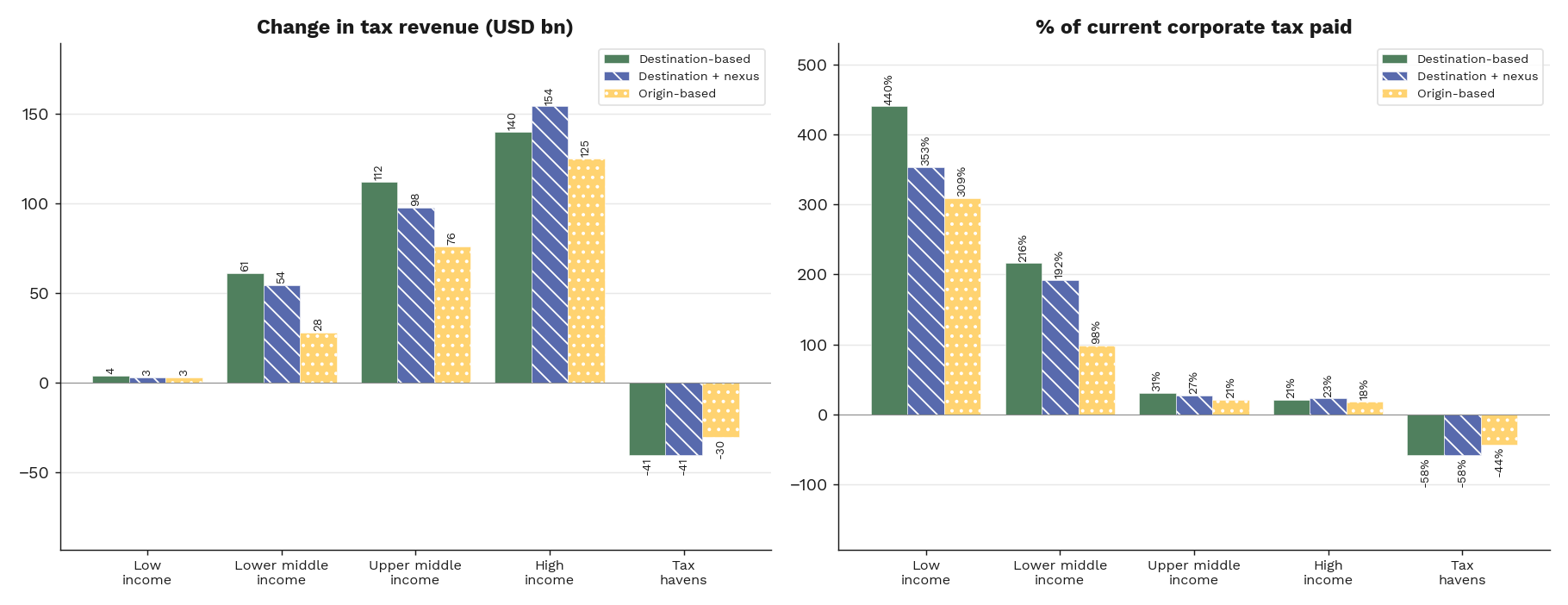
Figure 4 shows how much this matters. Under the sales and employees formula, moving from origin to destination raises the annual revenue gains of low-income countries by more than 40%, and those of lower-middle-income countries by 120% – from about US$28bn to about US$61bn a year, or from roughly doubling to more than tripling what they currently collect from multinationals. Upper-middle-income countries gain 48% more and high-income countries 12% more. The difference comes entirely out of tax havens, whose losses are 34% larger under a destination-based measure. Figure 4 also shows that imposing a physical-presence nexus requirement on destination-based sales shifts taxing rights back towards high-income countries and tax havens, reducing lower-middle-income countries’ gains from about US$61bn to US$54bn while increasing those of high-income countries from US$140bn to US$154bn. In an economy where multinationals reach customers through platforms, distributors and regional sales hubs, such a requirement has been overtaken by digitalisation.
Our measure of destination-based sales relies on imperfect proxies. It misses advertising-funded digital services, which generate no recorded imports in the users’ country, as well as goods sold directly to consumers from abroad through e-commerce. These are limits of the available statistics, not of unitary taxation itself. In practice, the system should not have to rely on proxies. It requires accurate data on where multinationals’ customers are located and how much revenue they generate there. Multinationals should therefore be required to report their revenues by customer location in their public country by country reports.[2]
Distributional decisions in technical clothing
Neither of these two questions looks political. Whether resource profits enter the unitary pool before or after apportionment sounds like a technical question of scope; whether sales are recorded where the seller or the customer is located sounds like a data problem. But getting the first wrong makes resource-rich countries appear to lose from a reform designed to grant them their fair share and reduces the gains of low-income countries by 35%. Getting the second wrong deprives lower-middle-income countries of more than half of what they stand to gain. In both cases, the losses fall on the countries with the largest relative gains at stake and the least capacity to challenge decisions buried in a technical annex. These questions therefore belong in the negotiations themselves, as does a commitment to global public country by country reporting that includes sales by customer location.
[1] We do not mean to suggest that single-factor formulas should be used. We present the effects of each factor separately only to allow for a systematic comparison of their distributional impacts.
[2] Most country by country reports are currently filed confidentially with tax authorities and are not publicly available. Public disclosure is necessary both to hold multinationals accountable for their current tax practices and to enable public scrutiny of profit allocation under unitary taxation.
References
Amaro, F. and Picciotto, S. (2026). Options for a Protocol on Services under the UN Framework. Working Paper. G-24. https://g24.org/wp-content/uploads/2026/04/Options-for-a-Protocol-on-Services-under-the-UNFCITC-1.pdf
Chin, M., Di Gregorio, E. and Torres, J. L. (2025). Revamping Fiscal Decentralization to Secure Peru’s Position as a Leading Critical Mineral Exporter. IMF Selected Issues Papers. International Monetary Fund. https://www.imf.org/en/publications/selected-issues-papers/issues/2025/06/16/revamping-fiscal-decentralization-to-secure-perus-position-as-a-leading-critical-mineral-567764
International Monetary Fund (2024). Angola: 2024 First Post-Financing Assessment — Press Release and Staff Report. Country Report 2024/224. https://www.imf.org/en/publications/cr/issues/2024/07/15/angola-2024-first-post-financing-assessment-press-release-and-staff-report-551882
International Monetary Fund (2025a). IMF Executive Board Concludes 2024 Article IV Consultation with Angola. Press Release No. 2025/41. https://www.imf.org/en/news/articles/2025/02/24/pr-2541-angola-imf-executive-board-concludes-2024-article-iv-consultation
International Monetary Fund (2025b). Peru: Selected Issues. IMF Country Report 2025/126. https://www.imf.org/en/publications/cr/issues/2025/06/10/peru-selected-issues-567577
MINEM (2024). 69.5% de las exportaciones del país son generadas por el Sector Energía y Minas. Nota de prensa. https://www.gob.pe/institucion/minem/noticias/910356-minem-69-5-de-las-exportaciones-del-pais-son-generadas-por-el-sector-energia-y-minas
OECD (2020). Tax Challenges Arising from the Digitalisation of the Economy — Economic Impact Assessment. Paris: OECD/G20 Inclusive Framework on BEPS, OECD Publishing. https://www.oecd.org/content/dam/oecd/en/publications/reports/2020/10/tax-challenges-arising-from-digitalisation-economic-impact-assessment_814ce768/0e3cc2d4-en.pdf
Reuters (2025). What Are the Debt Challenges Facing Angola? Mirici, D. and Gomes, M., 15 May 2025. https://www.reuters.com/world/africa/angolas-debt-economic-challenges-2025-05-15
The author

Related articles

UN Framework Convention – Roundup of the Fifth Session of Negotiations
Notes on the UN tax convention draft protocol on dispute prevention and resolution
11 September 2026
Report of the Fifth Session of negotiations on the UN tax convention
4 September 2026
Submission to Workstream I on Co-Lead’s Zero Draft of UN Framework Convention on International Tax Cooperation (post-Fifth Session)
28 August 2026
Submission to Workstream II on Taxation of Income from Cross-Border Services (post-Fifth Session)
26 August 2026
Submission to Workstream III on Dispute Prevention and Resolution (post-Fifth Session)
24 August 2026

From data to policy: Building Africa’s evidence ecosystem for better tax reform
A 500-billion-dollar decision for the world: the revenue impacts of global unitary taxation
2 August 2026

Public finance is feminist terrain