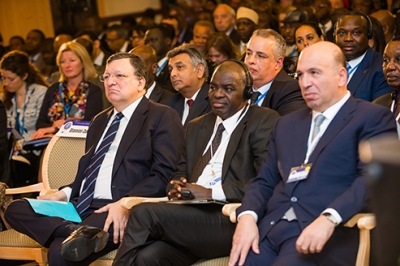
Qalaa chair and CEO Ahmed Heikal with former EU President José Manuel Barroso, March 2013
The European Commission has launched a series of investigations into the tax structures of companies like Google, Apple and Amazon, for fear that they are siphoning off tax revenue from Europe.
Far less attention has been paid to the role of institutions like the EU-backed European Investment Bank (EIB) in financing this offshore trade, particularly when it comes to developing countries.
Could this change? The Tax Justice Network’s Illicit Finance Journalism Programme has discovered that hundreds of millions of euros have flowed to companies linked to the secretive British Virgin Islands (BVI) though an Egyptian private equity fund, Qalaa Holdings.
The full investigation was published in a number of European and African publications, and it reveals some worrying loopholes in the EIB’s policy on offshore finance.
According to the EIB, the bank was able to knowingly send hundreds of millions of tax payer backed funds to companies controlled from the British Virgin Islands, because in 2010 when the investments were approved they didn’t consider the BVIs a tax haven.
The EIB was using the OECD’s famous ’empty list’ of tax havens, which by 2012 had just two tiny Pacific islands on it. This opened up potentially hundreds of billions of euros of tax payer funds being invested in loosely regulated tax havens across the world.
How many other investments like this the EIB made before the publication of the (slightly better but still deficient) Global Forum analysis of jurisdictions is a question the European Parliament may want to consider. The European Parliament’s International Development Committee has recently started putting together a report on tax havens and Linda McAvan, the chair, has promised to pass the TJN’s investigation onto the report authors.
There is also another question to consider here too. As Eurodad has noted, over 50% of funds that go to the private sector from DFIs go to the finance industry.
We all know that the finance sector is addicted to offshore – so why isnt the EIB and other institutions using some of that huge leverage they have to do something about it?
It was published today in the EU Observer here. It is running as the front page splash in Germany’s Tagesspiegel today in both its print and online version here. The piece is also expected to be published on a progressive Egyptian news magazine, Mada Masr later, as well as De Correspondent in the Netherlands, and in The Observer, Uganda on Monday.
The author

Related articles
UN tax convention hub – updates & resources

UN Framework Convention – Roundup of the Fifth Session of Negotiations
Notes on the UN tax convention draft protocol on dispute prevention and resolution
11 September 2026

The European Court of Justice strikes against transparency again. Our response should be to call for an end to corporate limited liability
Report of the Fifth Session of negotiations on the UN tax convention
4 September 2026
Submission to Workstream I on Co-Lead’s Zero Draft of UN Framework Convention on International Tax Cooperation (post-Fifth Session)
28 August 2026
Submission to Workstream II on Taxation of Income from Cross-Border Services (post-Fifth Session)
26 August 2026
Strengthening public resource mobilization through tax justice
25 August 2026
Submission to Workstream III on Dispute Prevention and Resolution (post-Fifth Session)
24 August 2026

From data to policy: Building Africa’s evidence ecosystem for better tax reform